A 700,000-year-old elephant tooth reveals a lost world where early humans lived
A remarkably preserved elephant tooth dating back nearly 700,000 years has revealed a surprisingly lush prehistoric world where giant elephants and early humans lived side by side. Discovered in northern Israel alongside ancient stone tools, the tooth belonged to a straight-tusked elephant, one of the largest land mammals of the Ice Age.
Key points
- A 700,000-year-old elephant tooth from northern Israel helped scientists reconstruct a lush prehistoric landscape.
- The site, Gesher Benot Ya'aqov, also held Acheulian stone tools made by early humans.
- Researchers say the Hula Valley's wetlands and rivers supported life along a key migration corridor.
A fossil elephant tooth found in northern Israel has helped researchers reconstruct a landscape of forests, rivers, wetlands and grasslands from nearly 700,000 years ago, according to a study published in Quaternary Science Reviews. The environment supported giant elephants and some of the region's earliest human populations.
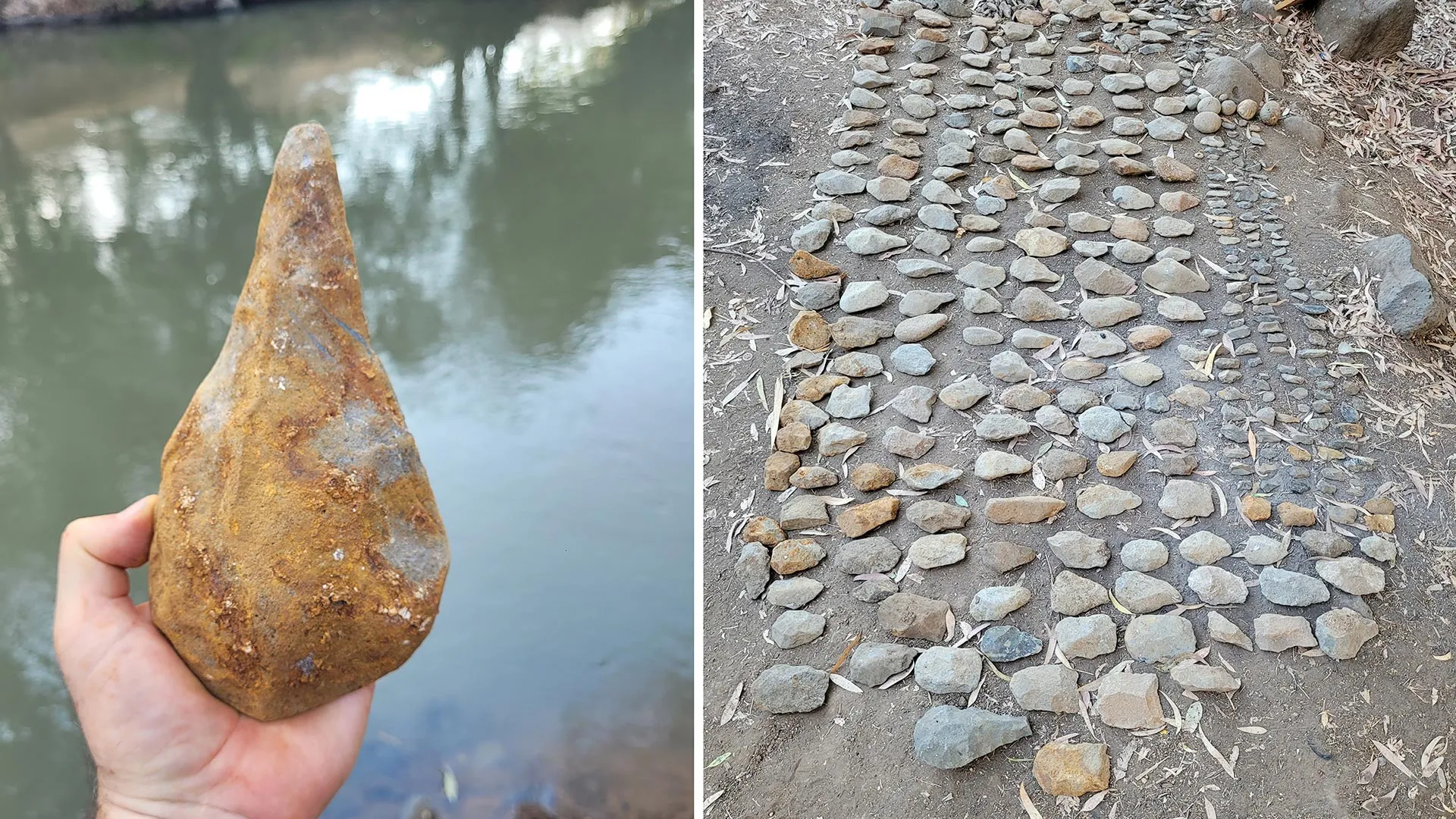
The tooth came from Gesher Benot Ya'aqov (Daughters of Jacob Bridge), an archaeological site in the Jordan Rift Valley just south of today's Hula Valley. Elephant remains there were found alongside basalt handaxes and cleavers of the Acheulian stone tool tradition. The research was led by Hannah Farrell, a PhD candidate at Haifa University, using material excavated by Prof. Gonen Sharon of Tel-Hai University of Kiryat Shmona and colleagues.
What the tooth revealed
The fossils belonged to Palaeoloxodon antiquus, the straight-tusked elephant, one of the largest land mammals of the Pleistocene. The team treated the molar as a record of its surroundings, combining CT scans, 3D reconstruction, microscopic tooth-wear examination, isotope geochemistry and pollen analysis.
Carbon isotope measurements suggested a dependable water supply. Pollen in nearby sediments showed wetland plants including reeds, sedges, willow, tamarisk and aquatic vegetation, pointing to a persistent landscape of woodlands, grasslands, marshes and rivers.
understanding how humans and animals responded to environmental change hundreds of thousands of years ago helps us better understand the forces that shaped our species.
— Prof. Sharon
A corridor for early humans
The Hula Valley sits in the Levantine Corridor, a natural passage between Africa and Eurasia. Researchers believe the area acted as a relatively stable ecological refuge, with water, vegetation and animal life available to populations moving through the region.
Prof. Sharon said the wetlands, rivers and woodlands "helped sustain life along one of the world's earliest migration corridors." The study involved specialists from several Israeli universities, including Cheryl A. Makarewicz and Nimrod Marom of the University of Haifa and Minji Jin and Dafna Langgut of Tel Aviv University.