NASA discovers Jupiter’s invisible shield is more complex than Earth’s
NASA’s Juno spacecraft has discovered that Jupiter uses a surprisingly complex system of powerful plasma waves and multiple shock regions to defend against the solar wind. The findings reveal major differences between Jupiter and Earth and could help scientists understand the enormous shock waves produced by exploding stars.
Key points
- NASA's Juno spacecraft found that Jupiter's bow shock uses plasma waves with multiple frequencies, called harmonics, to slow and heat solar particles, unlike Earth's simpler single-frequency system.
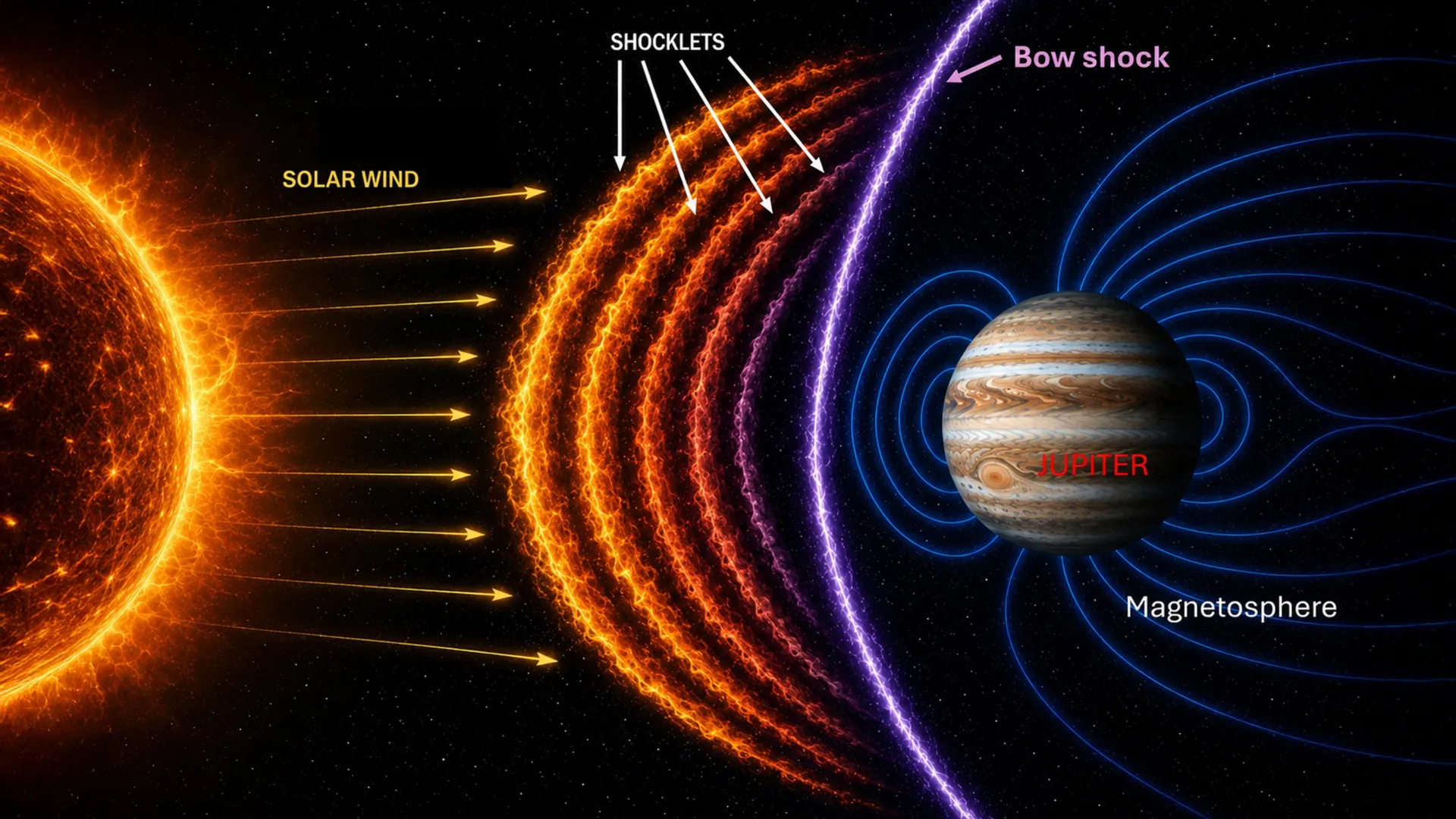
- Researchers also found that Jupiter's solar wind passes through smaller shock structures called shocklets before reaching the main bow shock, an extra step Earth does not need.
- The findings, published July 31 in Nature Communications, could help scientists model powerful shock waves around supernova remnants and other cosmic objects.
NASA's Juno spacecraft has revealed new details about how Jupiter withstands the constant flow of high-energy particles from the Sun, showing that the giant planet's invisible shield is more complex than Earth's. The research, led by scientists at the University of Iowa, offers the most detailed observations yet of Jupiter's bow shock, the boundary where solar particles meet the planet's magnetic environment.
How the two planets differ
The Sun continuously releases charged particles known as the solar wind. At Earth, the bow shock slows and heats these particles and redirects much of the solar wind around the planet. Jupiter also has a bow shock, but its size, powerful magnetic field and gaseous makeup make it a key place to study how such boundaries behave.
Juno's measurements show Jupiter uses plasma waves with multiple frequencies, known as harmonics, to slow and heat incoming solar particles. Earth's bow shock relies mainly on waves concentrated around a single frequency. The researchers also found that particles approaching Jupiter encounter smaller shock structures called shocklets before the main bow shock, an extra step Earth does not require.
Jupiter has found its own way to deal with the solar wind, through plasma waves that are stronger and exhibit richer harmonic structures.
— Jayasri Joseph
What the researchers said
Jayasri Joseph, a postdoctoral researcher at Iowa and the study's corresponding author, said Jupiter has "found its own way to deal with the solar wind." She said multiple frequencies allow the bow shock to heat more solar wind particles and slow them down.
Coauthor Bill Kurth, a research scientist at Iowa, said Earth does not need these extra steps because the impact there is not as powerful. The team said the results could also help explain extreme shock waves tied to exploding stars.