Scientists discover a plastic-eating “Pac-Man” enzyme with a surprising secret
Scientists have discovered a remarkable “Pac-Man enzyme” that helps bacteria devour certain types of plastic and may offer new hope in the fight against plastic pollution. Researchers found that several biodegradable plastics completely broke down in soil within about a year, while conventional plastic remained largely unchanged.
Key points
- Researchers at the University of Konstanz discovered an enzyme that can break down certain polyesters and also penicillin.
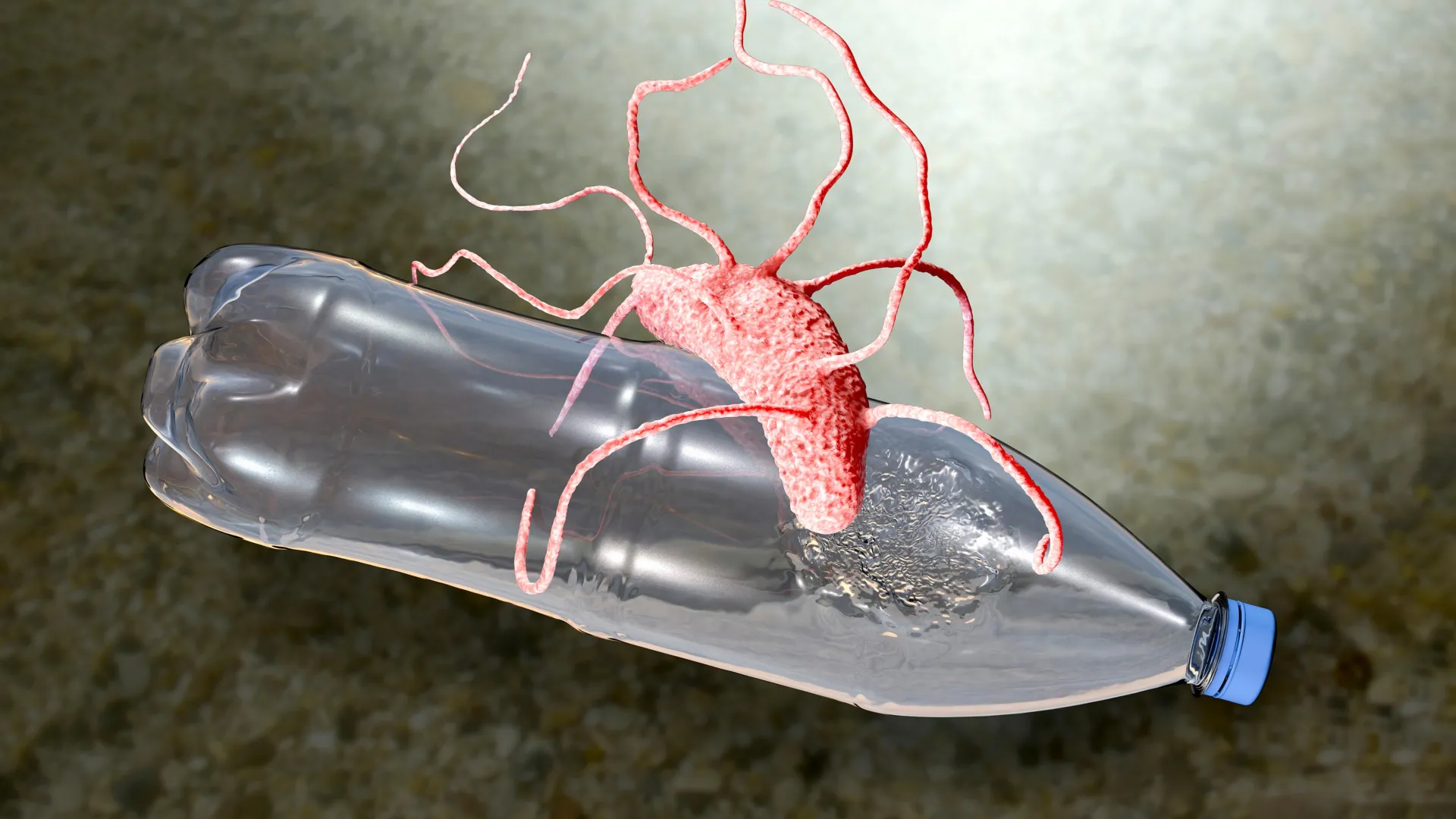
- The enzyme, nicknamed Pac-Man for its wide active site, leaves cell-sized holes in buried bioplastic films.
- Biodegradable plastics degraded in 250 to 330 days, while conventional HDPE showed almost no decomposition.
Scientists at the University of Konstanz have identified a previously unknown enzyme that can digest certain biodegradable polyesters and also break down penicillin. The enzyme, nicknamed Pac-Man for its unusually wide active site, was found in forest soil where bioplastic films were buried for a year.
The findings, published in The ISME Journal, suggest that some bacteria may be adapting to break down specific plastics faster than previously thought, though the enzyme does not affect conventional polyethylene.
What the experiments showed
Researchers buried small pieces of long-chain aliphatic polyester (LCAP) bioplastic film about ten centimeters deep in the humus layer of forest soil at the university's botanical garden. In laboratory tests, they mixed powdered bioplastics into soil from the same forest and monitored microbial activity for a year.
All bioplastic materials were completely degraded within roughly 250 to 330 days, while cellulose broke down after about 80 days. High-density polyethylene (HDPE) showed virtually no degradation. Electron microscopy revealed numerous tiny holes in the recovered plastic films, each matching the size and shape of a single bacterial cell.
I find this encouraging, because it seems that bacteria can adapt to breaking down polyester plastics more quickly than we expected.
— David Schleheck
The Pac-Man enzyme
DNA sequencing of the soil microbial community identified a gene that was strongly enriched in soil containing LCAP. The gene produces an esterase with a secretion signal and a lipid anchor that keeps it attached to the bacterial cell membrane. Its exposed active site allows it to interact with polymer chains.
Laboratory tests confirmed the enzyme can break polyester chains into monomers and also cleave penicillin. Its structure resembles both esterases and beta-lactamases, which are known for antibiotic resistance. However, the researchers note that breaking down penicillin in the lab does not prove the enzyme provides resistance to living bacteria.