Scientists recreate a bizarre quantum effect that stops a particle cold
Oxford physicists have recreated a bizarre quantum effect in which a particle responds to a magnetic field without ever traveling through it. Using a hybrid quantum computer, they demonstrated how introducing a simulated magnetic flux could completely halt a particle's movement through quantum interference. The experiment brings a decades-old prediction into a new setting where matter and quantum fields influence…
Key points
- Oxford researchers used a hybrid quantum computer to recreate the Aharonov-Bohm effect.
- The simulated particle stopped moving when magnetic flux was encoded in entangled qubits.
- The study was published in Nature Physics alongside related work from the University of Maryland.
Researchers at the University of Oxford have recreated a quantum phenomenon known as the Aharonov-Bohm effect using a hybrid quantum computer. The experiment showed how an invisible magnetic influence can bring a simulated particle's movement to a complete stop, even though the particle's path never passes through a magnetic field.
The findings, published in Nature Physics, demonstrate how combining qubits with quantum oscillators could help scientists study fundamental interactions that are difficult to simulate on conventional computers.
How the experiment worked
The Oxford team, led by Dr. Sebastian Saner and Dr. Oana Bazavan, began the project in 2022 in collaboration with Dr. Alejandro Bermudez of the Instituto de Física Teórica in Madrid. They used qubits encoded in trapped ions to represent gauge fields and quantum oscillators from the ions' vibrations to represent matter.
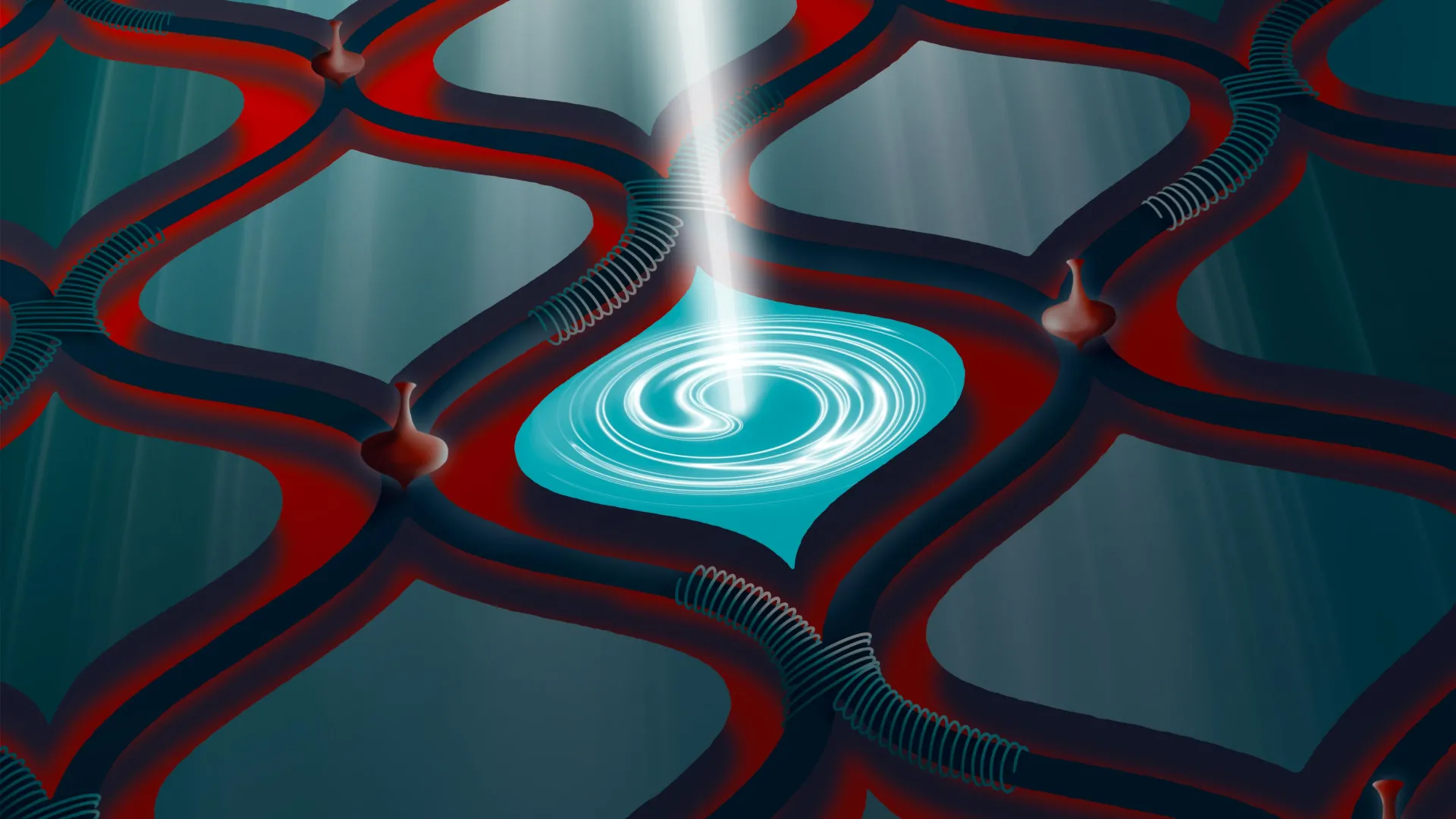
The researchers constructed a simple loop as a basic building block of a lattice gauge theory. They then placed the two qubits into an entangled state, which represented magnetic flux passing through the center of the loop.
For us, the exciting step was to encode the magnetic flux in a gauge field that was itself dynamical.
— Dr. Saner
Particle frozen by interference
Without magnetic flux, the simulated particle could tunnel freely around the loop. When the flux was introduced, the two possible paths interfered destructively, canceling each other out and completely suppressing the tunneling.
This left the simulated particle frozen in its original state. The outcome demonstrated the Aharonov-Bohm effect within a lattice gauge theory containing a dynamical field.
Related work and implications
The Oxford findings were published alongside a related study by researchers at the University of Maryland, led by Professor Norbert Linke. The Maryland team also used a hybrid quantum system but focused on simulating the Yukawa potential.
Although the groups developed their methods independently, they coordinated the submission of their studies to Nature Physics. Together, the experiments show how hybrid quantum computers could become valuable tools for investigating fundamental interactions.