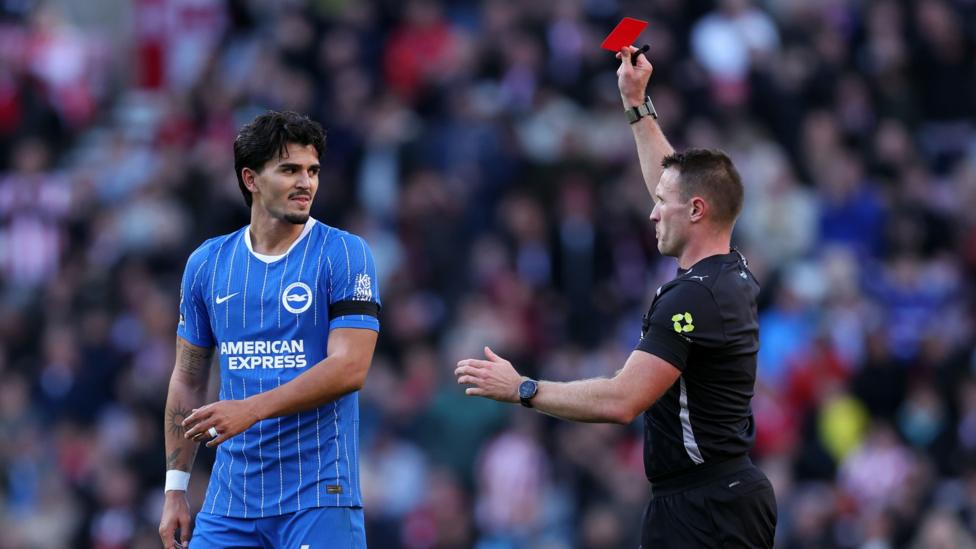
Struijk red card shown after VAR intervention is overturned
The red card controversially shown to Brighton defender Pascal Struijk against Sunderland is overturned.
Key points
- Brighton defender Pascal Struijk's red card at Sunderland was overturned after a successful wrongful dismissal claim.
- Struijk was sent off in the 57th minute after VAR intervention for denying an obvious goalscoring opportunity.
- The appeal means Struijk avoids a one-match ban and can face Crystal Palace this weekend.
Brighton defender Pascal Struijk has had the red card he received at Sunderland overturned after a successful claim of wrongful dismissal. The card was shown in the 57th minute of Saturday's match at the Stadium of Light.
Struijk was sent off after referee Thomas Bramall, following a VAR intervention by Neil Davies, judged that he had fouled Sunderland forward Wilson Isidor as he tried to run on to a through-ball. Neither Bramall nor his assistant initially gave a foul, but after reviewing the replay multiple times, Bramall showed a straight red for denial of an obvious goalscoring opportunity.
What the appeal means
The successful appeal means Struijk will not serve a one-match ban and is available for Brighton's Premier League match against Crystal Palace this weekend. Struijk joined Brighton from Leeds in a £20m move in the summer and was making his second Premier League start for the club.
Despite the red card, Brighton won the match 2-0 and are third in the table, five points behind leaders Manchester City.
If Struijk had been sent off by referee Bramall it would have been a poor decision. That it came via a VAR intervention is much worse.
— BBC Sport
Why the decision was questioned
The article notes that red cards for denying an obvious goalscoring opportunity via video review are rare because there are many subjective considerations. Last season there were three such cases, for Liverpool's Dominik Szoboszlai, Crystal Palace's Maxence Lacroix and Bournemouth's Marcos Senesi, though the latter was wrongly rejected at the monitor.
It adds that there was far too much doubt that Isidor would get to the ball before Bart Verbruggen, meaning it was a possible rather than obvious goalscoring opportunity. With such a high bar on VAR in the Premier League, Bramall should not have been sent to the monitor, and it was the kind of situation where the referee should reject the VAR's advice.