A quantum highway just one atom high could transform superconductors
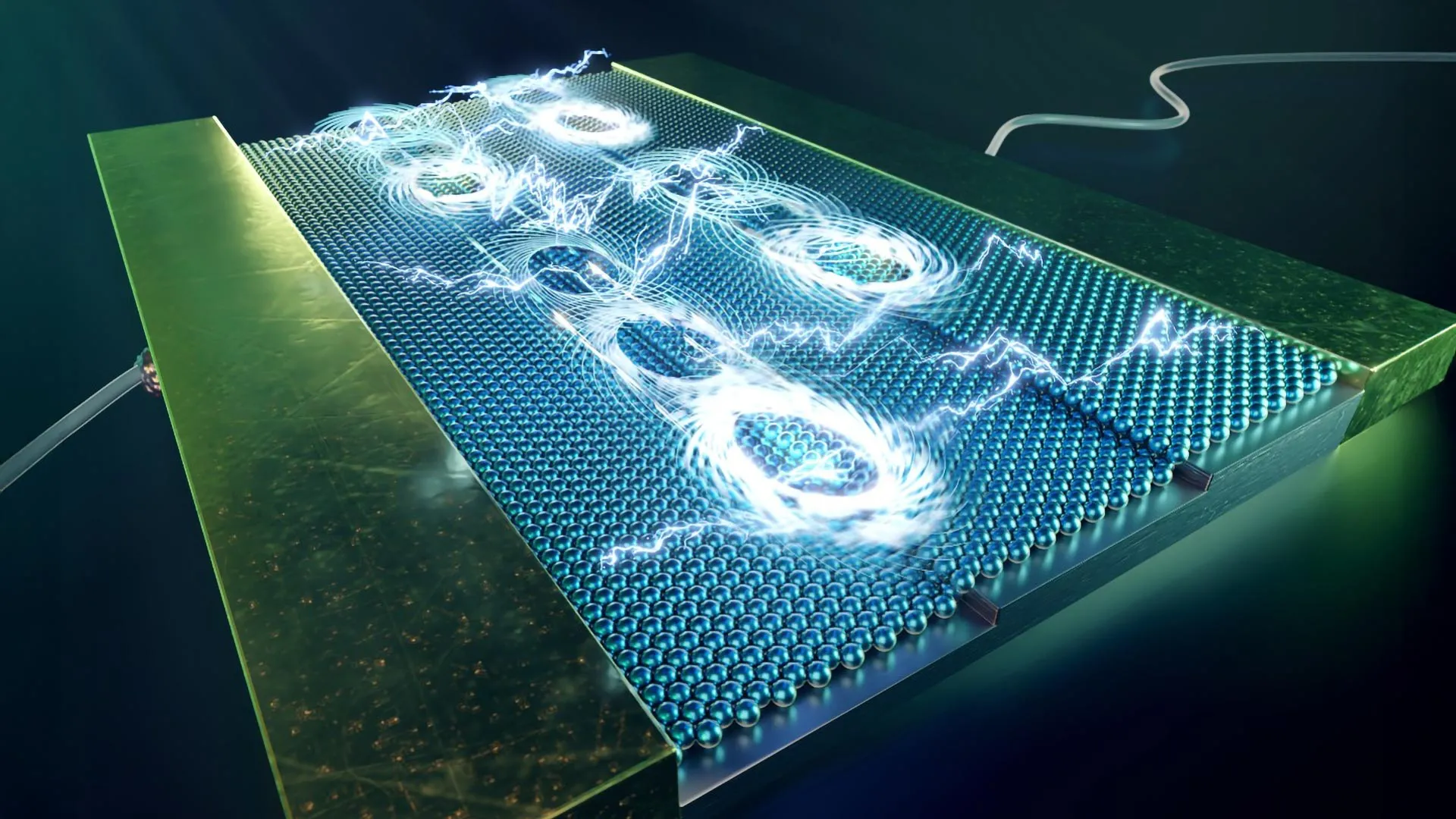
Scientists discovered that atomic steps just one atom high can guide quantum vortices through superconductors, making them move more than 1,000 times more easily in one direction than another. This remarkable control over quantum motion could lead to a new generation of ultra-efficient superconducting electronics.
Key points
- Atomic steps one atom high guide quantum vortices in an ultrathin superconductor.
- Vortices moved over 1,000 times more easily along steps than across them.
- Temperature and magnetic field can tune this guiding effect.
Researchers in Japan have found that atomic steps just one atom high can act as microscopic tracks for quantum vortices in an ultrathin superconductor. The team, led by Takashi Uchihashi at the Research Center for Materials Nanoarchitectonics (MANA), part of the National Institute for Materials Science (NIMS), reported that under certain conditions vortices moved more than 1,000 times more easily along the steps than across them. The findings were published in the journal Physical Review B.
Superconductors carry electricity without resistance when cooled below a critical temperature, but they contain vortices that can cause resistance when they move. Controlling vortex motion in extremely thin, two-dimensional superconductors has been difficult until now.
How the experiments were done
The team studied an ultrathin superconductor with regularly spaced atomic steps on its surface. Using scanning tunneling microscopy, they confirmed the steps ran parallel and directly observed vortices positioned along them.
Four-terminal resistance measurements showed that in intermediate magnetic fields, vortices traveled more than 1,000 times more easily along the steps than across them. The steps acted like rails, creating preferred pathways for the vortices.
Our study shows that atomic-scale steps can act as effective rails that guide superconducting vortices, and that this guiding effect can be tuned simply by changing the temperature or magnetic field
— Takashi Uchihashi
Tuning and quantum effects
The researchers found they could adjust the guiding effect by changing the temperature or magnetic field. When the magnetic field ranged from about 0.10 to 0.20 T, vortices flowed freely along the steps without becoming trapped by material imperfections, a behavior called one-dimensional pinning-free vortex flow.
At the lowest temperatures, vortex motion was governed by quantum tunneling, where quantum objects pass through energy barriers. The findings suggest that atomic-scale steps could help control vortex motion and heat flow in future superconducting technologies.