
AI reveals a hidden chemical shortcut that could turn CO2 into fuel
Scientists used artificial intelligence to uncover nearly 10,000 chemical reactions involved in transforming carbon dioxide into fuels and chemicals, revealing crucial pathways that traditional models had missed. The discovery dramatically improved predictions of CO2 conversion and uncovered a surprising hydrogen reaction that could inspire more efficient catalysts.
Key points
- Researchers at the Indian Institute of Science used machine learning and computer simulations to expand a copper-catalyst reaction network from 152 to 9,389 reactions.
- The expanded model predicted about 40 times more CO2 conversion and correctly identified methanol and carbon monoxide as major products, matching experiments.
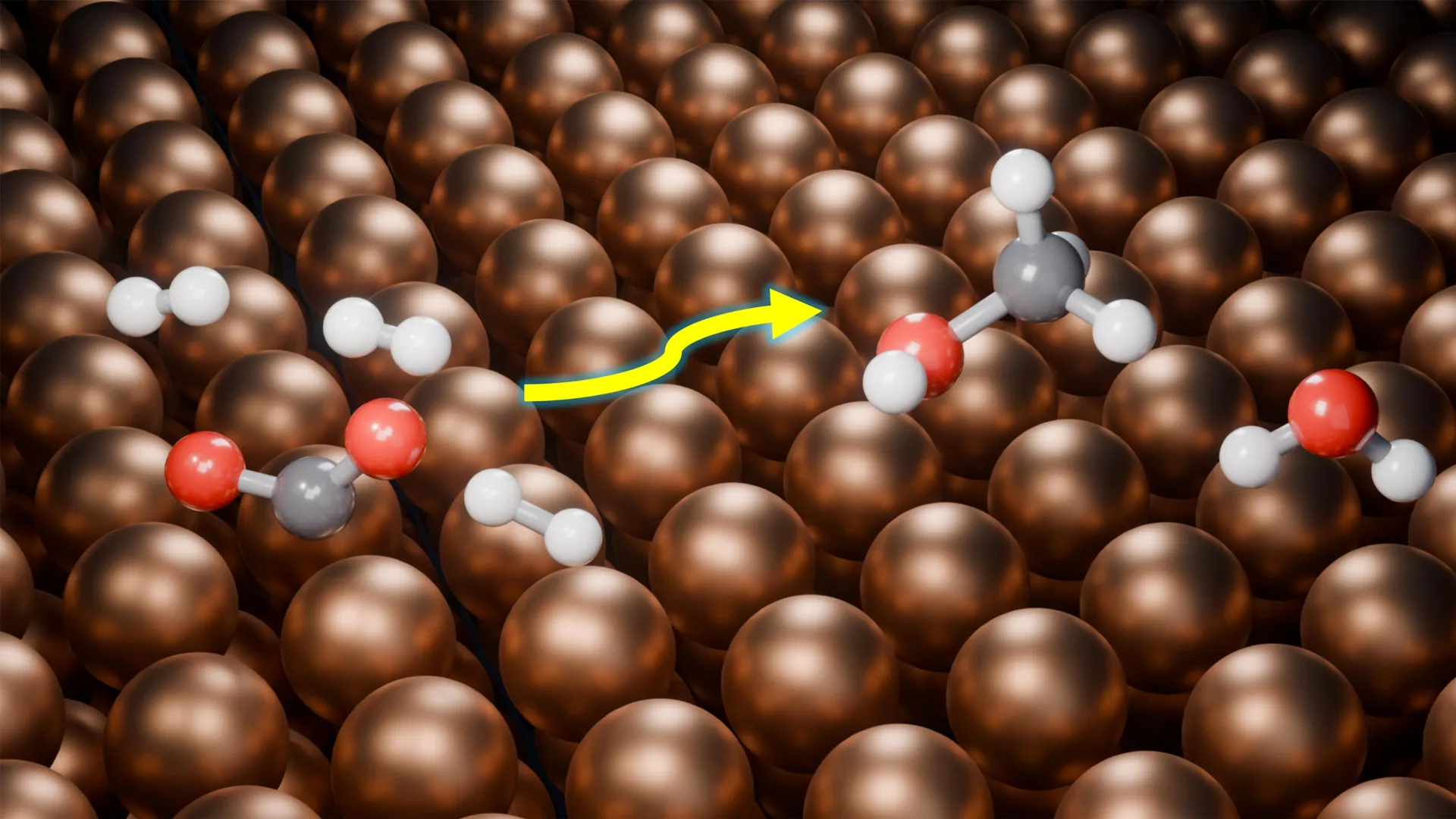
- The larger network revealed that hydrogen can transfer to oxygen-containing intermediates as intact molecular H2 rather than only as separate atoms.
Scientists at the Indian Institute of Science (IISc) have identified 9,389 previously overlooked chemical reactions on a copper catalyst that could improve the conversion of carbon dioxide (CO2) into fuels and industrial chemicals. The findings were published in Nature Communications.
The team combined machine learning with quantum mechanics simulations. Starting from a database of 152 reactions, they used automated computational tools to examine possible reactions among 105 chemical species on the catalyst surface, expanding the network to 9,389 reactions.
Why the larger network matters
The smaller network misidentified formic acid as the main product instead of methanol and predicted far less CO2 conversion than experiments showed. With the expanded network, predicted CO2 conversion rose by roughly 40 times, and the model correctly identified methanol and carbon monoxide as major products.
Experimental validation was carried out by G Valavarasu and Santhosh Kotni at Hindustan Petroleum Corporation Limited's Green Research and Development Centre, with Amol Amrute and colleagues at the Agency for Science, Technology, and Research in Singapore. Ambedkar Dukkipati at IISc also contributed to the machine learning models.
The idea that hydrogen can transfer as an intact molecule, without first splitting into atoms, runs against what most of us were taught.
— Shivam Chaturvedi
A surprising hydrogen pathway
The larger network showed that in several important steps, hydrogen can be transferred to intermediate compounds directly as molecular H2, not only through separate hydrogen atoms. Quantum mechanics calculations confirmed this pathway can be especially favorable when hydrogen is transferred to oxygen-containing intermediates.
The researchers say the mechanism could guide the design of catalysts that interact more effectively with molecular hydrogen. The computational framework may also be useful for other processes, including CO2 reduction with different catalysts, nitrogen reduction, and water splitting.


