
Einstein Probe reveals a hidden phase of neutron star collisions
Einstein Probe revealed nearly 10 minutes of soft X-ray activity following a short gamma-ray burst, exposing a phase of neutron star mergers that previous missions may have missed. The prolonged emission could have been powered by a newly formed magnetar and may provide a valuable new counterpart to gravitational-wave signals.
Key points
- Einstein Probe detected a short gamma-ray burst on July 4, 2025 that kept emitting soft X-rays for nearly ten minutes instead of fading.
- Researchers linked the prolonged X-ray emission to a compact object merger, possibly leaving behind a magnetar that powered continued energy injection.
- The finding suggests fast X-ray transients can be electromagnetic counterparts to gravitational-wave sources and may be common but previously missed.
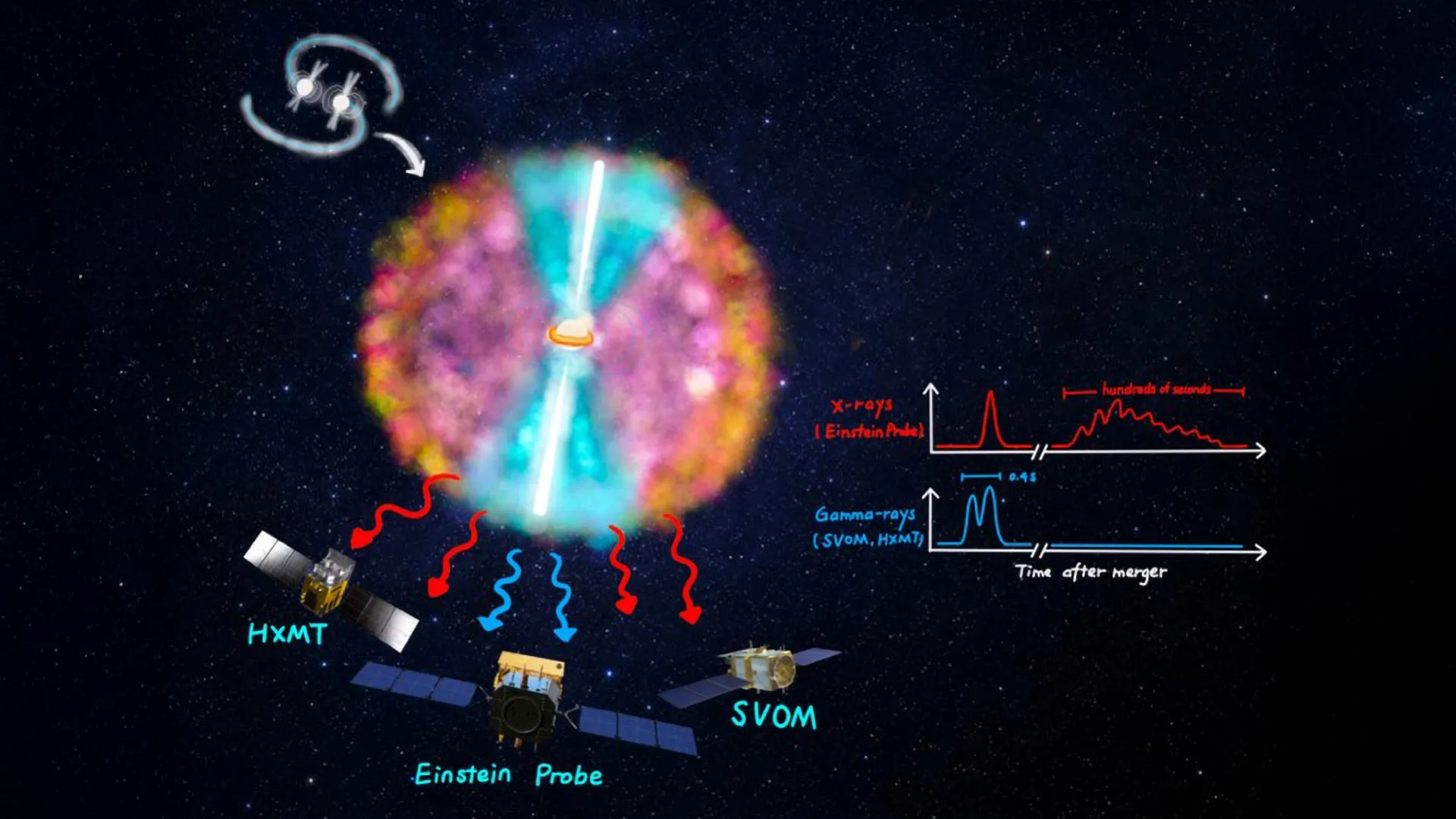
The Einstein Probe has observed a previously unseen phase of a neutron star collision, according to research reported by ScienceDaily. The event, designated EP250704a/GRB 250704B, was detected on July 4, 2025, when a bright flash lasting less than half a second appeared in gamma rays and X-rays.
Instead of fading, the source continued emitting soft X-rays for nearly ten minutes. Astronomers say the prolonged activity occurred at wavelengths conventional gamma-ray instruments would have struggled to detect.
What the observations showed
An Li, a PhD student at Beijing Normal University and the Transient Advocate for EP, was on duty when the signal appeared. Li said the event first looked like an ordinary short GRB, but that the source kept emitting soft X-rays for nearly ten minutes rather than fading away.
Professor Bin-Bin Zhang of Nanjing University, a co-corresponding author, said the emission was so soft that Swift's Burst Alert Telescope would have remained below its detection threshold, meaning previous missions would have recorded only the brief gamma-ray flash.
However, instead of fading away, the source continued emitting episodes of soft X-rays for nearly ten minutes.
— An Li
Follow-up and possible source
An international campaign used X-ray, optical and radio observations. Professor Eleonora Troja of the University of Rome "Tor Vergata," a co-corresponding author, said the coordinated observations identified the host galaxy, measured its distance, ruled out an accompanying supernova and linked the X-ray emission to a compact object merger.
Yi-Han Iris Yin of The University of Hong Kong, a co-corresponding author, said the changing brightness, evolving spectrum and later afterglows pointed to continued activity from the central engine. One plausible explanation, Yin said, is that the merger produced a rapidly rotating, highly magnetized neutron star, known as a magnetar.
Implications for gravitational waves
The researchers suggest this extended soft X-ray activity may not be unusual and could accompany other short GRBs but have gone unnoticed. Troja said the newly discovered soft X-ray component provides a new probe indicating that fast X-ray transients are also electromagnetic counterparts to gravitational-wave sources.
Yin said the discovery extends the view of neutron star mergers beyond the brief gamma-ray flash and opens a new window for studying merger remnants. Zhang added that it demonstrates Einstein Probe's capability to uncover new classes of transient phenomena in multi-messenger astronomy.


