From 'Dune' to 'Wicker,' how this ‘tiny’ European country became a hub for Hollywood
Hungary, a small country in central Europe, has played a major part in the movie business since the late 19th century.
Key points
- Hungary has become a hub for Hollywood films such as Poor Things and Dune, with production costs 30% to 50% cheaper than in the U.S.
- Budapest has doubled for Paris, Berlin and Rome in movies including Evita and Inferno, and offers varied landscapes.
- A paused 30% production rebate was restarted in December, and the new government has proposed adding 63 billion forints ($193 million).
Hungary has become a major hub for Hollywood productions, with films such as Poor Things, Blade Runner 2049 and The Brutalist shot largely in the central European country rather than California. Large production complexes, varied landscapes and generous incentives have drawn international stars including Arnold Schwarzenegger, Tom Cruise and Anne Hathaway to Budapest and its surroundings this year.
The country's film history dates back to 1896, when the Lumière brothers brought their cinematograph to Budapest's Grand Hotel Royal months after its Paris debut. The first Hungarian film staged for the screen was shot in 1901 on the rooftop of the Uránia in Budapest.
Budapest as a stand-in
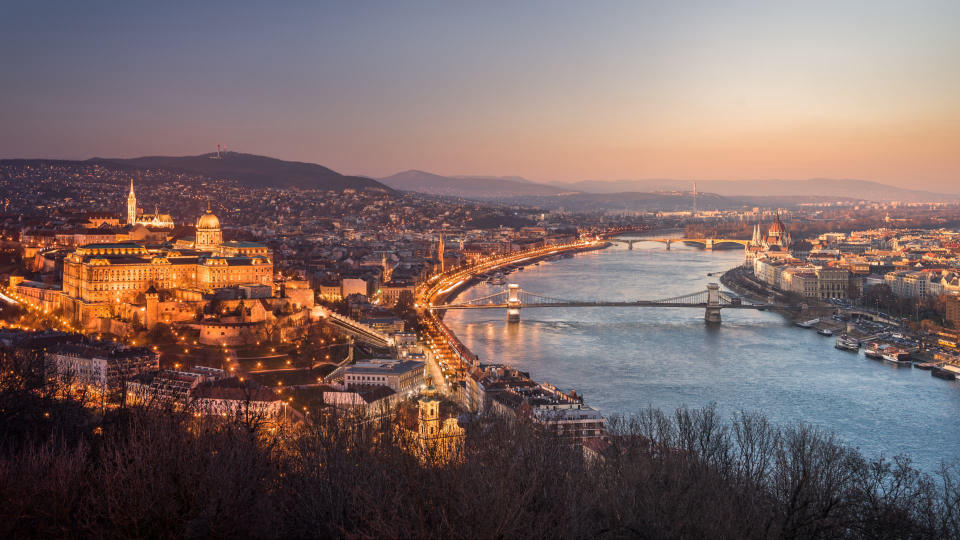
Budapest has doubled for European cities such as Paris, Berlin and Rome in movies including Evita, Max and Inferno. Producer Barbara Reardon told CNBC that the city "has got many different looks" and is easy to get around, adding that it is "equipped with a little bit of everything."
Author Judy Laufer, whose family fled Budapest during the 1956 Hungarian Revolution, produced the independent film Ashes to Iron, which tells her family's story and was shot in Hungary. She said that unless a specific landmark identifies Budapest, "you really could be anywhere." The film is being submitted to festivals including Sundance and Berlin, with a private screening in Budapest later this month.
Budapest is equipped with a little bit of everything. You can find your green juices and healthy salads ... and a lot of studio heads and and actors, they like that.
— Barbara Reardon
Studios and incentives
Origo Studios, about a 20-minute drive north of Budapest, has 11 stages and 4 acres of backlot. Large parts of Dune, Dune: Part Two and Inferno were shot there. CEO Márta Fekszi Horváth described August as a "transition period" but said she was "very optimistic" about upcoming productions.
Production costs in Hungary are around 30% to 50% cheaper than in the U.S., according to Barbara Reardon. Former Prime Minister Viktor Orbán paused a 30% rebate on production spending, restarting it in December, while the former government capped the value of productions for the first half of 2026. The new government has proposed adding 63 billion Hungarian forints ($193 million) to the rebate, and Deputy Prime Minister and Foreign Minister Anita Orbán said the administration aims to provide a "stable and predictable framework."
Wicker, starring Olivia Colman and Alexander Skarsgård, was filmed on two medieval backlots at Korda Studios and the National Film Institute. Barbara Reardon said it was one of the first big international films with major stars to hire a local production designer, costume designer and hair and makeup designer.