
Hubble Space Telescope may have found a planet born after its star died
A strange chemical signature in old Hubble observations may point to a planet that formed after its star had already died. Astronomers found unusually high levels of niobium around the white dwarf HS 0209+0832, suggesting some of the star’s expelled material may have assembled into a new gas giant. TESS data also hints at a Jupiter-sized planet orbiting just 3.7 million miles from the star.
Key points
- Astronomers revisiting 1999 Hubble observations of the white dwarf HS 0209+0832 found an unusual niobium signature suggesting a possible second-generation planet.
- The candidate world is estimated to be a Jupiter-sized gas giant orbiting about 3.7 million miles from the white dwarf, far closer than Mercury is to the Sun.
- Lead author Jamie Williams plans to keep using Hubble over the next several years to study how second-generation planets form and how common they are.
Astronomers re-examining decades-old Hubble Space Telescope observations have found a possible second-generation planet around the white dwarf HS 0209+0832, according to a study published Oct. 5 in Nature Astronomy. A white dwarf is the leftover core of a low-mass star that has used up its fuel and shed its outer layers into space.
The team reports an unusual chemical signature in the system. Hubble observed HS 0209+0832 in 1999, but about 100 chemical features in the data went unidentified at the time. Lead author Jamie Williams, a doctoral candidate at the University of Warwick in the United Kingdom, returned to those observations with an updated chemical database and found that niobium accounted for many of the unexplained signatures.
What the researchers found
The researchers propose that after the dying star expelled chemically enriched material, some of it gathered together and eventually formed a gas giant planet. Most of the remaining material would have dispersed into space long ago, while the planet stayed in orbit.
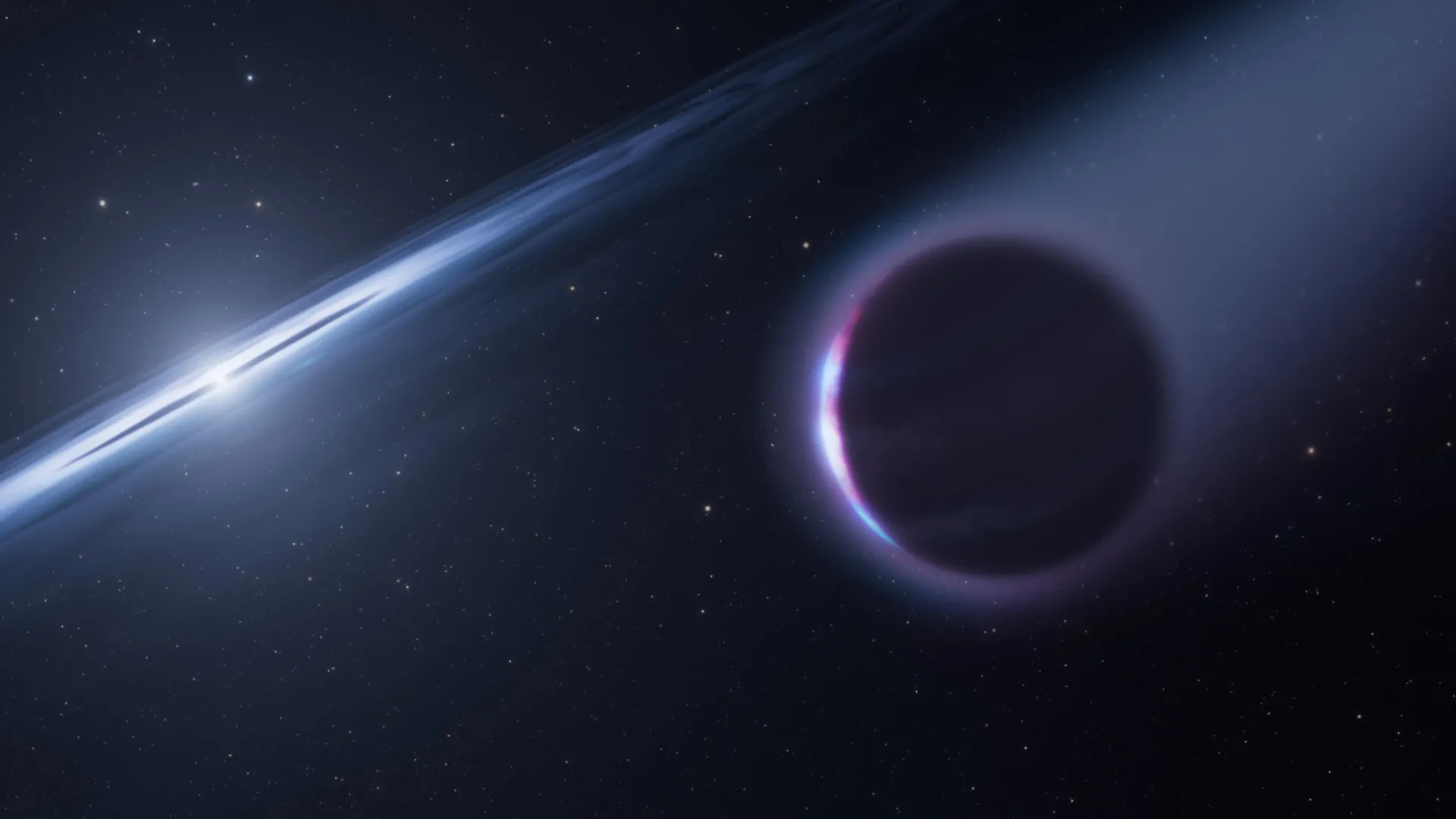
NASA's TESS monitored the white dwarf for four months and detected repeating changes in brightness. Those variations suggest a planet may orbit about 3.7 million miles (6 million kilometers) from the star. The team estimates the candidate world is a gas giant roughly the size of Jupiter and appears to be losing its atmosphere rapidly.
Rather than the white dwarf stage being a kind of epilogue to the story of a star and its planets, this research points to the systems we are familiar with only being the first chapter of a potentially much longer tale, with some new characters showing up.
— Jamie Williams
Supporting evidence and next steps
The team checked the Hubble result against observations from NASA's retired FUSE mission, which also revealed strong niobium signatures in the system. Because the white dwarf formed relatively recently, it remains extremely hot, and its energy is likely stripping material from the planet's outer atmosphere. That escaping gas could create a comet-like tail, with some material forming a disk around the white dwarf before falling onto its surface.
Williams said he does not expect the possible planet to disappear quickly. He plans to continue using Hubble over the next several years to investigate how second-generation planets form, how common or rare they are, and how they evolve around a dead star.


