India and China aren't friends - but Nepal wants to unite them against climate threats
Can Nepal bring the two regional giants together to confront a shared climate threat in the Himalayas?
Key points
- Nepal's Prime Minister Balendra Shah proposed a Himalayan Climate Resilience Mechanism to unite India and China on cross-border disaster response and data sharing.
- India and China have not formally responded to the proposal, and past joint efforts on Himalayan climate research have stalled.
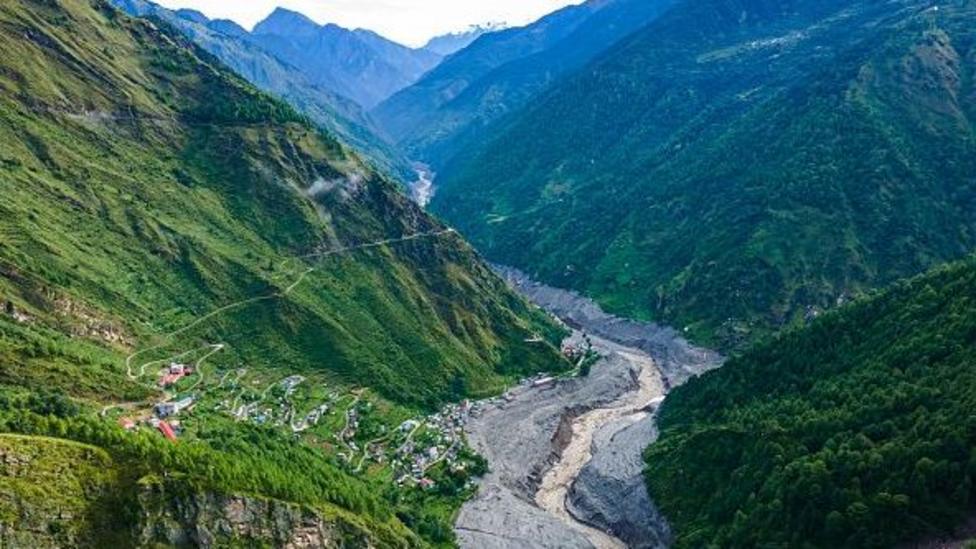
- Glaciers in the Hindu Kush Himalaya are melting at an accelerating rate, raising risks of floods and landslides that cross borders.
Nepal's Prime Minister Balendra Shah used his speech at the recent UN General Assembly to warn about the growing threat of climate-related disasters in the Himalayas and to propose a regional mechanism bringing together India and China. He called for a Himalayan Climate Resilience Mechanism to improve cross-border disaster response and share scientific data in one of the world's most environmentally fragile and geopolitically sensitive regions.
A senior official at Nepal's foreign ministry, speaking anonymously, said the proposal is still at an early stage. Neither India nor China has formally responded, and the BBC has contacted their foreign ministries for comment.
Climate risks in the Himalayas
Temperatures in the Himalayan region are rising faster than the global average, accelerating glacier retreat and permafrost thaw. This contributes to growing risks of landslides, rockfalls, avalanches and glacial lake outburst floods that can sweep across national boundaries.
A March report by the International Centre for Integrated Mountain Development found that glaciers across the Hindu Kush Himalaya are melting at an accelerating pace, with ice loss having doubled since 2000 compared with 1974-1999. On the Qinghai-Tibet Plateau, glaciers have shrunk by 24% in area over the past six decades, according to Kang Shichang, director of a Chinese Academy of Sciences institute.
Let the Himalayas become a laboratory of international co-operation rather than a frontier of fragmented information
— Nepal's Prime Minister Balendra Shah
Obstacles to cooperation
India and China share a disputed frontier of roughly 3,500km across the Himalayas, and their territorial claims have led to war, deadly clashes and military stand-offs. Past efforts to work together on Himalayan environmental issues have made little progress. In 2009, the two countries agreed to joint research on glaciers, but the initiative went nowhere, according to a scientist involved.
Since the early 2000s, India and China had agreements under which Beijing provided flood-season hydrological data on the Brahmaputra and Sutlej rivers. In August 2025, India's junior foreign minister Kirti Vardhan Singh told parliament that both agreements had expired. China stopped sharing Brahmaputra data in June 2023, and India has received no Sutlej data since 2022.