
MIT astronomers catch a star in a feast that could last billions of years
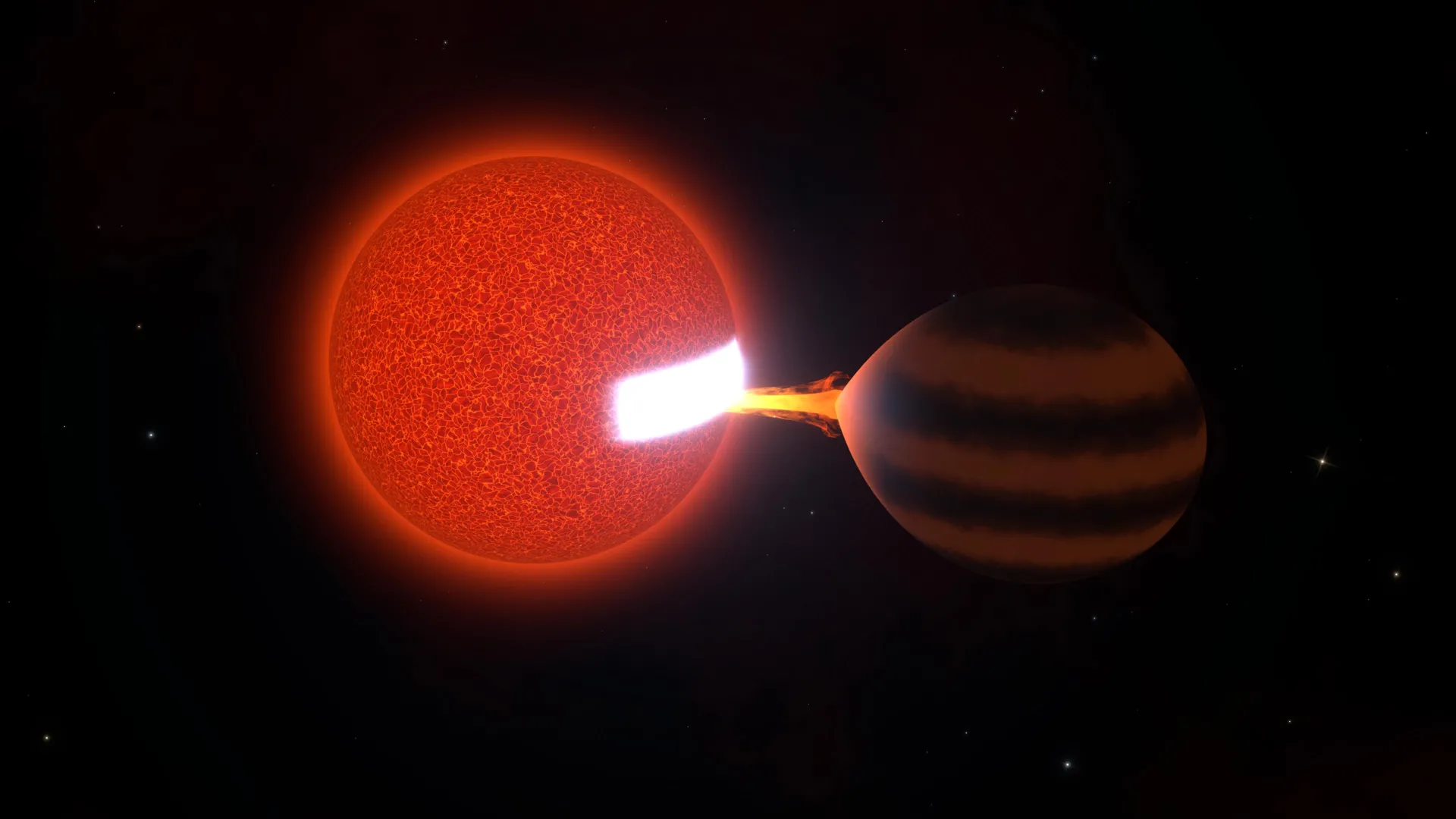
Astronomers have discovered a bizarre star system about 300 light-years from Earth where a small star is slowly devouring a nearby brown dwarf, an object too massive to be a planet but too small to be a true star. Unlike stars that rapidly swallow their companions, this one is gradually stealing material in a process that could continue for billions of years.
Key points
- MIT-led team found a star 300 light-years away slowly consuming a brown dwarf.
- The brown dwarf orbits the star every 87 minutes, fitting inside the Sun's diameter.
- The star eats about one hundred-thousandth of Earth's mass yearly, possibly for billions of years.
Astronomers led by MIT have discovered a star system about 300 light-years from Earth where a small star is gradually consuming a nearby brown dwarf. The study, published October 5 in Nature Astronomy, describes the first observed case of a low-mass star steadily drawing material from another low-mass object.
The system, called ZTF J0440+2325, is in the Milky Way. The star has about 85 times Jupiter's mass, while the brown dwarf weighs about 25 Jupiter masses. The brown dwarf orbits the star every 87 minutes, and its entire orbit would fit within the Sun's diameter.
A puzzling triangular signal
The discovery began with data from the Zwicky Transient Facility at Palomar Observatory in California. Astronomer Kevin Burdge noticed a strange triangular pattern in the brightness of an object, unlike the smooth rise and fall of supernovae.
Burdge initially considered a black widow binary, but the expected rapid motion was absent. Years later, he and graduate student Aaron Householder measured a small wobble, confirming the system was a low-mass star orbited by a brown dwarf.
Instead of swallowing the thing up, the star can gradually eat it, for billions of years.
— Kevin Burdge
Slow feeding process
Simulations showed that material from the brown dwarf falls directly onto the star's surface. The star consumes about one hundred-thousandth of Earth's mass each year, a rate that could continue for billions of years.
The infalling matter creates a bright hotspot that rotates in and out of view, producing the triangular light curve. The researchers say this is the first time a low-mass star has been caught actively accreting from another low-mass object.


