
NASA’s Webb finds signs of Mars-sized worlds smashing together
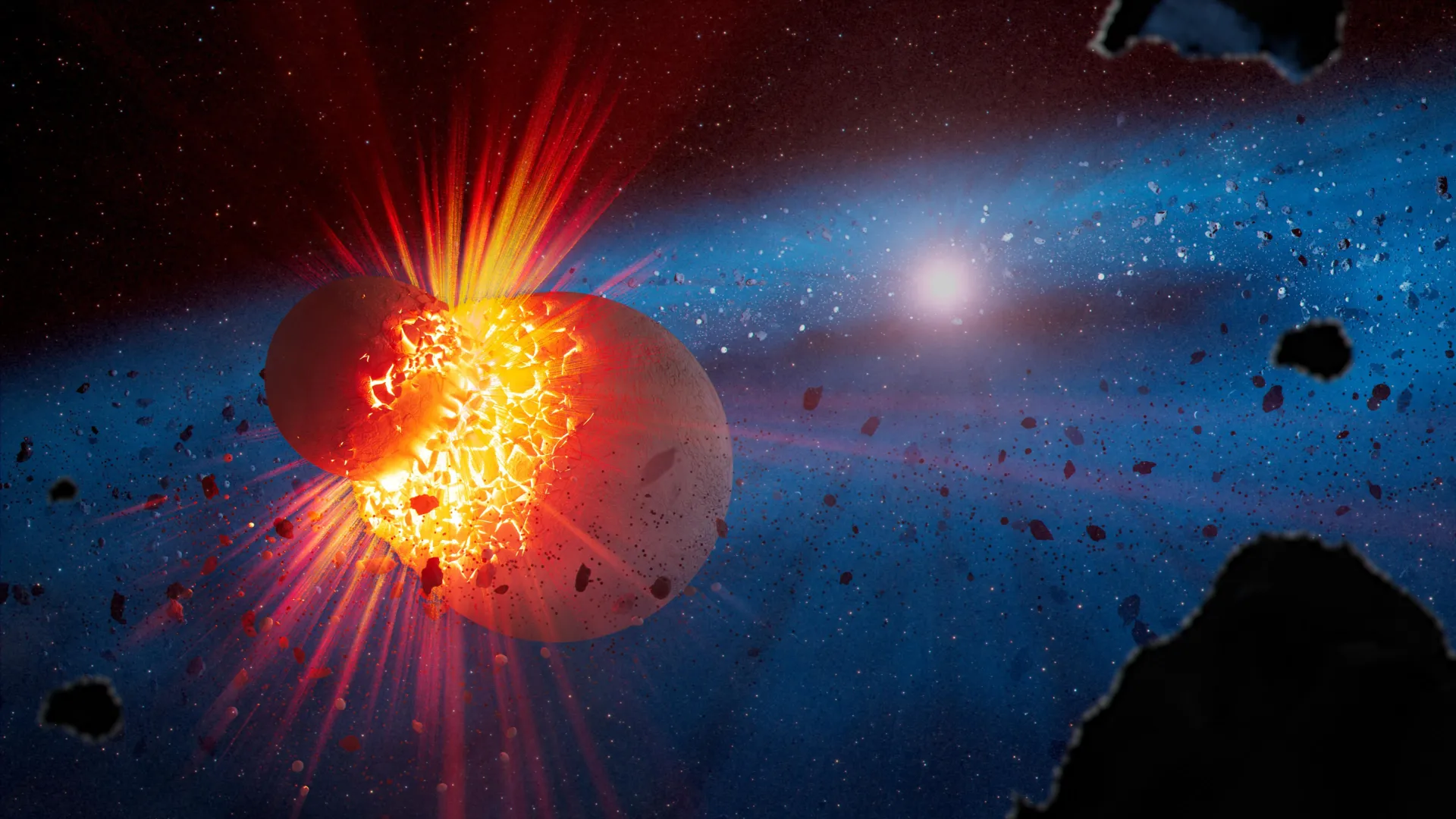
NASA’s James Webb Space Telescope is giving astronomers a glimpse of the kinds of violent collisions that may have shaped our own solar system, including the giant impact thought to have created the Moon. By studying 21 rare “extreme debris disks” around young stars, researchers found that their dust can reveal the scale and intensity of planetary collisions.
Key points
- Webb studied 21 extreme debris disks, finding 12 new and 4 follow-up systems.
- Disks split into silica-rich and silica-poor groups, likely from different collision energies.
- Silica-rich disks appear only around stars younger than 300 million years.
Astronomers using NASA's James Webb Space Telescope have investigated a rare class of young star systems called extreme debris disks, which may be shaped by violent collisions between Mars-sized bodies. The findings, published Oct. 1 in The Astrophysical Journal, offer new clues about how rocky planets form and evolve.
The study examined 21 extreme debris disks: five from archival Spitzer observations and 16 studied with Webb, including 12 newly observed and four follow-up systems. The team was led by Kate Su of the Space Science Institute in Boulder, Colorado.
What the disks reveal
Extreme debris disks contain unusually large amounts of warm dust close to their stars and show irregular brightness changes over time. Webb and Spitzer mid-infrared spectra confirmed that their dust grains are smaller than those in protoplanetary or typical debris disks.
Analysis of minerals in the disks divided them into two groups: silica-rich and silica-poor. About one-third are silica-rich, likely formed after extremely energetic collisions between Mars-sized bodies. The other two-thirds are silica-poor, appearing to result from lower-energy collisions, including grazing impacts between Moon-sized objects.
This is the first time we have gathered enough systems to truly understand this subclass that we call extreme debris disks.
— Kate Su
Age and solar system links
Silica-rich disks have only been found around stars younger than 300 million years, while silica-poor disks span a wider age range and tend to show stronger brightness changes. The team suggests this variability may come from the rapid evolution of newly created debris.
The findings may help reconstruct our solar system's history, which could have passed through more than one extreme debris disk phase. The timeline matches estimates that Earth and the Moon formed roughly 100 million years after the Sun, with the Moon likely resulting from a collision between Earth and a Mars-sized object.


