Scientists discover a secret glow in toxic fire salamanders
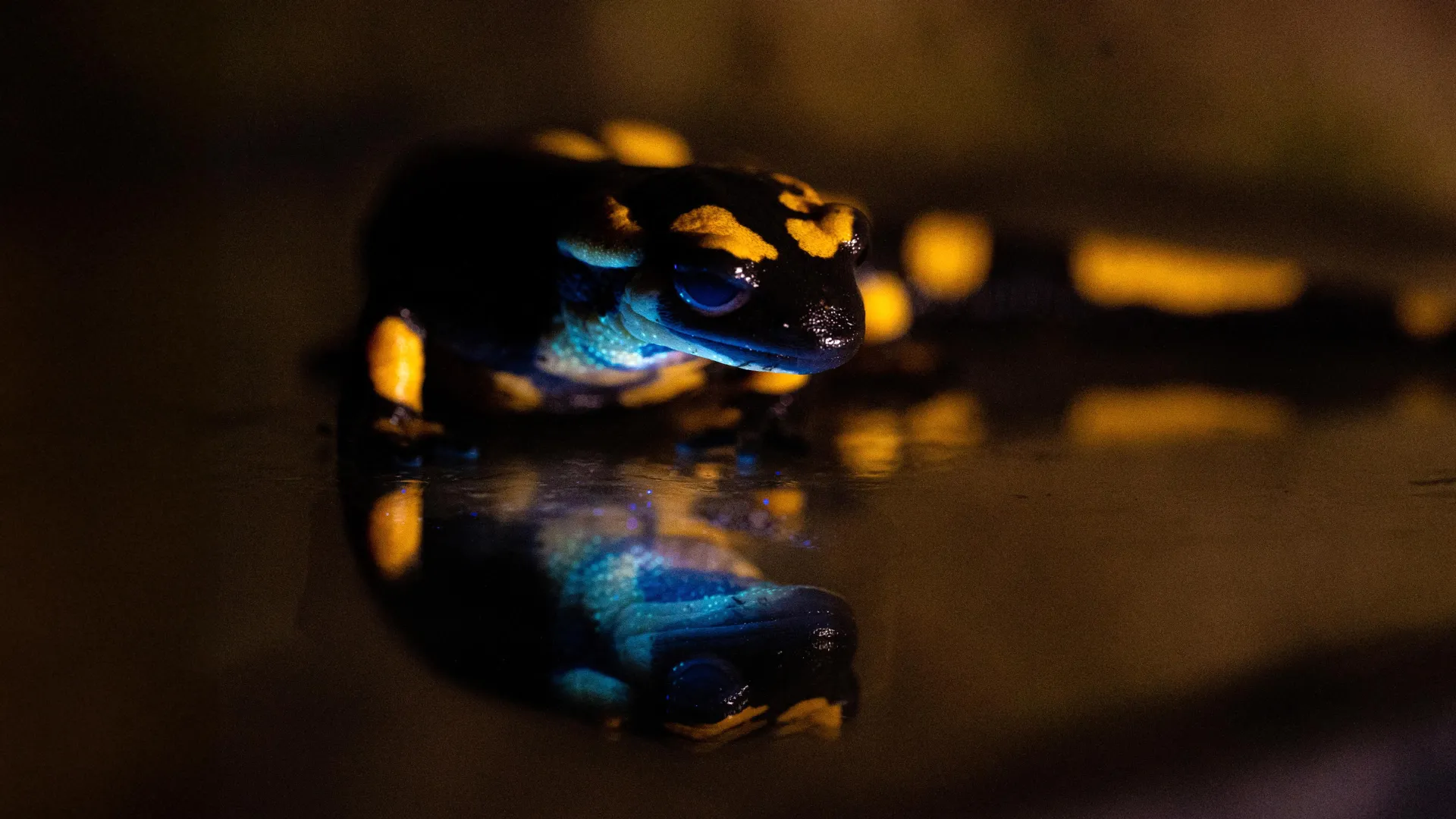
Researchers have discovered a surprising hidden ability in Europe's familiar black-and-yellow fire salamanders: they glow green and cyan under ultraviolet light. The mysterious fluorescence comes mainly from glands in their skin and their toxic secretions, which can continue glowing for more than 24 hours after being released.
Key points
- Fire salamanders fluoresce under ultraviolet light, most strongly on their yellow underside and sides.
- The fluorescence comes mainly from skin glands and their secretions, which can stay fluorescent for over 24 hours after leaving the body.
- The biological purpose of the glow is unknown, and researchers have not yet identified the compound responsible.
Researchers have found that fire salamanders, the black-and-yellow amphibians known for releasing poisonous substances to deter predators, fluoresce under ultraviolet light. The glow is most pronounced on the yellow underside of their bodies and along their sides, according to the study.
The researchers traced the fluorescence primarily to glands in the animals' skin and the substances those glands release. These secretions can remain fluorescent for more than 24 hours after leaving the salamander's body. The species is classified as vulnerable on the IUCN Red List of Threatened Species.
How the glow works
Compounds in the salamander's skin absorb ultraviolet light, which humans cannot see, and reemit that energy as visible light, producing vivid green and cyan colors. This process is known as biofluorescence and requires an outside light source, unlike bioluminescence, in which animals such as fireflies produce their own light chemically.
Scientists once thought biofluorescence occurred almost exclusively in marine organisms, with scorpions as an unusual land example. Recent studies have found fluorescent properties in a growing variety of terrestrial animals, including reptiles, birds and amphibians.
It is fascinating that such a well-studied species still harbors unknown phenomena like this.
— Bernat Burriel
Possible functions and next steps
The biological purpose of the glow remains uncertain. Researchers suggest it could aid communication, helping salamanders recognize one another or assess potential mates, or make their warning coloration more noticeable to predators. In forests, moonlight and starlight provide nighttime illumination, and full moonlight contains more ultraviolet and violet wavelengths than daylight.
The team is now working to identify and chemically characterize the compound behind the fluorescence. The study involved scientists from the Institute of Subtropical Biology and the Catalan Society of Herpetology and forms part of an amphibian conservation project in Catalonia supported by the Barcelona Zoo Foundation.