These bizarre prehistoric mammals may have been misunderstood for 150 years
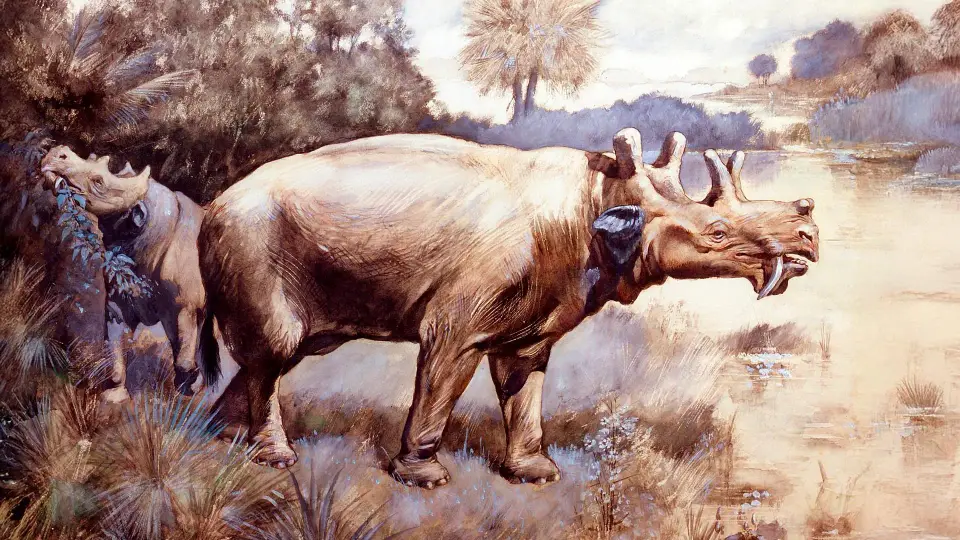
Giant horned mammals that emerged shortly after the extinction of the dinosaurs may have had far fewer physical differences between males and females than scientists once believed. The discovery challenges a classic example of sexual dimorphism and raises questions about how historical biases have shaped our understanding of extinct animals.
Key points
- New research suggests male and female uintatheres differed less than paleontologists assumed for 150 years.
- Skull measurements of about 30 Uintatherium anceps specimens did not split into two clear groups.
- The same statistical methods clearly detected sex differences in modern bison skulls.
A new study from the University of Kansas, published in PLOS One, questions a 150-year-old assumption that uintatheres, giant extinct mammals with horns and large canine teeth, showed strong physical differences between males and females. Uintatheres appeared about 58 million years ago and lasted roughly 20 million years.
Study author Kevin Mulcahy, a doctoral student at the KU Biodiversity Institute & Natural History Museum, began the work after researchers tried to identify a broken upper molar found during fieldwork in Montana.
What the skull measurements showed
Mulcahy measured skulls at the American Museum of Natural History in New York and later gathered data from fossils at other institutions, ending with about 30 skulls of a single species, Uintatherium anceps. If males and females had differed as sharply as long thought, the measurements should have formed two distinct groups, but the initial analysis found no such separation.
Mulcahy then tested his methods on modern bison, whose sex can be confirmed. The same techniques clearly separated male and female bison, suggesting the weak results for uintatheres were not simply a limit of the statistics.
When you step back and actually test that hypothesis, it doesn't really hold up.
— Kevin Mulcahy
Why the idea took hold
Mulcahy said the fossils were first described in the late 1800s by male paleontologists working in what he called a "very Victorian-era mindset," when it was assumed males would be bigger and more threatening. He said that when the hypothesis is actually tested, it does not hold up.
The findings add to other research challenging the assumption that male mammals are usually larger than females, and may affect how other extinct species are interpreted.