This 345-million-year-old fossil had scientists fooled for decades
A famous 345-million-year-old fossil has turned out to be something entirely different from what scientists believed for decades. Advanced X-ray imaging revealed hidden gills and thousands of tiny teeth, exposing a primitive aquatic or amphibious creature rather than an early reptile. The discovery suggests that several adaptations associated with life on land actually evolved in animals still dependent on water.
Key points
- New X-ray scans show the 345-million-year-old Westlothiana lizziae fossil was not an early reptile but an aquatic or amphibious animal.
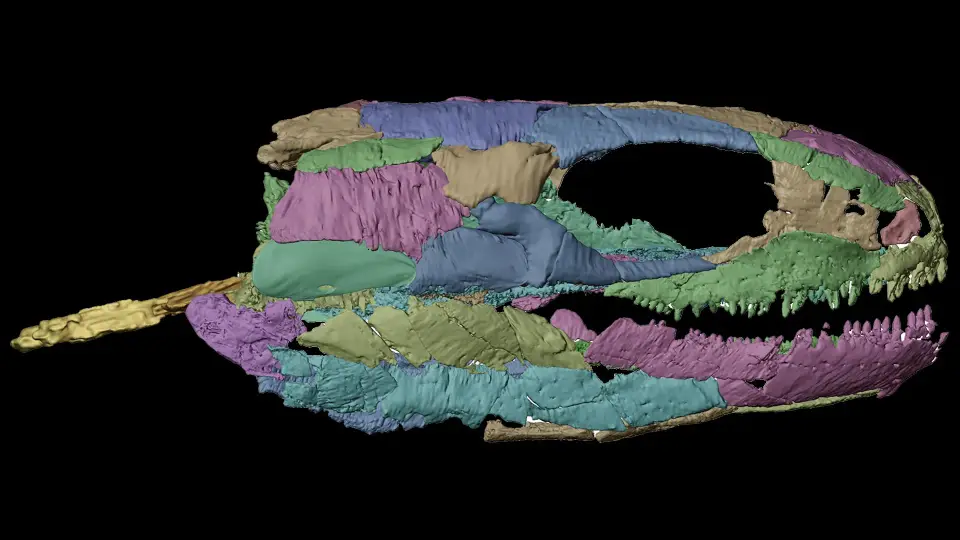
- The fossil has a primitive skull, internal gills with bone and a fish-like mouth with thousands of tiny teeth.
- Claw-like digits and five-fingered limbs may have evolved in water-dwelling relatives before land animals appeared.
A 345-million-year-old fossil found in Scotland, long considered one of the earliest known reptiles, has been reidentified as a very different kind of animal, according to research published in Nature. The study was led by scientists at the American Museum of Natural History and the University of Oxford with the European Synchrotron Radiation Facility.
The fossil, discovered in 1984, belongs to Westlothiana lizziae, nicknamed Lizzie for its lizard-like appearance. It was described in 1990 and widely treated as the earliest known amniote adapted to land. Amniotes are the vertebrate group that includes reptiles, birds and mammals.
What scans revealed
Using powerful X-ray imaging at the European Synchrotron Radiation Facility in Grenoble, France, the researchers reconstructed anatomy hidden inside the crushed rock slabs. They found a primitive skull, internal gills containing bone and a fish-like mouth with thousands of tiny teeth.
These features rule out the fossil's earlier place in the lineage leading to reptiles. The animal appears to have been aquatic or amphibious rather than mainly land-dwelling.
It turns out looks can be deceiving, and Lizzie lived a completely different lifestyle than we previously thought
— Ben Igielman
Rethinking early tetrapod traits
The team now believes traits such as claws and five digits on each hand and foot emerged in earlier animals still tied to water, within the lineage leading to tetrapods, the broader group of four-limbed vertebrates.
The findings may affect how fossil trackways are read. If relatives such as Westlothiana had claws, footprints alone may not show that the animals that made them were amniotes, and some trackways once attributed to early amniotes may have been left by more ancient amphibious creatures.