
This “golden tree” coral was too strange for any known family
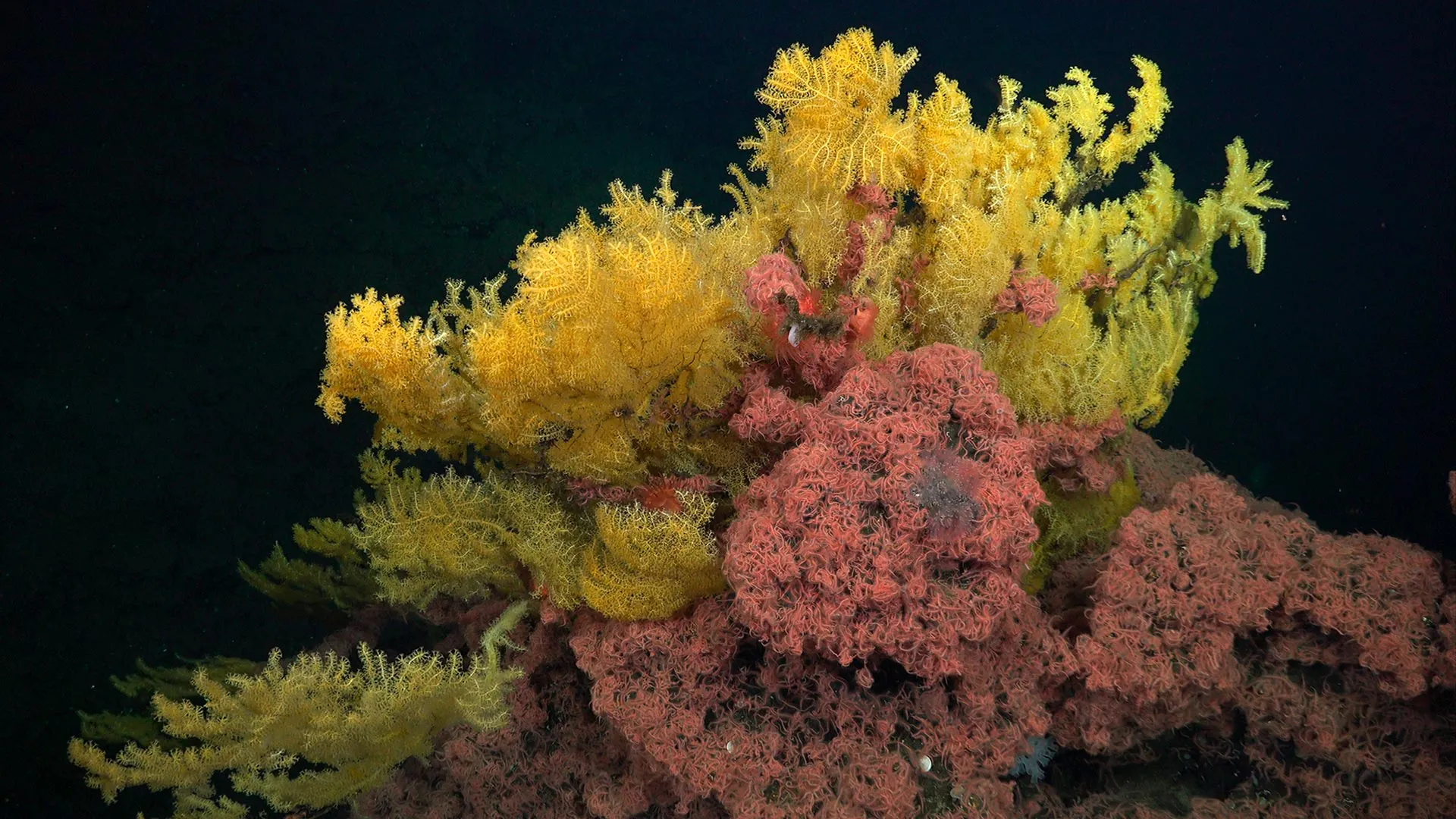
A brilliant yellow coral discovered off Costa Rica proved so unusual that scientists had to create an entirely new family to classify it. The meter-tall colonies rise from seafloors covered in brittle stars, inspiring the Tolkien-inspired name Laurinque elenya, or “golden tree of the stars.” Advanced genetic analysis revealed that the coral belongs to a previously unknown evolutionary lineage.
Key points
- Scientists surveying seamounts off Costa Rica found a bright yellow branching coral so genetically and physically distinct that they created a new family, Laurinqueidae, for it.
- The coral, named Laurinque elenya after Quenya words meaning golden tree and stellar, was found between 360 and 529 meters deep and collected during 2019 and 2023 expeditions.
- Researchers turned to phylogenomics after three standard coral genes each pointed to a different family, concluding the species is most closely related to Eunicellidae but distinct enough for a new family and genus.
Scientists surveying underwater mountains off Costa Rica have identified a new coral so unusual that it required an entirely new family. The bright yellow, branching coral was found between 360 and 529 meters below the Pacific Ocean's surface, and the findings appear in the open-access journal ZooKeys.
Some colonies grow more than a meter tall. Specimens were collected with the remotely operated vehicle SuBastian during expeditions in 2019 and 2023 aboard the Schmidt Ocean Institute vessels Falkor and Falkor (too), which explored seamounts near Isla del Coco and along Costa Rica's Pacific margin.
A name from Elvish
The coral was especially abundant on rocky outcrops where brittle stars covered nearly every surface, with the yellow branches appearing to rise from the seafloor like glowing trees surrounded by stars. That scene inspired the scientific name: the genus Laurinque comes from Laurinquë, meaning golden tree in Quenya, the Elvish language J.R.R. Tolkien created for The Lord of the Rings and The Silmarillion.
The species name, elenya, means stellar or of the stars in Quenya, referring to the dense brittle star populations around the colonies. Researchers described the setting as an almost mystical elvish landscape on the deep ocean floor.
I saw the octocoral garden for the first time in 2019 and I was impressed by the beauty of the landscape, which inspired, later the elvish name of the taxa.
— Dr. Odalisca Breedy
Untangling the family tree
Placing the coral on the evolutionary family tree proved complicated. Three genes commonly used to classify corals each suggested a different, unrelated family, so the team used phylogenomics, which compares hundreds of genes at once.
That analysis showed the species belongs to no previously recognized coral family. It is most closely related to Eunicellidae, but its genetics and anatomy differ enough to justify a new family, Laurinqueidae, and a new genus, Laurinque.
Dr. Odalisca Breedy of the Universidad de Costa Rica, the study's lead researcher, said she first saw the octocoral garden in 2019 and was impressed by its beauty, which later inspired the elvish name. She said preliminary morphological analysis showed it did not match known taxa, and that 2023 samples and molecular work by colleagues Cathy McFadden, Catalina Murillo and Andrea Quattrini determined its taxonomic placement at one of the most enigmatic sites. The Schmidt Ocean Institute and a National Geographic Society research grant supported the expeditions.


