Trump invokes executive privilege in Kennedy Center legal fight
President Trump has formally invoked executive privilege to shield certain records from a Democratic congresswoman who sits on the Kennedy Center board.
Key points
- President Trump formally invoked executive privilege to shield records from Rep. Joyce Beatty's lawsuit over his effort to temporarily close the Kennedy Center.
- White House deputy counsel Joshua Hoyt told a federal judge that the privilege covers communications between Trump, his advisers and Kennedy Center employees.
- The Justice Department called Beatty's inquiry a "fishing expedition" raising separation-of-powers concerns, while her lawyers accused it of asserting a blanket privilege in an unprecedented fashion.
President Trump has formally invoked executive privilege to withhold certain records from Democratic Rep. Joyce Beatty of Ohio as part of her legal challenge to his effort to temporarily shutter the Kennedy Center for renovations.
White House deputy counsel Joshua Hoyt told a federal judge on Wednesday that the presidential communications privilege covers information, documents and communications between Trump, his advisers and Kennedy Center employees about the president's duties and the performing arts institution's "effective functioning."
What the filings said
Hoyt argued that because the president appoints members of the Kennedy Center's board and a related Advisory Committee on the Arts, he must familiarize himself with the institution's management, operations, fundraising and planned activities. He wrote that without the privilege's protection, presidential advisers and staff would be chilled from gathering information and providing fully informed recommendations.
In a separate filing, Justice Department lawyers accused Beatty of a "fishing expedition" that raises separation-of-powers concerns. They argued that what matters for executive privilege is that Beatty seeks information about the president's actions in his official capacity. Executive privilege is not absolute and can be overcome by an adequate showing of need.
improperly asserting a blanket privilege in an unprecedented fashion
— Beatty's lawyers
Background of the dispute
The Kennedy Center's board, made up of Trump administration officials and the president's allies, elected Trump as its chairman last year, making him the first sitting president to hold the role. His assertion of executive privilege over records relating to the center raises untested questions about whether the protection extends to his actions as chairman of the institution, created by Congress in 1958 and funded through federal dollars, ticket revenue and private donations.
Trump asserted privilege over records concerning his attempt to close the center for two years for renovations, its financial condition, the effort to add his name to the facade and the possibility of demolition. Concerns about demolition emerged after Trump said last month the center would close and "end up being ripped down" without recognition for his fundraising and repairs. He was also photographed on Air Force One looking at a placard that appeared to say "Kennedy Center Demolished."
The lawsuit and discovery
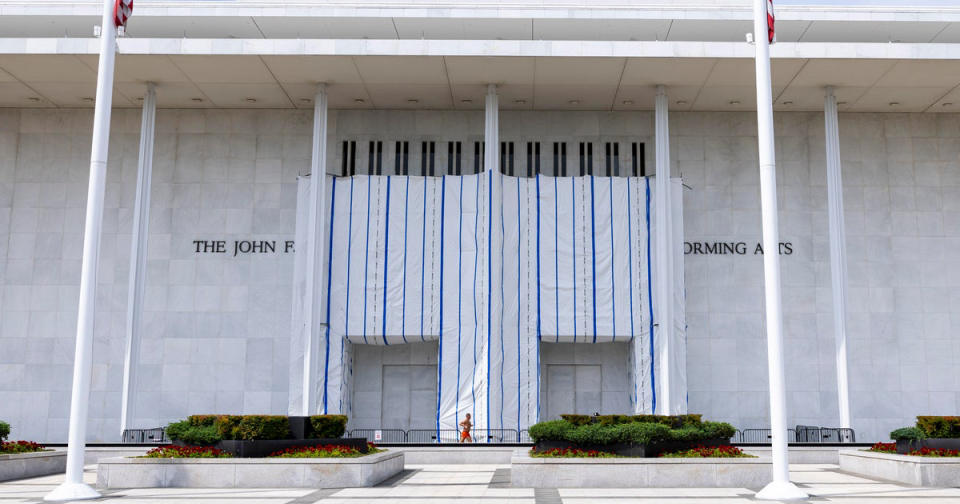
Beatty filed the lawsuit in December challenging the board's move to rename the center the Donald J. Trump and The John F. Kennedy Memorial Center for the Performing Arts and to shutter it for two years. She is an ex officio member of the board. In May, U.S. District Judge Christopher Cooper blocked the closure and ordered Trump's name removed from the facade; crews stripped it in June, but the front portico has since been covered by a tarp.
Cooper allowed Beatty to collect information from the Kennedy Center about the closure decision and any potential demolition, and to take depositions. Beatty's lawyers said the Justice Department sought to block inquiries about input and instructions Kennedy Center staff received from Trump as board chairman and refused to turn over related documents. They accused the department of "improperly asserting a blanket privilege in an unprecedented fashion" and asked Cooper to order the center to turn over the material. Last week, during a deposition with executive director and chief operating officer Matthew Floca, a Justice Department lawyer repeatedly instructed him not to answer certain questions based on a protective assertion of executive privilege.