Tunisia: What has Kais Saied achieved economically in seven years?
Rising prices, unemployment and public debt test Saied’s economic promises.
Key points
- Tunisia's annual inflation reached 5.6% in September 2026, with food prices up 8.4% year on year.
- Unemployment among 15-24 year olds stands at 35.4%, while the overall rate is 14.9%.
- Public debt was 82.1% of GDP in 2025, and the 2026 budget projects 83.4%.
Nearly seven years into Kais Saied's presidency, Tunisia's economy shows mixed results. The country has faced the COVID-19 pandemic, volatile global food and energy prices, and geopolitical turmoil. While the economy continues to grow and overall unemployment has eased from its pandemic-era peak, food prices remain a burden and youth unemployment is high.
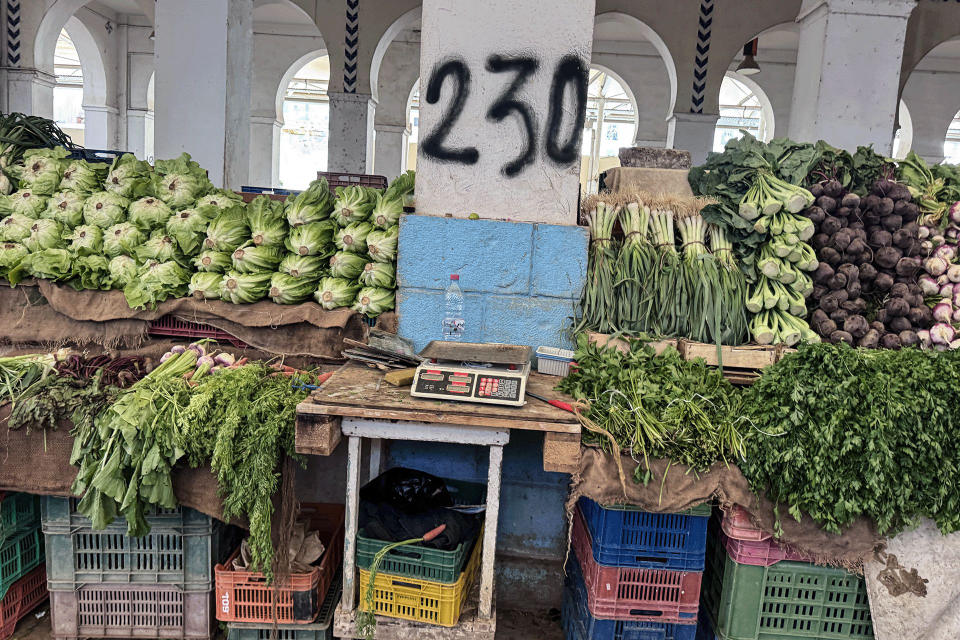
Annual inflation reached 5.6% in September 2026, up from 5.4% in August and 4.8% in January, according to the National Institute of Statistics. Food and beverage prices rose 8.4% year on year, with poultry up 16.5%, fruit up 16.3% and lamb up 14.6%. Core inflation stood at 4.9%.
Economic growth and unemployment
The economy grew by 2.3% year on year in the second quarter of 2026, according to the National Institute of Statistics. The 2026 Finance Law had projected annual growth of about 3.3%. Economist Ridha Chkoundali says growth matters to households only when it translates into greater production, investment, employment and income.
Overall unemployment was 14.9% in the second quarter of 2026, down from 15.3% a year earlier and 17% in 2020. But unemployment among people aged 15 to 24 reached 35.4%, and among university graduates it stood at 26.6%.
an absolute necessity to save the state
— Houssam Ben Ahmed
Public finances and borrowing
Public debt rose from 67.8% of GDP in 2019 to 84.9% in 2024, before falling to 82.1% in 2025, according to Finance Ministry data. The 2026 Finance Law projects a ratio of approximately 83.4%. Chkoundali warns that the government's reliance on domestic borrowing could make it harder for private businesses to obtain financing. Domestic borrowing was about 7 billion dinars in both 2024 and 2025, with 11 billion dinars at the beginning of 2026.
The 2026 Finance Law assumed a Brent crude price of about $63.30 per barrel, but by the end of June the average price had reached approximately $92.60. Fuel subsidies amounted to 2.427 billion dinars in the first half of 2026, or 48.6% of the allocation for fuel subsidies under the Finance Law. Public investment expenditure over the same period totalled 1.665 billion dinars.