US-Iran stalemate: What are Trump’s next military options?
Trump has ruled out attacks before the midterms. Analysts weigh what he could do next, and at what cost.
Key points
- Trump says he will not attack Iran before the November 3 midterm elections but hints at action afterward.
- Iranian attacks on shipping in the Strait of Hormuz have surged to their highest level since the war began.
- Analysts say the US naval blockade and escorts are the most likely course, but escalation would be costly.
US President Donald Trump has said on Truth Social that he will not attack Iran before the November 3 midterm elections. But he told a Republican convention in September that the conflict "is going to end immediately after the elections", and the US military has been sending more forces to the region in recent weeks.
Meanwhile, Iranian attacks on shipping in the Strait of Hormuz have surged to their highest level since the war began. An Iranian official told Reuters that Tehran has begun using different offensive tactics against vessels it considers to violate its restrictions.
Current US military posture
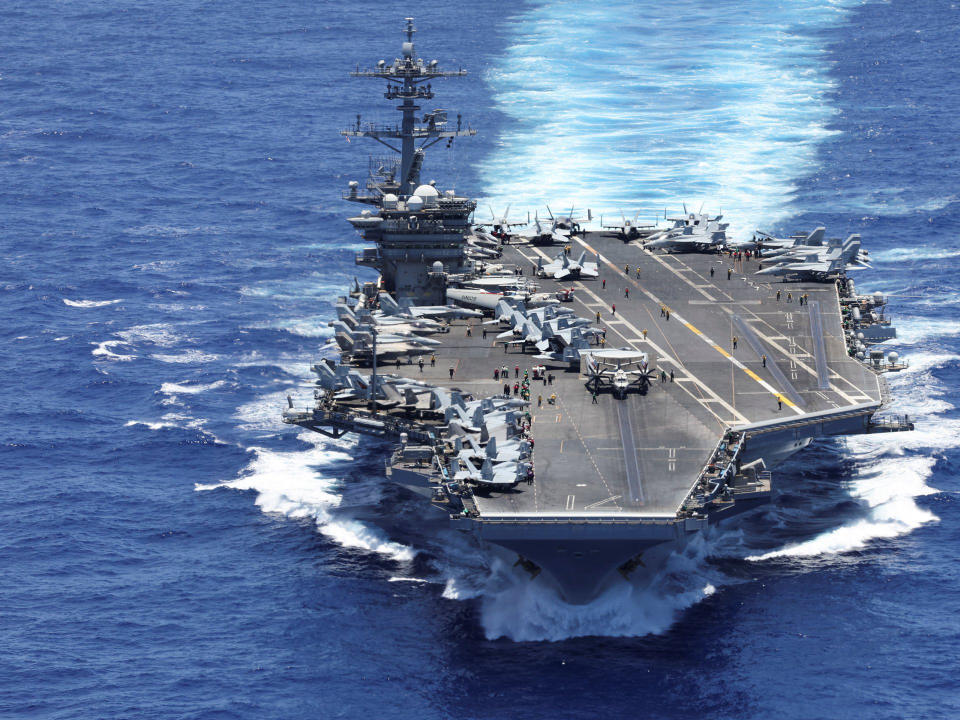
The US has at least three aircraft carrier strike groups in the Gulf or heading there. The USS Theodore Roosevelt carrier strike group, with about 7,000 sailors and 2,000 Marines, is sailing to the Middle East to join the carriers already there. The US also maintains about 50,000 soldiers at bases in Middle East countries.
The US naval blockade on Iranian ports and naval escorts for commercial ships through the Strait of Hormuz are the status quo. Patrick Bury, a former NATO research analyst, told Al Jazeera this is the most likely course of action.
You are smuggling, but the strait is under Iran's control.
— Mohsen Rezaei
Escalation options and costs
Trump has said it may be "possible" to ramp up bombing after the elections, but has not given details. Bury said he expects "further strikes in fairly limited packets" against targets on Iran's coastline and further inland if the situation escalates.
Afzal Ashraf, a former Royal Air Force officer, said a new campaign could "actually achieve a lot less" because Iran has adapted and can conceal its weapons better. He added that each cheap Iranian drone or missile can force the US to fire an interceptor costing a million dollars or more, and the US is running out of missiles for its own defence.
The US has fired more than 1,000 Tomahawk cruise missiles at Iran during the war. According to CSIS estimates, fully restoring pre-war inventory could take until the end of 2030. Bury said getting back to pre-war levels across key munitions would take three to four years.