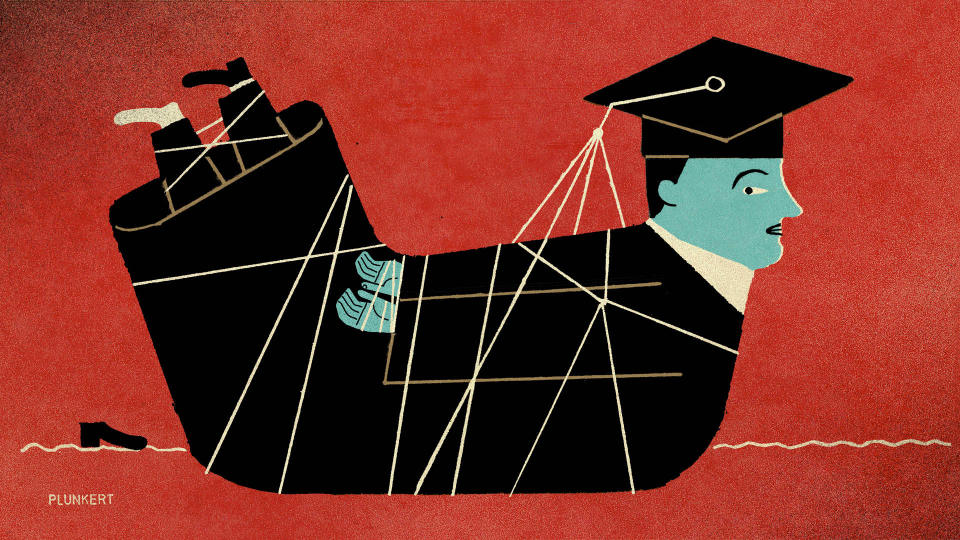
College was supposed to be ‘good debt.’ For many borrowers, it isn’t paying off
Rising college costs, growing student debt, changing repayment rules and a tougher job market are challenging the idea that student loans are "good debt."
Key points
- More than 42 million Americans hold federal student debt, totaling over $1.7 trillion, up from $516 billion and 28 million borrowers 20 years ago.
- The average student loan balance is now $40,768, and 3.8 million borrowers owe more than $100,000.
- The OBBBA eliminated affordable repayment plans and deferment options, while AI is reducing entry-level job openings by 35%.
Student loans have long been viewed as 'good debt,' but soaring tuition, changes to the federal lending system and a volatile job market are challenging that idea. More than 42 million Americans now carry federal education debt, with outstanding balances exceeding $1.7 trillion, up from $516 billion and 28 million borrowers two decades ago.
The average student loan balance is $40,768, up from $30,414 a decade ago. Over the past 10 years, the number of borrowers owing more than $100,000 has grown to 3.8 million from 2.4 million, with their average balance rising to about $187,000 in 2026 from $172,000 in 2017.
Rising costs and growing skepticism
The average annual tuition and fees at a private four-year college reached $45,000 in 2025-2026, up from $14,550 in 1971-72 after inflation adjustment. Tuition has risen about 5.5% a year on average since 1983, outpacing inflation and wage gains. With room and board, the annual tab at a private institution averages $60,920, and some colleges charge over $100,000 a year.
Nearly 8 in 10 adults say colleges are doing only a 'fair' or 'poor' job at keeping tuition affordable, and 55% gave the same score for preparing students for well-paying jobs, according to a 2025 Pew Research Center study. A NerdWallet survey found nearly 80% of Americans agreed the federal student loan system is broken.
Student loans that constrain wealth-building for 20 or 25 years cannot be called 'good debt,'
— Nadine Chabrier, senior policy counsel at the Center for Responsible Lending
Policy changes and job market shifts
President Donald Trump's 'one big beautiful bill' act, or OBBBA, eliminated several affordable repayment plans and cut the safety net, including options to pause payments during unemployment. The new Repayment Assistance Plan extends terms to 30 years. As of June 30, roughly 9.3 million federal borrowers were in default, up from about 6.2 million in 2016.
The rise of artificial intelligence is disrupting entry-level hiring, with job openings for such roles down 35% between 2023 and 2025, according to Revelio Labs. The unemployment rate for recent college graduates rose to 5.7% in June 2026 from 4.9% a year earlier. A Cornell University report said higher education 'faces an unprecedented crisis' as public trust declines.