Fact vs. fiction: Doctors share whether peptides are safe and effective
As peptides gain popularity among some wellness influencers and federal government officials, doctors share what you need to know.
Key points
- Synthetic peptides are widely promoted online for benefits such as muscle recovery, longevity and sexual function, but many are not FDA-approved.
- The Department of Health and Human Services is reportedly planning to let specialty pharmacies compound certain synthetic peptides backed by Health Secretary Robert F. Kennedy Jr.
- Doctors interviewed by CNBC recommend against using injectable peptides that are not FDA-approved.
Health experts are warning consumers about synthetic peptides, a class of compounds made of short amino acid chains that are heavily promoted by online influencers for benefits ranging from muscle recovery and longevity to improved sexual function. Some peptides, such as GLP-1 drugs like Ozempic, are federally approved for medical use, but many others are not.
The Department of Health and Human Services is reportedly planning to allow specialty pharmacies to compound certain synthetic peptides supported by Health Secretary Robert F. Kennedy Jr., who told podcaster Joe Rogan in a February 2026 interview that he is a "big fan" of the injectables. The reported move would be an interim access policy for specific peptides not currently approved by the U.S. Food and Drug Administration.
Safety concerns and evidence gaps
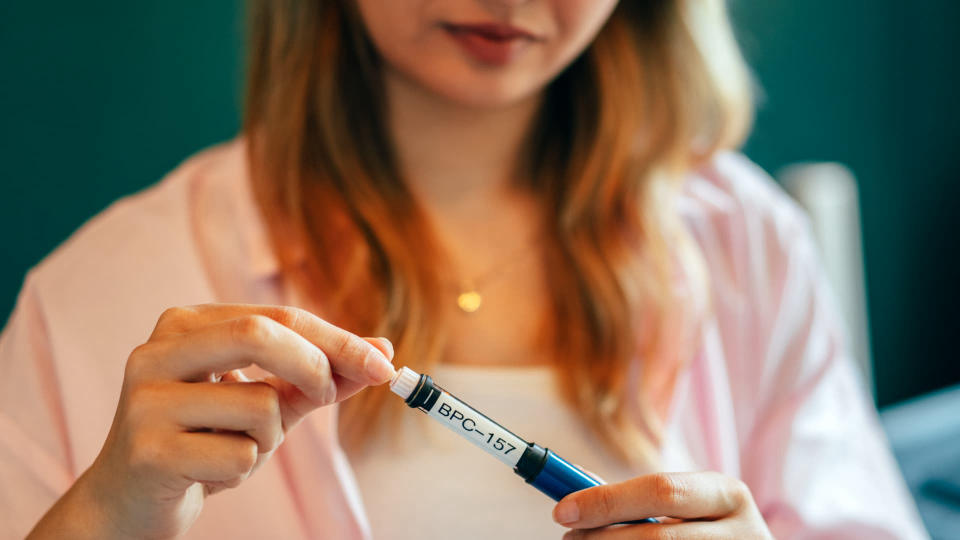
Multiple peptides, including BPC-157, which is reportedly part of the health department's proposal, appear on an FDA list of injectables that may present significant safety risks. BPC-157 has shown potential anti-inflammatory effects in some animal and lab studies but has not undergone large-scale human testing for safety or effectiveness.
Dr. Caleb Alexander, a professor at the Johns Hopkins Bloomberg School of Public Health, said a main reason for concern is "the absence of evidence," including robust human studies. Dr. Pieter Cohen of Harvard Medical School said buying peptides on the gray market can mean receiving different compounds or contaminated products.
My recommendation is not to use any of the novel, unstudied injectable peptides because we simply do not know if they work. And if they do work, if they're safe
— Dr. Pieter Cohen
What doctors recommend
The experts who spoke with CNBC Make It advise against using any injectable peptides that are not FDA-approved, particularly when the source or production method is unknown. They recommend consulting a medical professional before making major health changes.
Cohen said he would not use unstudied injectable peptides because it is unknown whether they work or are safe. Alexander said the benefits of such products are unclear and urged advocates to fund the studies needed to establish their true safety and effectiveness.