Hidden climate superpower: Why some ocean “snow” carries six times more carbon
Scientists have discovered that the stickiness of underwater “marine snow” plays a surprisingly important role in how much carbon reaches the deep ocean. Gooier particles resist bacterial breakdown and can transport more than six times as much carbon to the depths, revealing an unexpected connection between ocean slime and Earth's climate.
Key points
- Marine snow removes over 10 gigatons of carbon yearly, but only about two gigatons reach long-term storage depths.
- Stickier marine snow can carry more than six times as much carbon to the deep ocean as thinner particles.
- Researchers used 3D confocal microscopy and fluorescent molecules to watch bacteria interact with marine snow.
Researchers at UC San Diego's Scripps Institution of Oceanography and the University of Lincoln have found that the stickiness of marine snow affects how much carbon it carries into the deep ocean. Their findings were published October 8 in the journal Science.
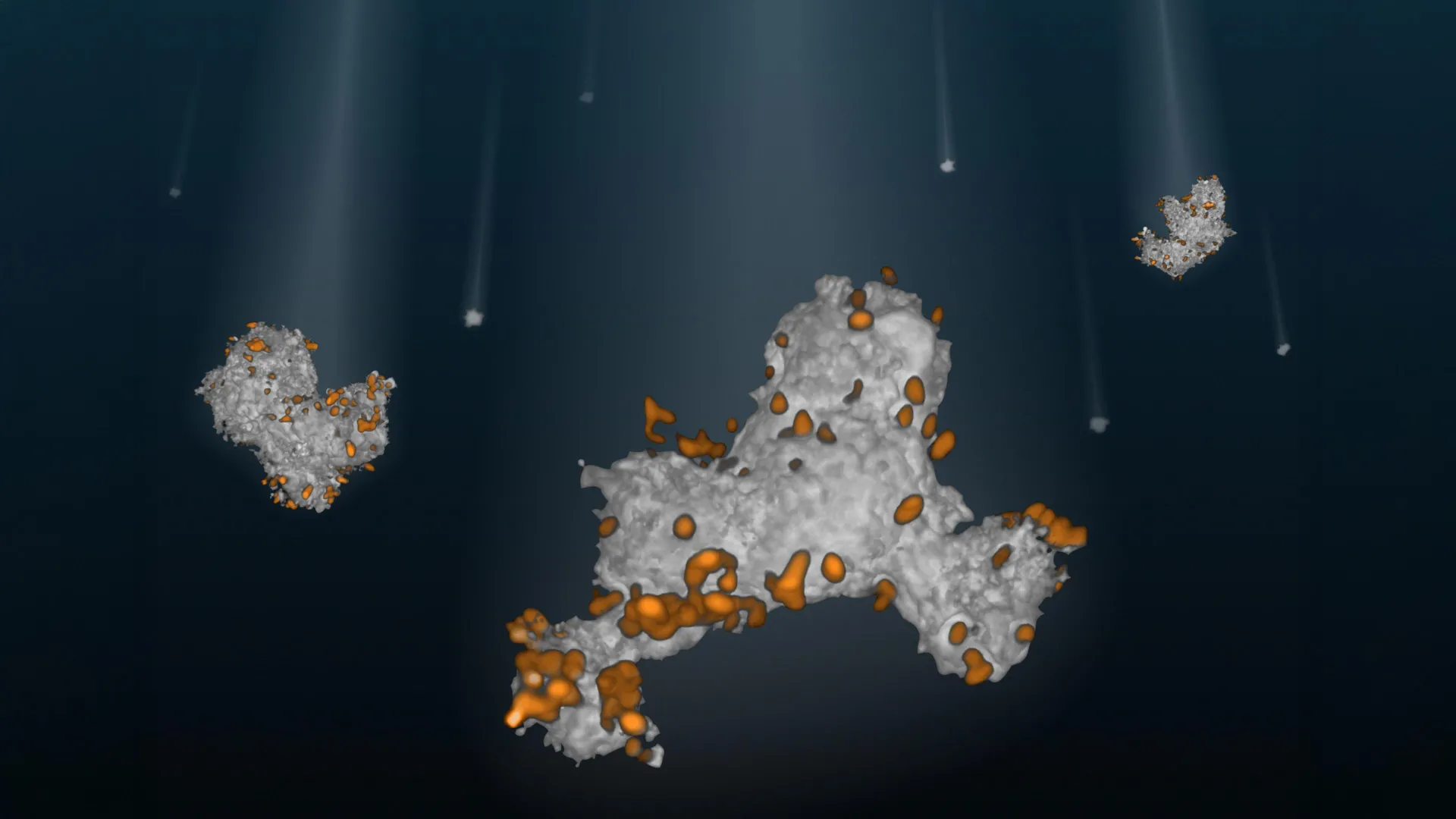
Marine snow is made of sinking clumps of waste, dead organisms, mucus, feces, silt and plankton remains. It removes more than 10 gigatons of carbon from surface waters each year, but only about two gigatons reach depths where carbon stays stored for hundreds or thousands of years.
How bacteria break particles down
Bacteria feed on marine snow as it sinks, breaking it apart and reducing how much carbon reaches the depths. The team found that bacteria settle near particle surfaces where material is less viscous, while denser, stickier regions deeper inside are harder to penetrate.
In lab experiments, more viscous particles resisted bacterial breakdown for longer, and computer simulations suggested they sink deeper before fragmenting. The team estimates highly viscous marine snow can deliver more than six times as much carbon to the deep ocean as less viscous particles.
Think of it like a worm in an apple: the flesh is easy to penetrate, but the core is tough to chew through
— Bryce Inman
A new way to see mucus
The project began in 2021, and after several failed attempts the team developed a working technique in 2025. It combines 3D confocal microscopy with specially designed fluorescent molecules, letting scientists watch living bacteria move through individual particles.
The researchers say the method could also help study bacteria and mucus in coral reefs, kelp forests, plant roots and digestive systems. Funding came from the Simons Foundation and the Engineering and Physical Sciences Research Council.