Oxford scientists discover how viruses build themselves without a blueprint
Scientists have captured virus-like particles assembling themselves step by step, revealing how a surprisingly simple process of trial and error produces complex structures with remarkable precision. The discovery uncovers a crucial molecular turning point that speeds up assembly and could lead to new ways to disrupt viruses and develop vaccines.
Key points
- University of Oxford researchers watched virus-like particles assemble one molecule at a time, publishing the findings in Nature.
- Weak initial protein connections let failed arrangements break apart and retry until stable closed structures form.
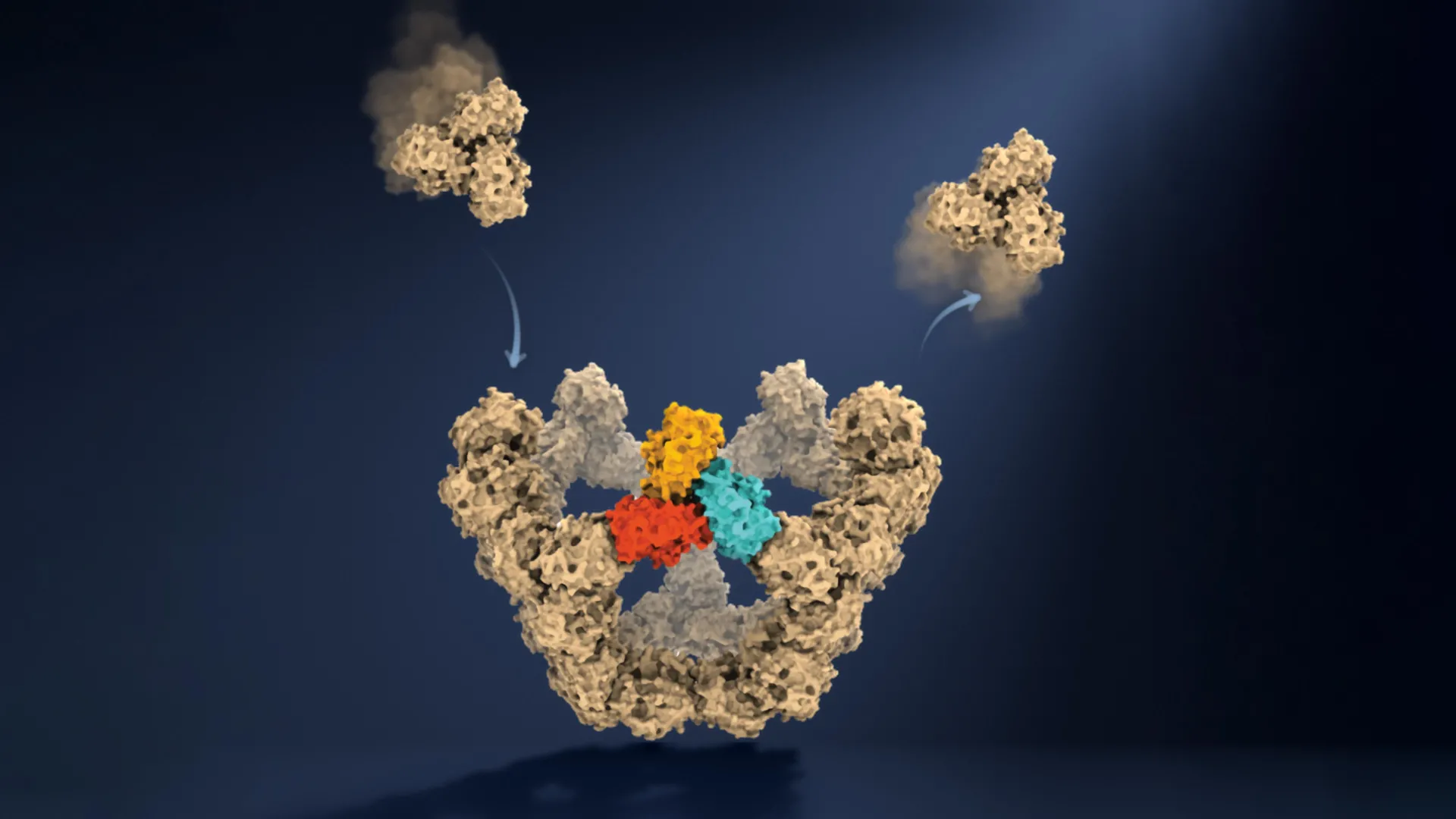
- The first highly stable step is a closed pentagonal ring of five larger protein blocks, after which growth speeds up.
Researchers at the University of Oxford have observed virus-like particles assembling themselves molecule by molecule, revealing simple rules that let complex biological structures form reliably. The findings were published in Nature.
The team studied an engineered virus-like particle made of 60 protein units, using mass photometry, an Oxford-developed technique that measures the mass of individual molecules by the light they scatter. Combined with a new method for keeping single molecules confined and continuously observable, it let scientists track proteins attaching to a growing particle over time.
How the assembly process works
Viral assembly resembles navigating a maze in which only certain paths lead to lasting progress. Proteins first form weak connections that break apart if the arrangement fails, allowing repeated attempts until particular closed structures form. Once several connections hold a structure together, it becomes far more stable.
These stable arrangements act as checkpoints that narrow the many possible routes to a smaller set of successful ones. A key milestone is five larger building blocks joining into a closed pentagonal ring, the first highly stable structure in the process. After that, each stable stage needs fewer additional blocks, so the particle grows faster.
we just take a video!
— Dan Loewenthal
What the researchers said
Co-lead author Dr. Roi Asor said a virus must find the right arrangement among a huge number of possibilities without a blueprint or machinery. He added that weak interactions give the system room to make mistakes, with components separating and trying again until the right closed arrangement locks in.
Co-first author Dan Loewenthal said the method lets the team study assembly directly: "we just take a video!" Co-author Dr. Jack Tan said understanding these processes at the molecular level could aid vaccine development and antivirals that disrupt viral assembly.