Scientists smash oxygen nuclei to recreate matter from the Big Bang
Scientists have recreated a primordial state of matter from the dawn of the universe by colliding oxygen nuclei at nearly the speed of light. The surprising results show that this exotic substance can form in smaller, lower-energy collisions than previously demonstrated, challenging the known boundaries of early-universe physics.
Key points
- The STAR experiment at RHIC found evidence of quark-gluon plasma in collisions between oxygen nuclei, much smaller than the gold nuclei usually used.
- Researchers observed a 20% suppression of high-energy particles, a sign of jet quenching, in oxygen collisions at 200 GeV recorded in 2021.
- The results set a new lower energy boundary for conditions that can produce quark-gluon plasma, though RHIC has now ended operations.
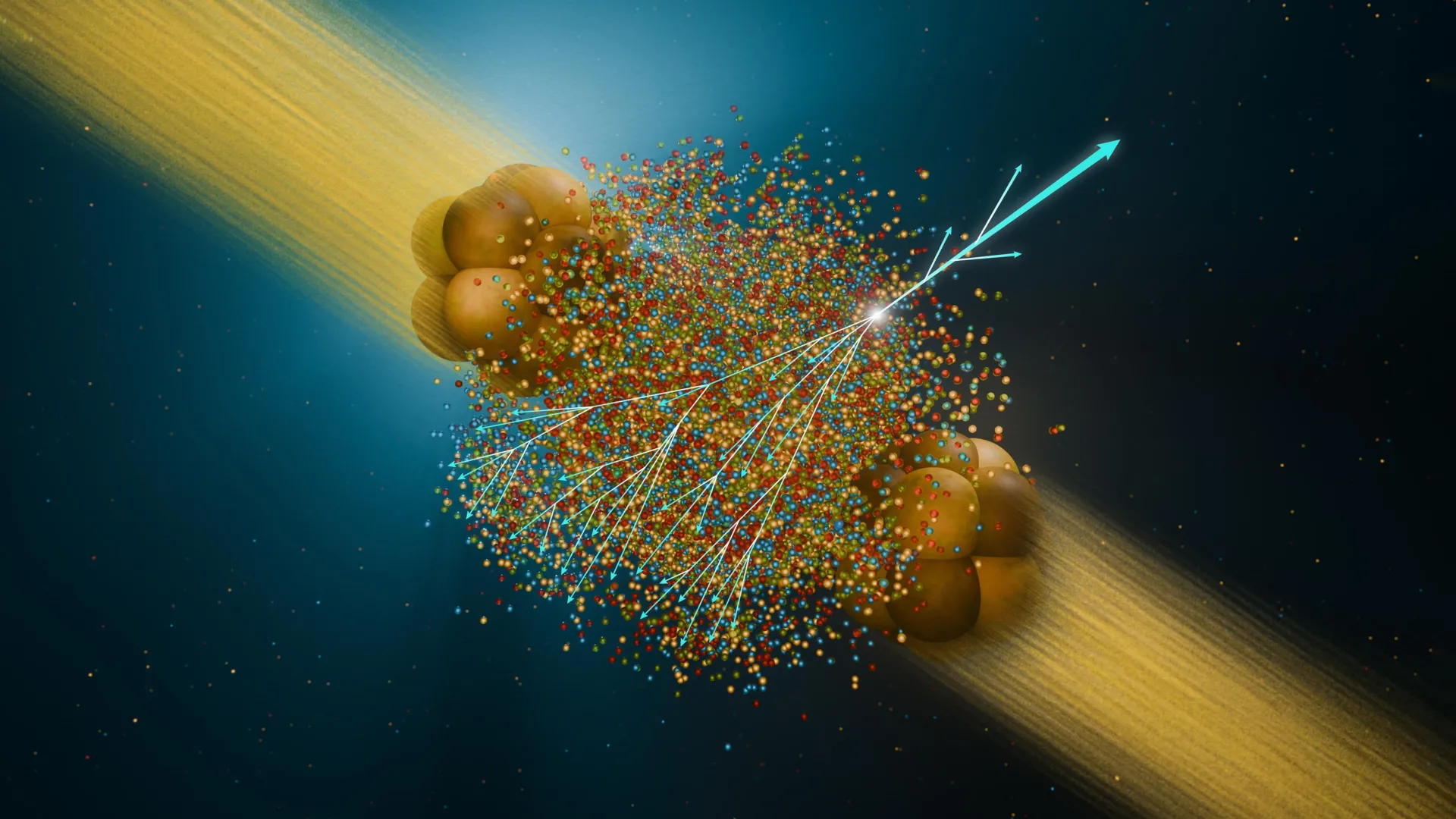
Scientists working on the STAR experiment at the Relativistic Heavy Ion Collider (RHIC) report evidence that quark-gluon plasma, the hot, dense matter thought to have existed shortly after the Big Bang, can form in collisions between small oxygen nuclei. The findings were published in Physical Review Letters.
The team found that high-energy particle streams lose energy as they pass through the material created in these collisions, an effect known as jet quenching. Jet quenching had previously been seen in collisions of much larger nuclei at RHIC and in oxygen collisions at CERN's Large Hadron Collider.
Why the oxygen results matter
The oxygen collisions took place at substantially lower energies than the LHC's oxygen runs. The results set a new lower boundary for the conditions known to produce quark-gluon plasma in this small collision system, helping scientists narrow down what it takes to create matter resembling that of the infant universe.
The team analyzed STAR measurements from oxygen collisions at RHIC in 2021 at a collision energy of 200 billion electron volts (GeV). The results showed a 20% suppression of high-energy particles linked to jet quenching, smaller than in gold collisions but still strong enough to indicate plasma formation.
You can think of it like shooting a bullet through, say, water. Because of the resistance, the bullet will slow down.
— Li Yi
What researchers said
Li Yi, a physics professor at Shandong University who oversaw the STAR analysis, said understanding the plasma's properties is essential to learning how the early universe evolved in its first microseconds. She said scientists study the plasma by finding where its signatures appear and where they turn off.
Rongrong Ma, a STAR physicist at Brookhaven Lab, said the analysis pushes to an extreme case to learn about jet quenching and the conditions needed to generate a quark-gluon plasma. RHIC ended operations with oxygen collisions recorded by the STAR and sPHENIX detectors on February 6, 2026, and remaining data may show how small or low-energy a system can be before plasma stops forming.