The All Blacks' Haka explained - plus rugby's other rituals
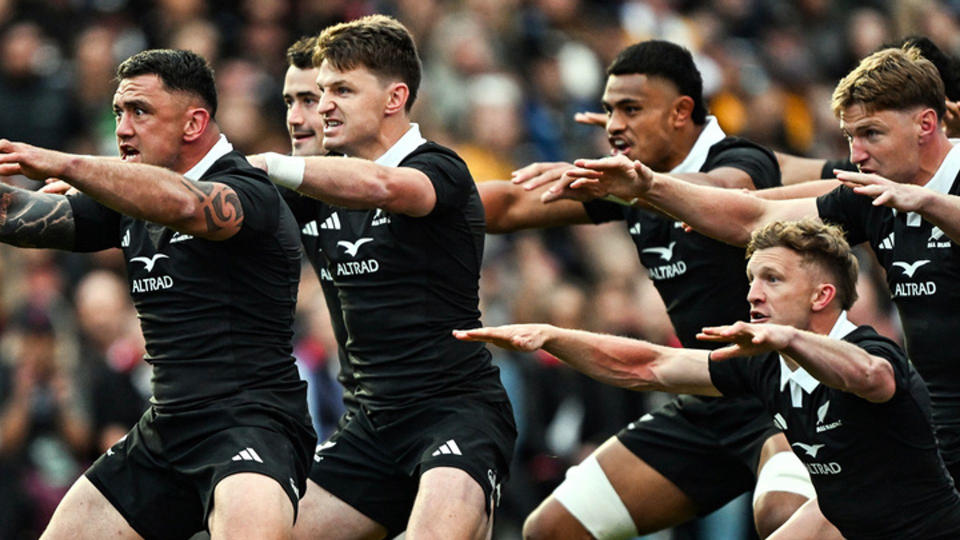
One of the most intriguing and anticipated moments in the sport of rugby union: the sight of New Zealand's All Blacks performing their world-famous haka as the opposition stands before them.
Key points
- The All Blacks have performed the haka since an 1884 tour to Australia.
- Buck Shelford reformed the haka before the 1987 World Cup.
- Fiji, Samoa and Tonga also perform their own pre-match war dances.
New Zealand's All Blacks have performed the haka, a traditional Māori war dance, before rugby matches for well over a century. The earliest European record of the haka came in 1769, when Joseph Banks and James Cook noted it during their first voyage to New Zealand.
New Zealand's first rugby union side performed the haka in Sydney in 1884, and a New Zealand native team did so in the UK on October 3 1888 against Surrey. The All Blacks name dates from their 1905 tour of Britain.
How the haka became a ritual
The All Blacks performed the "Ka Mate" haka, composed in 1820 by Māori chief Te Rauparaha, before Tests against Scotland and Wales in 1905. Performing it on home soil and before every Test did not become custom until 1986.
Ahead of the 1987 World Cup, Buck Shelford pushed for organised, in-sync performances. Shelford and Hika Reid then trained the squad in correct pronunciation and actions, and the All Blacks performed the haka in New Zealand for the first time at that tournament, which they won. The "Kapa o Pango" haka was first performed in August 2005 before a Tri-Nations Test against South Africa in Dunedin.
If we're going to do it, we're going to do it right. Either perform the haka properly or not at all.
— Buck Shelford
Famous responses and other nations
Opposition teams have responded to the haka in various ways. Australia ignored it in Wellington in 1996, England used a V-shaped formation in Yokohama in 2019 and were fined £2000, and France walked close to the All Blacks in Cardiff in 2007. Wales and New Zealand had disputes over the haka's timing in 2005, 2006 and 2008, while Ireland lined up in a figure of eight in memory of Anthony Foley in Chicago in 2016.
Fiji, Samoa and Tonga also perform their own pre-match war dances: the Cibi, the Siva Tau and the Sipi Tau.