A dead star's mysterious rings reveal what could happen when our Sun dies
Astronomers have discovered a strange double ring of planetary wreckage around a dead star, revealing a possible preview of our Solar System's distant future. The two rings are separated by a mysterious gap that researchers believe is maintained by surviving planetary bodies, including one potentially as large as Pluto or the Moon. Their different chemical compositions suggest they may contain the remains of…
Key points
- Astronomers found two separate debris rings around the white dwarf J1328−1450 using ESO's Very Large Telescope.
- Two surviving planetary bodies may be keeping the rings apart, one possibly as large as Pluto or the Moon.
- The rings differ in magnesium content, hinting the debris came from separate planets or different layers of one.
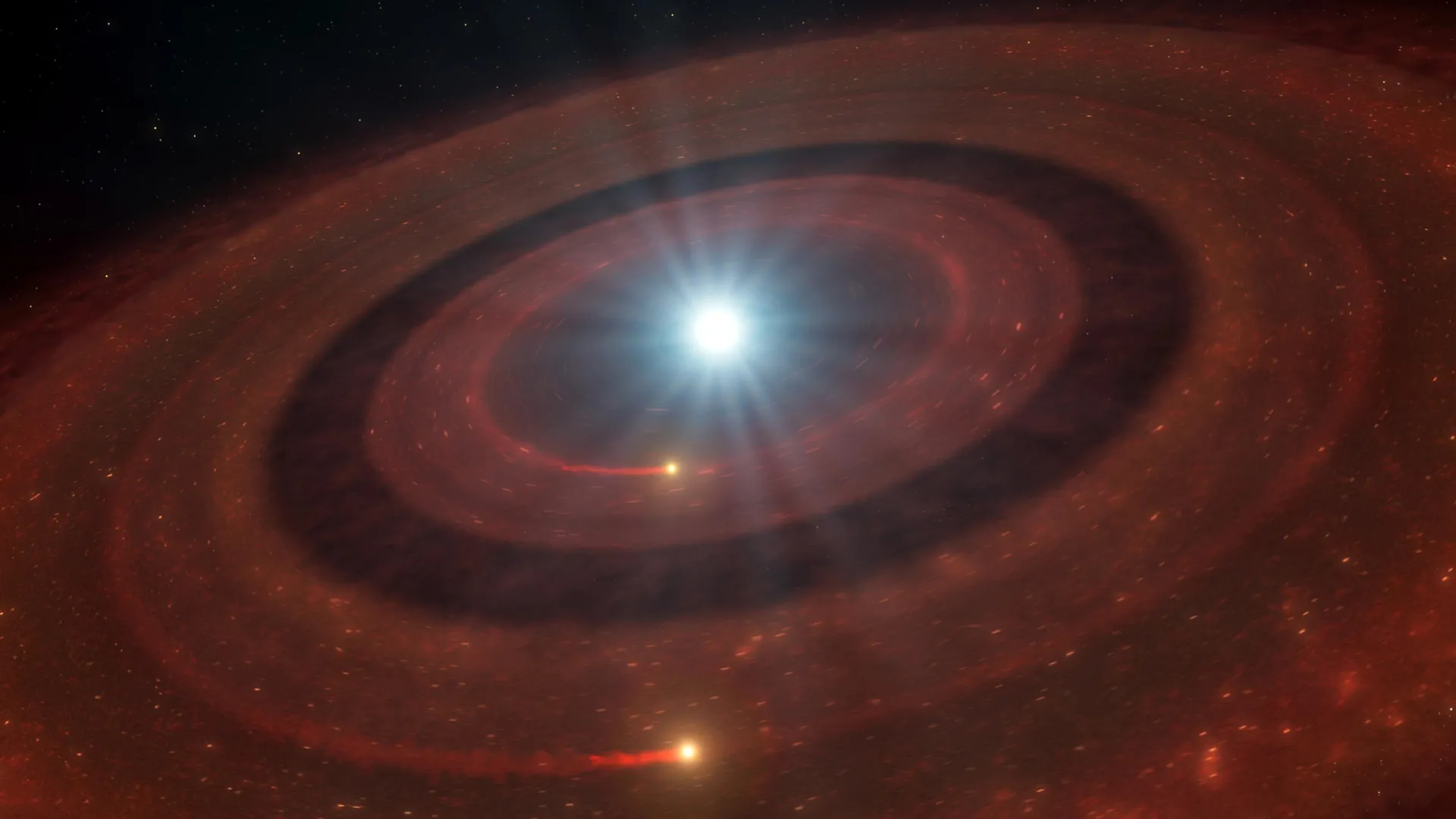
Astronomers have found two distinct rings of planetary debris around a dead star, a structure that may resemble what remains of our own Solar System billions of years from now. The system, called J1328−1450, centers on a white dwarf, the dense remnant left when a Sun-like star sheds its outer layers. The observations were made with the European Southern Observatory's Very Large Telescope and published in Nature Astronomy.
Unlike other debris discs seen around white dwarfs, this one has two concentric rings separated by a clear gap. Researchers believe two surviving planetary bodies, each on its own orbit, may be holding the structure in place.
Possible surviving worlds
The object linked to the inner ring is thought to be a few kilometers across, similar to a typical asteroid. The outer object could be far larger, perhaps the size of Pluto or the Moon. Neither suspected survivor has been directly observed, but their gravitational pull could explain why the debris stays in two rings rather than one continuous disc.
The system therefore offers a remarkable glimpse of what the future of planetary systems, including systems like our own, might look like
— Felipe Lagos-Vilches
Chemical clues in the debris
The rings contain calcium, oxygen, magnesium and iron, elements typical of rocky planetary material. The inner ring holds substantial magnesium gas while the outer ring is largely depleted of it. This suggests the material came from separate planets with different compositions, or from different layers of a single destroyed world.
Lead author Nicola Gentile Fusillo, of the Università degli Studi di Trieste, said the system is "a rare glimpse of the violent, chaotic process" by which a planetary system ends.