A quantum breakthrough makes light behave like both a solid and a liquid
Scientists have observed a bizarre quantum state of matter that combines the structure of a crystal with the frictionless flow of a liquid, all at room temperature. The breakthrough overturns a major practical limitation of exotic quantum experiments and could help bring powerful new light-based computing and sensing technologies closer to reality.
Key points
- Researchers observed a supersolid, a state with crystal-like order and frictionless flow, at room temperature.
- The team used exciton polaritons in liquid-crystal microcavities instead of ultracold atoms.
- The device can be tuned electrically, offering a new platform for quantum photonic research.
An international team has demonstrated a supersolid, a quantum state that combines the ordered structure of a crystal with the frictionless flow of a superfluid, at room temperature. The work was carried out by researchers from the University of Warsaw, the Military University of Technology in Poland, IBM Research Zurich and the French National Centre for Scientific Research (CNRS), and published in Science Advances.
Supersolids were first confirmed experimentally in 2017 in ultracold atomic Bose-Einstein condensates, which typically require cooling to near absolute zero. The new experiment instead used exciton polaritons, hybrid particles formed when light couples strongly with matter inside a microcavity.
How the experiment worked
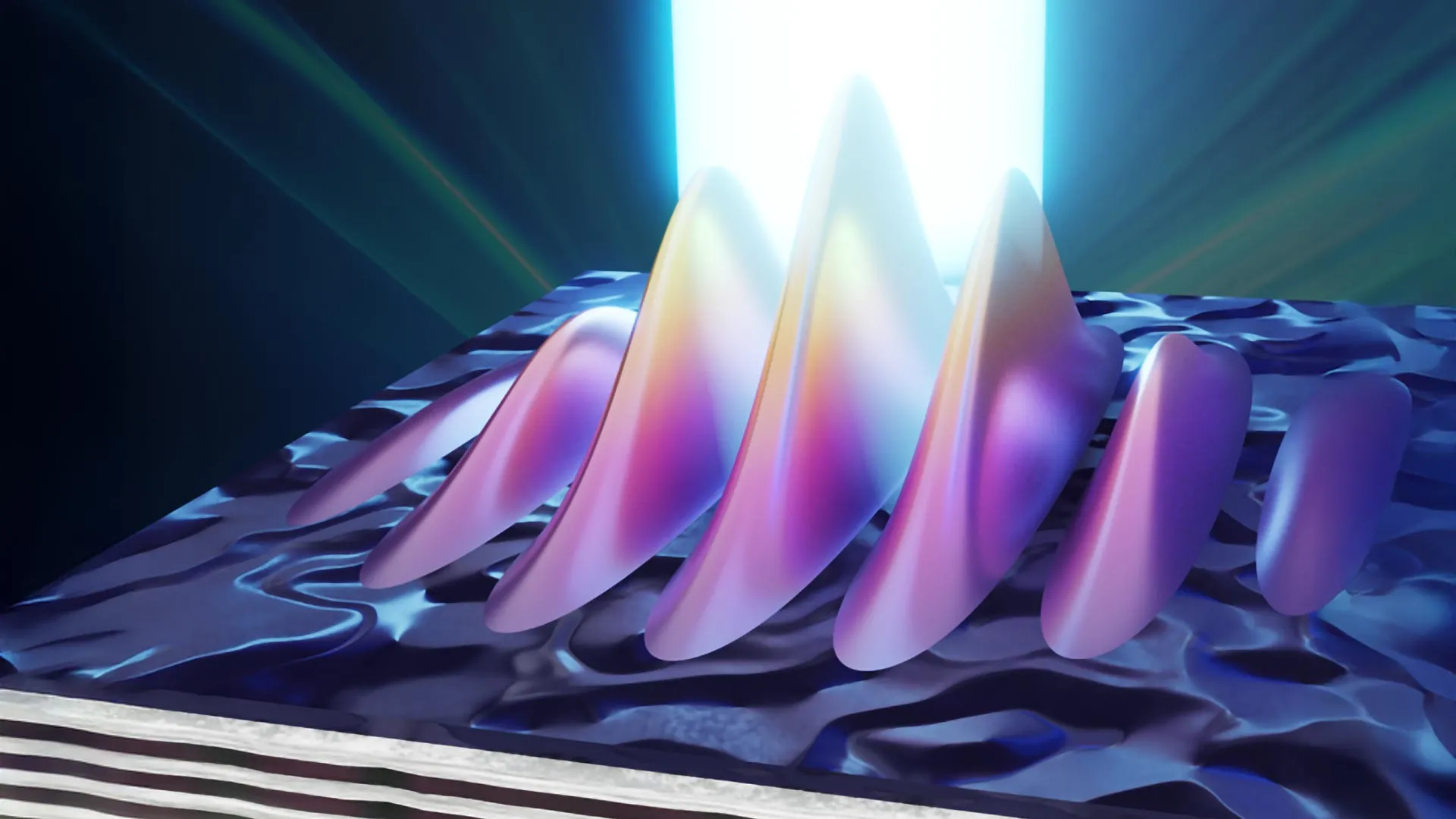
The team built an optical microcavity containing a specially engineered liquid crystal covered with an organic semiconductor. When the system entered the supersolid phase, the emitted light showed regularly spaced bright fringes, indicating a repeating density variation in the condensate.
The fringes appeared in a different position after each laser pulse, which the researchers describe as spontaneous symmetry breaking. The condensate also showed a persistent spin helix, a repeating variation in the polarization of the emitted light.
Our liquid-crystal microcavities can operate even at temperatures approaching 60°C
— Professor Wiktor Piecek
Practical limits and possible uses
The organic semiconductor gradually reacted with the liquid crystal, so samples lasted only a few hours and the team had to plan each measurement sequence in advance. Key measurements were made at IBM Research Zurich on photonic structures manufactured at the Military University of Technology.
According to the article, the results suggest certain exotic quantum effects can be studied in photonic devices at ordinary temperatures. The microcavities also provide the first electrically tunable platform for studying supersolid exciton-polariton condensates, and the authors point to possible future uses in optical computing and sensitive sensors.