A simple touch can bring dying corals back to life in just 7 weeks
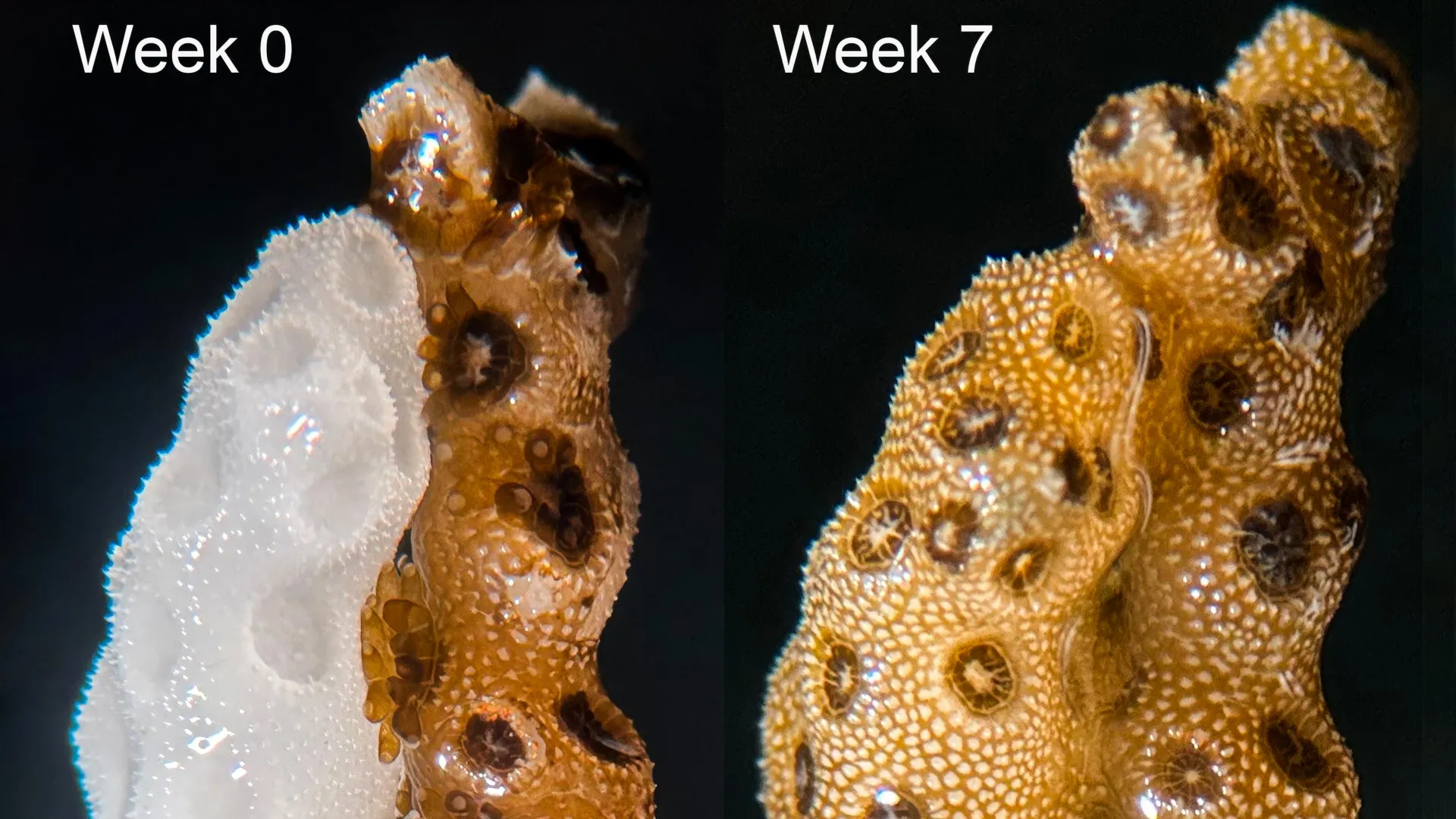
Scientists have discovered that severely bleached corals can make a remarkable comeback simply by touching healthy, genetically identical corals. In laboratory experiments, dying corals regained their color and fully recovered within seven weeks, with as little as five days of contact sometimes enough to start the healing process.
Key points
- Severely bleached corals fully recovered within seven weeks after a few days of contact with healthy clones.
- Touching fragments fused tissues, letting beneficial algae transfer within three days.
- The method needs genetically identical matches, so it cannot yet restore reefs at scale.
Researchers have shown for the first time that severely bleached corals can fully recover after only a few days of contact with healthy, genetically identical corals. In laboratory experiments, corals that had turned white and were near death regained their health within seven weeks, the fastest documented recovery from bleaching, according to a study published October 14 in Science Advances.
The work, from Stanford, could inform new ways to restore coral reefs, which some estimates suggest could vanish within decades as climate change drives more severe marine heat waves. Bleaching happens when warming oceans cause corals to lose the algae living in their tissues that supply much of their energy.
How the experiment worked
The study grew out of a 2025 observation by coauthor Steve Palumbi, who saw a bleached coral fragment regain color where it touched a healthy fragment from the same colony in an aquarium. Lead author Danny Collins then tested 10 pairs of fragments, each with one healthy and one bleached piece from the same coral animal. Five pairs touched; five were separated by gaps of a few millimeters.
Every touching bleached fragment recovered completely within seven weeks, while all the separated ones died. Microscopy showed tiny channels in the tissues lining up to form connections, with algae moving into damaged fragments within three days. One week of contact was enough, and in some cases five days; the algae then multiplied inside the new host, doubling about every four days in the second week, roughly ten times faster than seen in wild corals.
While bleached corals may be dying, they are not dead yet
— Danny Collins
Limits and next steps
The researchers say the approach cannot yet be used to restore reefs on a large scale, because each bleached coral would need a healthy, genetically identical counterpart, which would be impractical to find and supply across whole reefs. Over coming months the team plans to study other ways to deliver beneficial algae to bleached corals without physical contact, such as collecting algae from healthy corals before heat waves and giving large amounts to damaged corals afterward.
What researchers said
Collins said bleached corals may be dying but are not dead yet, and that the team wanted to know what could be done once a coral has bleached. Palumbi compared the tissue fusion to identical-twin organ transplants. Fiorenza Micheli said bleached corals are often seen as a lost cause because recovery after a heat wave is very slow, and said the findings give hope for the future.