Astronomers uncover new secrets of the Universe’s first five minutes
Scientists have achieved a major breakthrough in understanding the Universe’s earliest moments, measuring the amount of helium formed in the first five minutes after the Big Bang with unprecedented precision. Using one of the world’s most powerful telescopes, an international team studied 15 remarkably pristine galaxies that act as cosmic time capsules, preserving clues from nearly 13.8 billion years ago.
Key points
- Researchers measured helium from the Universe's first five minutes with 0.5% uncertainty, three times more precise than before.
- The team observed 15 pristine distant galaxies using 130 hours of Large Binocular Telescope data.
- The measurement lets scientists calculate the number of neutrino families in the early Universe.
An international research team that includes scientists from the University of Minnesota Twin Cities has measured the amount of helium produced in the Universe's first five minutes with unprecedented precision. The findings, presented in five papers in The Astrophysical Journal, are based on 130 hours of observations with the Large Binocular Telescope.
By analyzing distant galaxies, the researchers cut the uncertainty in the measurement to 0.5%, making it three times more precise than earlier estimates. The team says the result offers a clearer picture of conditions shortly after the Big Bang and a new way to test the Standard Model of physics.
How the measurement was made
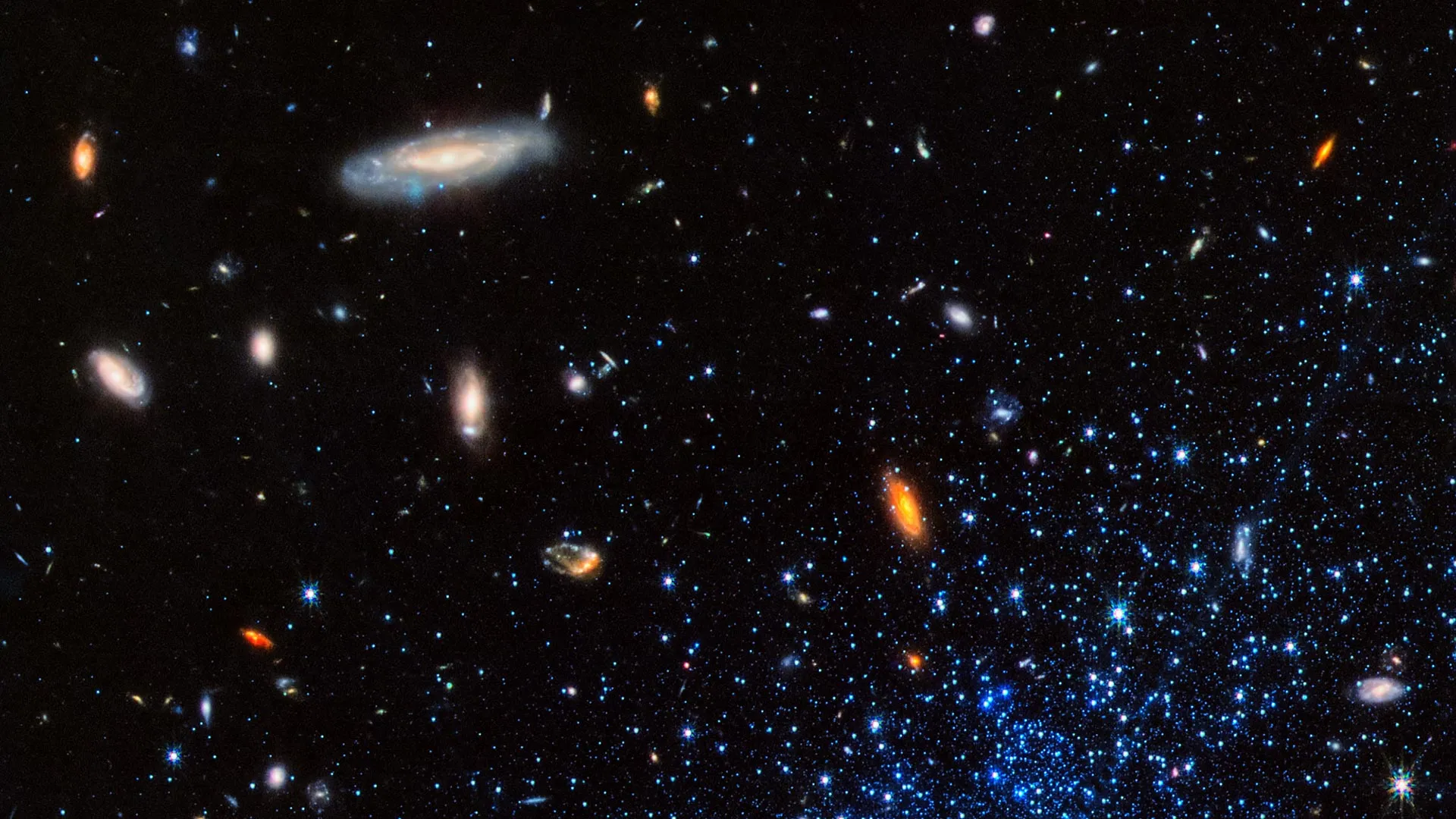
Instead of the usual method of observing many galaxies and extrapolating, the team selected 15 small, distant galaxies that have undergone relatively little chemical evolution. The researchers describe these galaxies as cosmic time capsules holding clues to the Universe's early composition.
The team used spectrographs developed at Ohio State University to examine more than 10 helium spectral lines and 15 hydrogen lines at the same time. Studying the signals together allowed them to identify and correct subtle sources of error that earlier studies could largely overlook.
This is a physics experiment on a grand scale and one of the biggest findings in my entire 40-year career
— Evan Skillman
What the team said
Evan Skillman, a Distinguished Professor at the University of Minnesota, called the work "a physics experiment on a grand scale" and said it was one of the biggest findings in his 40-year career. He added that the team promised a half-percent uncertainty in its proposal and reached it.
Richard Pogge of Ohio State University said the MODS spectrographs took 12 years to build from conception to first light on sky. The collaboration also included Gonzaga University, Northwestern University, The University of Texas at Austin, Indiana University, University of California Santa Cruz, University of Illinois, Universidad Nacional Autónoma de México and TRIUMF.