Large Hadron Collider reveals evidence of Big Bang matter in surprisingly small collisions
Scientists at CERN's Large Hadron Collider have uncovered compelling new evidence that even relatively small atomic collisions can recreate the extraordinary state of matter that filled the universe moments after the Big Bang. Known as quark-gluon plasma, this exotic substance forms at temperatures more than 100,000 times hotter than the center of the Sun, causing ordinary particles to break apart into their…
Key points
- All four major LHC collaborations report signs of quark-gluon plasma in oxygen and neon collisions.
- The results challenge the assumption that only very heavy nuclei can create this primordial matter.
- Researchers detected parton energy loss and other plasma signatures in the smaller collisions.
All four of the Large Hadron Collider's major research collaborations, ALICE, ATLAS, CMS and LHCb, have reported signs that quark-gluon plasma can form when oxygen and neon nuclei collide. The findings come one year after the first-ever oxygen collisions at the LHC and challenge a long-standing assumption about the forces needed to create this extreme matter.
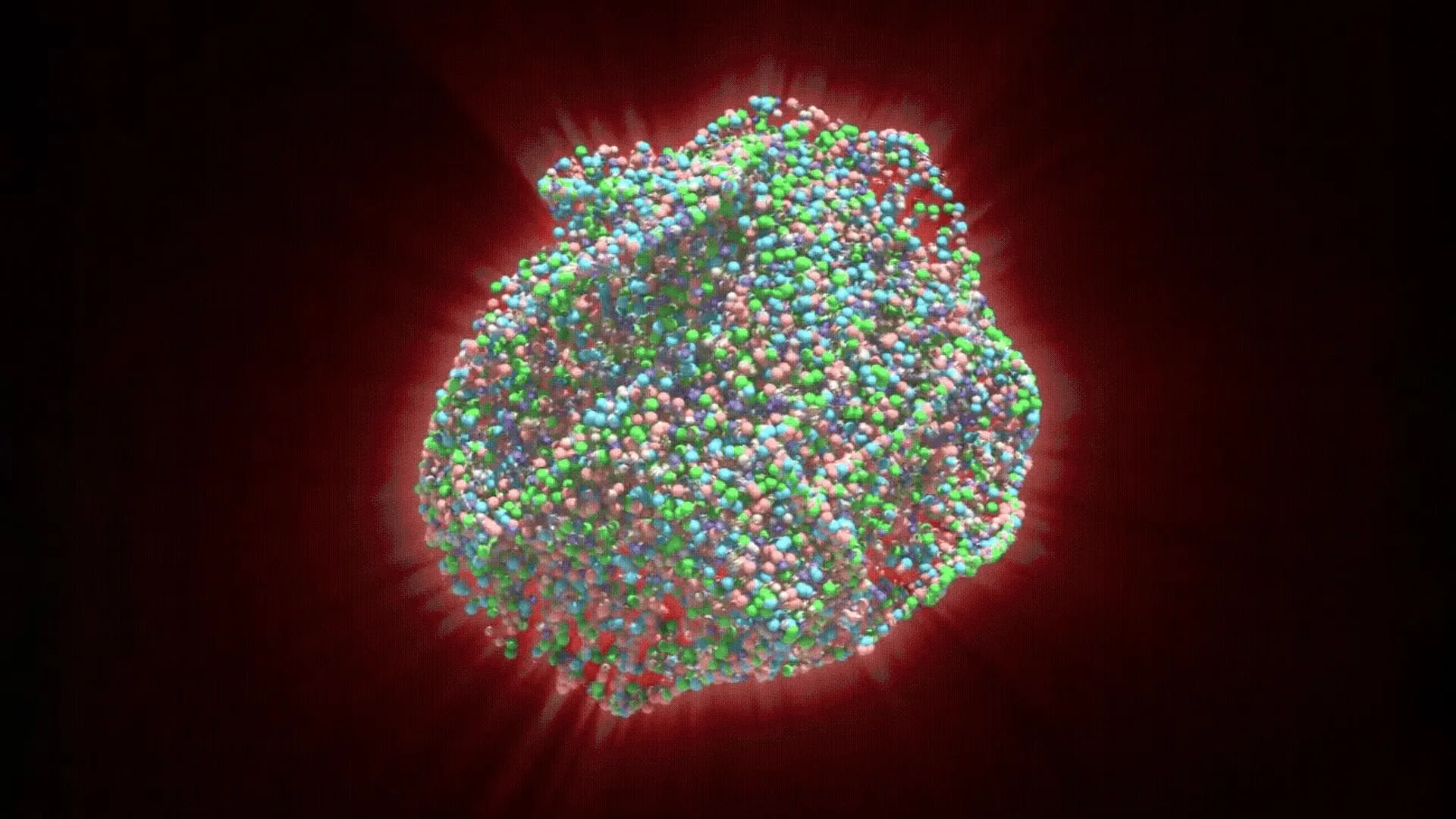
Quark-gluon plasma is a state in which protons and neutrons break apart into quarks and gluons at temperatures more than 100,000 times those at the Sun's center. Physicists believe the universe consisted of this matter in the first millionths of a second after the Big Bang. For decades, scientists thought producing it required collisions of very heavy nuclei, particularly lead, which is more than 200 times heavier than the protons typically used at the LHC.
Signs of energy loss
ATLAS detected parton energy loss, in which energetic quarks and gluons lose energy while passing through hot, dense material, by studying pairs of particle jets in oxygen-oxygen and neon-neon collisions. The effect was especially pronounced in more head-on collisions, which are expected to create a larger volume of plasma.
CMS found charged-particle production was suppressed in oxygen-oxygen and neon-neon collisions compared with proton-proton collisions. LHCb reported that suppression of particles containing a charm quark was more pronounced in the heavier neon collisions, behavior scientists would expect if larger collisions produce more plasma.
The findings are reshaping the understanding of the conditions needed to produce one of the most extreme states of matter known to physics.
— ScienceDaily
Other plasma signatures
ALICE compared neutral pion production in oxygen-oxygen and proton-oxygen collisions and reported unambiguous evidence of parton energy loss in oxygen-oxygen collisions. CMS found evidence of varying suppression in upsilon mesons, and LHCb reported preliminary evidence of similar behavior.
ALICE also reported preliminary findings that baryons showed a stronger preference for certain directions than mesons in oxygen-oxygen collisions, a pattern known as anisotropic flow that is explained by quark-gluon plasma formation. CERN is meanwhile upgrading the LHC into the more powerful High-Luminosity LHC to collect more collision data.