NASA’s Webb reveals the wild weather of a mysterious world 20 light-years away
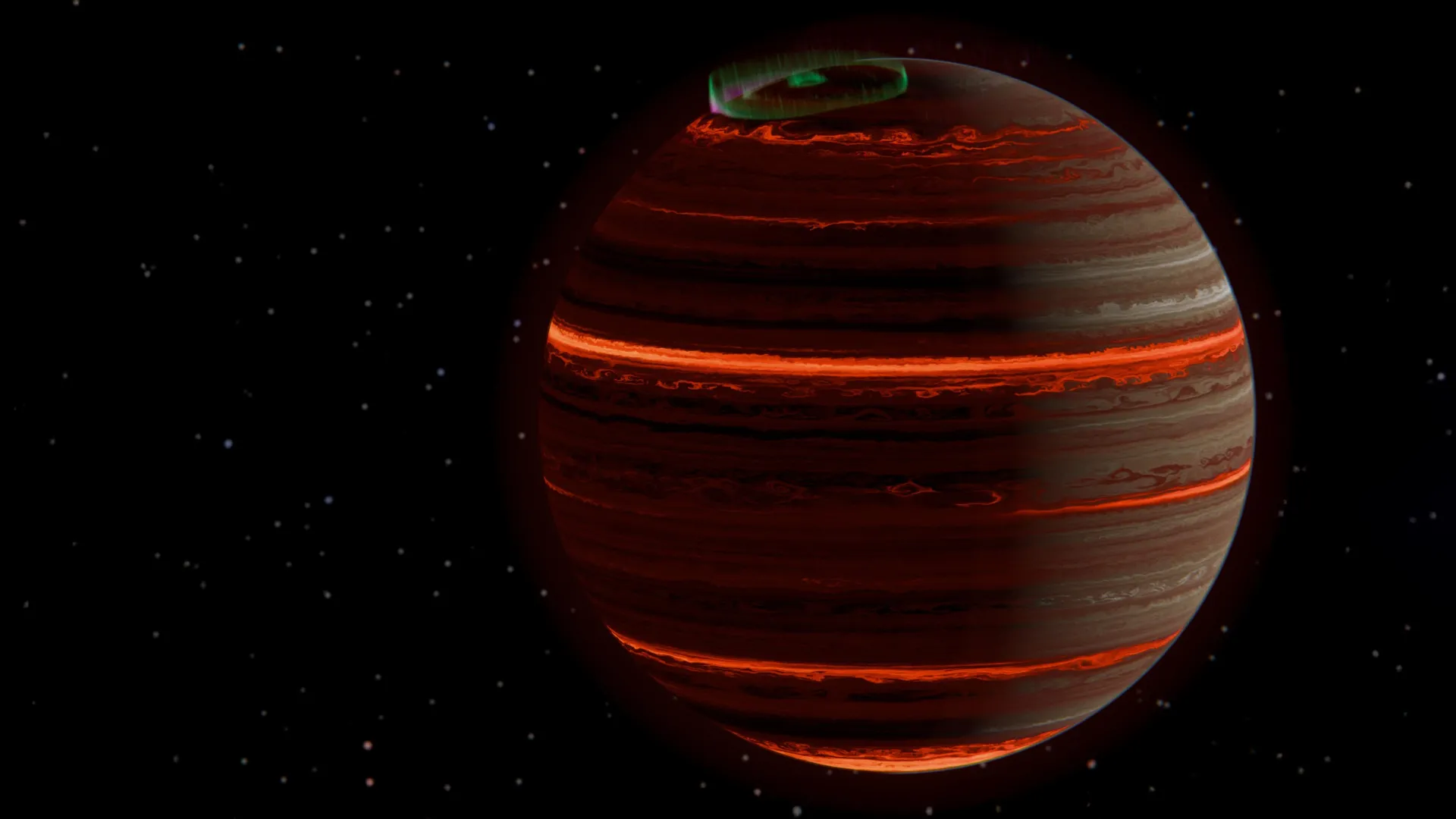
NASA’s James Webb Space Telescope has revealed that a turbulent world 20 light-years away has a surprisingly orderly weather system, with three recurring atmospheric states driven by temperature changes and shifting clouds. The breakthrough gives scientists a powerful new tool for uncovering weather patterns on distant worlds and understanding the conditions that shape their atmospheres.
Key points
- Researchers used JWST data and Principal Component Analysis to study the brown dwarf SIMP 0136, 20 light-years away.
- Nearly all atmospheric variability was explained by temperature changes and the vertical structure of clouds.
- The team identified three recurring weather states that appear and disappear as the object rotates.
Researchers at Trinity College Dublin have used NASA's James Webb Space Telescope to study the atmosphere of SIMP 0136, a brown dwarf about 20 light-years from Earth. The findings, published in Astronomy & Astrophysics, show that its complex weather is largely governed by two factors: temperature changes and the vertical structure of its clouds.
The team analyzed how the object's light changed as it rotated, using a mathematical technique called Principal Component Analysis to identify the strongest patterns in the data. Webb's sensitive instruments detected extremely small brightness changes as different parts of the atmosphere came into view.
Three recurring weather states
Although SIMP 0136's atmosphere appears highly complicated, nearly all of its observed variability could be explained by just two dominant components, consistent with temperature fluctuations and changes in cloud arrangement. The researchers also identified three recurring weather states that appear and disappear from view as the brown dwarf rotates.
Some regions are hotter with thinner clouds, while others are cooler with thicker cloud layers extending farther vertically. The patterns appear to follow an underlying structure rather than changing unpredictably.
We also discovered that these drivers of the weather patterns on SIMP-0136 persist over time, even as the detailed appearance of the atmosphere evolves over more than a dozen rotations
— Merle Schrader
What the researchers said
First author Merle Schrader, a PhD candidate in Trinity's School of Physics, said the drivers of the weather patterns persist over time, even as the atmosphere's detailed appearance evolves over more than a dozen rotations. She noted that light captured by Webb in 2023 had left the brown dwarf around the year she was born.
Professor Johanna Vos, Associate Professor in Trinity School of Physics, said the approach rapidly identifies the dominant components of the atmosphere and offers an efficient first step before computationally intensive modeling. The team says the technique could be applied to other brown dwarfs and giant exoplanets.