A 2,700-year-old solar eclipse just revealed something surprising about Earth
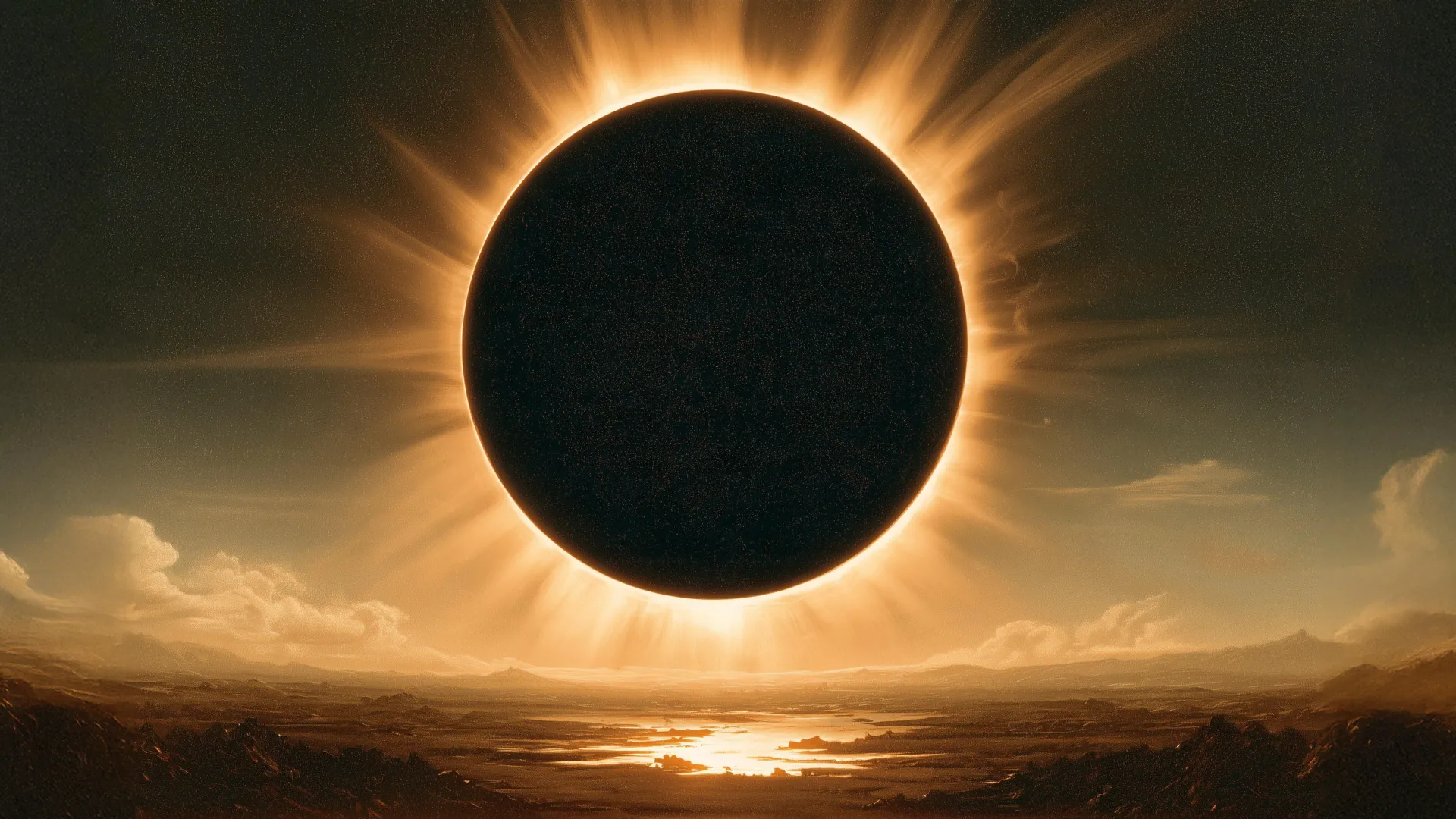
A solar eclipse recorded more than 2,700 years ago is revealing surprising secrets about Earth's rotation and the Sun's ancient behavior. By correcting an eight-kilometer error in the location of an ancient Chinese capital, scientists were able to reconstruct a total solar eclipse that occurred in 709 BCE and obtain more accurate measurements of how fast Earth was spinning at the time.
Key points
- Researchers corrected ancient Qufu's location by about eight kilometers to reconstruct the 709 BCE eclipse.
- The corrected position improved estimates of Earth's rotation speed during the eighth to sixth centuries BCE.
- A later Chinese text may describe the solar corona, suggesting the Sun was resuming regular activity cycles.
An international research team has re-examined a 2,700-year-old record of a total solar eclipse, using it to refine knowledge of Earth's rotation and the Sun's activity. The eclipse occurred on July 17, 709 BCE and was observed at the court of the Lu Duchy in ancient China. The findings were published in Astrophysical Journal Letters.
The team reconstructed how the eclipse would have appeared from Qufu, the Lu capital. Initial calculations conflicted with the historical record, but researchers traced the problem to an error in the city's assumed coordinates. Archaeological and historical geographic evidence showed that ancient Qufu was about eight kilometers from its previously calculated location.
Correcting the Location
Lead author Hisashi Hayakawa of Nagoya University explained that the correction allowed the team to measure Earth's rotation during the eclipse and simulate the corona's appearance. The original account in the Spring and Autumn Annals stated that 'the Sun was totally eclipsed.' A later passage in the Hanshu, written about seven centuries after the event, described the eclipsed Sun as 'completely yellow above and below,' which may refer to the solar corona.
The researchers calculated delta T, a measure of Earth's rotation variation, between 20,264 and 21,204 seconds for the 709 BCE eclipse. Coauthor Mitsuru Sôma of the National Astronomical Observatory of Japan said the new dataset fixes coordinate errors in previous studies and improves the accuracy of dating historical astronomical events.
Some of our ancestors were very skilled observers
— Dr. Meng Jin
Solar Activity and Rotation
Earth rotated slightly faster 2,700 years ago than it does today, partly because of tidal friction from the Moon. The eclipse took place shortly after a period of unusually low solar activity known as the Neo Assyrian Grand Minimum, which lasted from about 808 to 717 BCE. The possible corona description suggests the Sun was returning to a more active phase and may have been near the peak of its 11-year cycle.
Coauthor Mathew Owens of the University of Reading said the addendum is 'critical for providing a spot reference on solar activity reconstructions from tree rings and ice cores.' The interpretation remains uncertain because the corona passage was written centuries after the eclipse.