Smithsonian scientists just recreated the first 2 billion years of the Universe
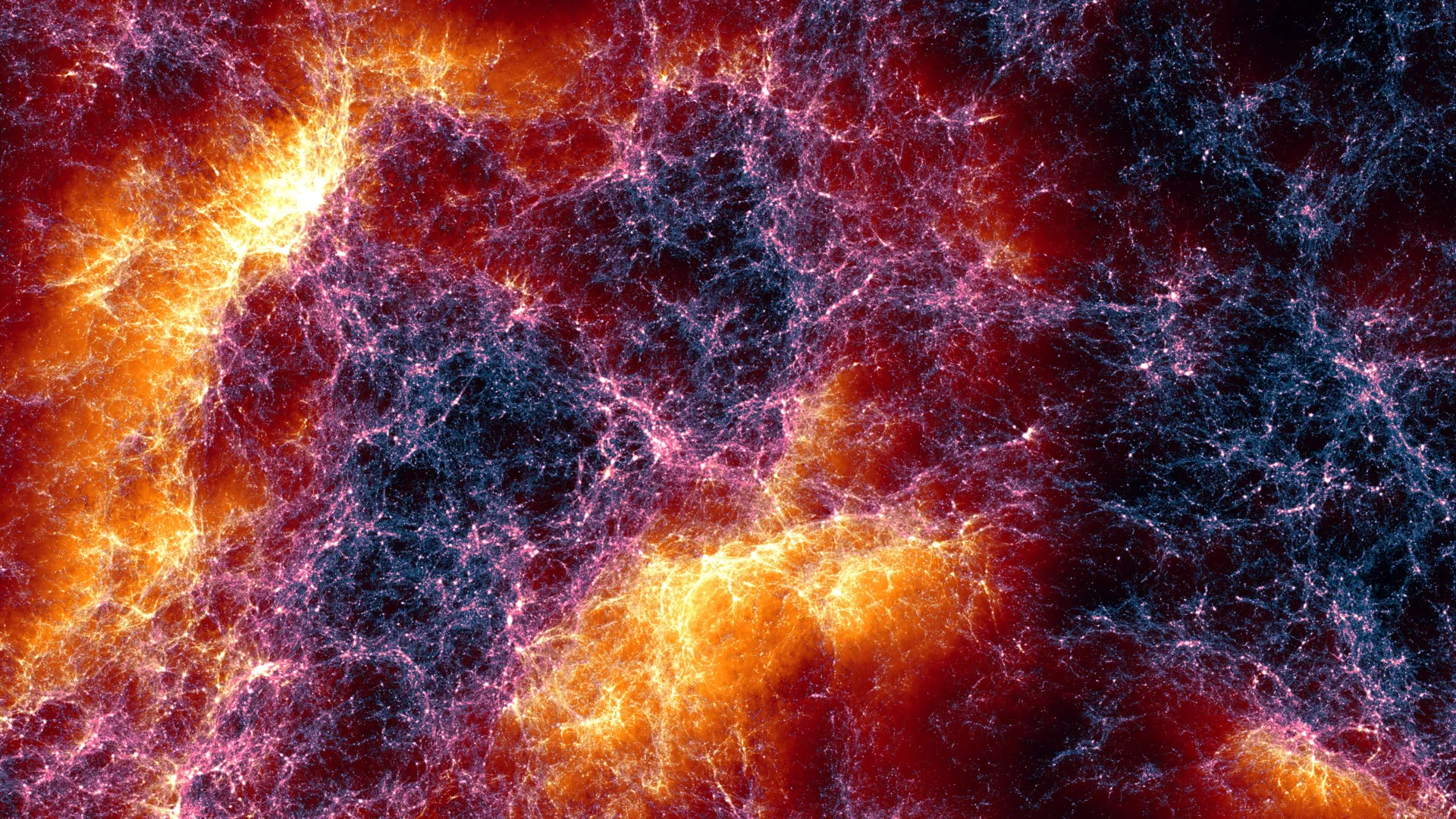
Scientists have created one of the largest and most detailed simulations of the early universe ever made, offering an extraordinary new glimpse into the cosmos shortly after the Big Bang. Called Lumina, the groundbreaking simulation recreates the universe’s first 2 billion years, showing how dark matter, gas, and radiation interacted to give rise to the earliest stars, galaxies, and black holes.
Key points
- Scientists at the Center for Astrophysics | Harvard & Smithsonian have built Lumina, a simulation reconstructing the universe's first 2 billion years.
- Lumina models a cube about 1.5 billion light-years on each side, more than 100 times the volume of earlier comparable projects.
- The team used more than 15,000 graphics processing units on the Frontier supercomputer at Oak Ridge National Laboratory in Tennessee.
Researchers at the Center for Astrophysics | Harvard & Smithsonian have built one of the largest and most detailed simulations of the early universe, named Lumina. The work, published in Monthly Notices of the Royal Astronomical Society, reconstructs the first 2 billion years after the Big Bang by modeling how ordinary matter, dark matter and radiation interacted.
Scientists say Lumina is meant to help astronomers interpret observations from the James Webb Space Telescope, the Nancy Roman Space Telescope and other instruments. Comparing its predictions with real telescope data lets researchers test how well current theories explain cosmic evolution and spot findings that may challenge them.
Scale and computing power
Lumina is described as the largest cosmological radiation hydrodynamics simulation ever produced. It covers a volume more than 100 times larger than earlier comparable projects, spanning a cube roughly 1.5 billion light-years on each side.
To run it, the team used more than 15,000 graphics processing units on Frontier, one of the world's fastest supercomputers, at Oak Ridge National Laboratory in Tennessee. The researchers say this let them model a vast region while keeping the fine detail needed to study individual galaxies and other structures.
With JWST, the early universe has become an exciting new frontier in astrophysics
— Oliver Zier
Helium reionization modeled
The simulation tracks helium reionization, the process in which radiation strips electrons from helium atoms. According to the article, it is the first simulation of its kind to follow that transformation as it happens while also accounting for its effects on the surrounding universe.
Lead author Oliver Zier, an ITC Fellow at the Center for Astrophysics | Harvard & Smithsonian, said the early universe has become "an exciting new frontier in astrophysics" with JWST. The team plans to use Lumina to study gas movement between galaxies and the emergence of regions with high rates of star formation.