James Webb discovers a scorching lava planet with a “giant sunscreen”
A scorching lava planet 280 light-years away has surprised astronomers by apparently maintaining a thick atmosphere despite conditions that should have stripped it away billions of years ago. James Webb Space Telescope observations suggest that TOI-561 b reflects about 75% of incoming starlight, possibly because of mineral clouds that act like a giant sunscreen. The planet may also be continually replenishing its…
Key points
- Astronomers using the James Webb Space Telescope found evidence that the rocky exoplanet TOI-561 b, about 280 light-years from Earth, may have a substantial atmosphere despite intense stellar radiation.
- The planet appears to reflect roughly 75% of the starlight reaching it, possibly due to a layer of reflective silicate clouds acting as a natural sunscreen.
- Researchers say the planet's molten rock ocean may be constantly releasing gases that replenish its atmosphere, and they hope further JWST observations will reveal its chemical makeup.
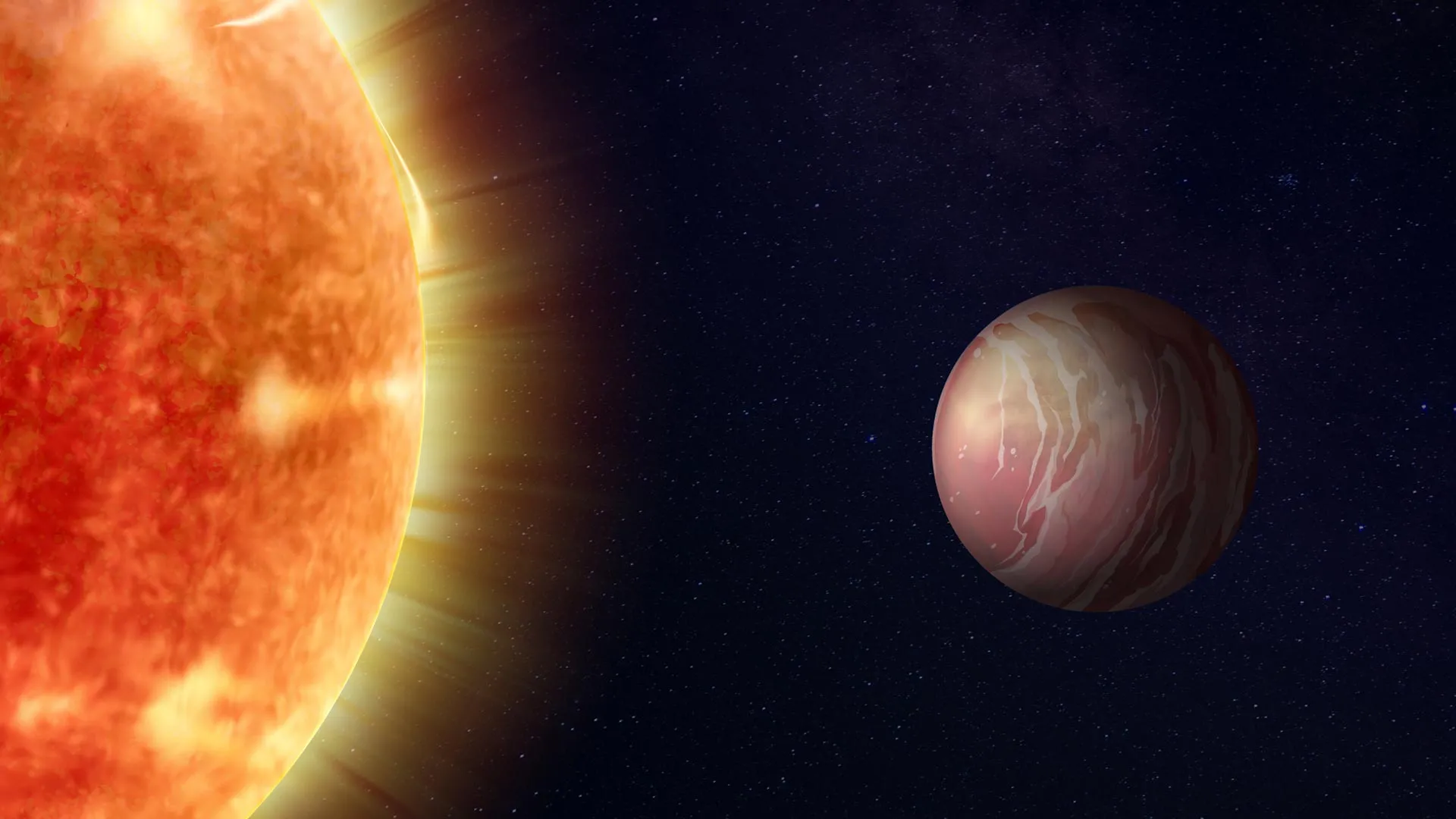
Astronomers have found evidence that a scorching, molten-rock planet about 280 light-years from Earth may be shielded by a reflective layer of clouds that works like a giant sunscreen. An international team, including Dr. Anjali Piette of the University of Birmingham, reported the findings in The Astronomical Journal after using the James Webb Space Telescope to monitor the exoplanet TOI-561 b for 37 hours, covering nearly four complete orbits around its host star.
The observations suggest TOI-561 b may have a substantial atmosphere, even though its conditions would be far too hostile for life as we know it. Scientists had previously thought the planet's extreme conditions would make an atmosphere nearly impossible.
Why the planet is so reflective
Earlier measurements showed the planet's dayside was cooler than predicted for a dark rocky world orbiting so close to its star. The team examined the nightside for the first time and found it was not warm enough to account for all the missing heat.
The findings indicate TOI-561 b reflects about 75% of the starlight reaching it, a proportion comparable to Venus. Computer models suggest clouds containing silicate minerals such as silicon dioxide and magnesium silicate may form over the dayside and reflect radiation before it reaches the surface.
Our discovery challenges current theories.
— Dr. Anjali Piette
What researchers said
Dr. Anjali Piette, Assistant Professor in Astronomy at the University of Birmingham, said the discovery challenges current theories, since a heavily irradiated rocky planet like TOI-561 b would be expected to have lost its atmosphere billions of years ago. She said the evidence suggests it still has a significant atmosphere today.
Professor Lisa Dang, who led the project at the University of Waterloo in Ontario, Canada, said the team measured how the planet's brightness and heat changed throughout its orbit. Researchers now hope to learn whether TOI-561 b is more like an extremely hot Venus or an intense version of the volcanic moon Io, and plan further JWST observations at longer wavelengths.