A forgotten fossil reveals a fearsome dinosaur with giant claws
A 120-million-year-old fossil forgotten in a museum for nearly a century has revealed a terrifying new dinosaur that may have been more dangerous to humans than a T. rex. The tiger-sized predator also provides the first evidence of megaraptorans in Europe, helping explain how these mysterious dinosaurs eventually became gigantic hunters.
Key points
- A fossil skull fragment found on the Isle of Wight and stored at the Natural History Museum since 1924 has been identified as a new dinosaur species, Invictibellatrix amberina.
- The dinosaur was a megaraptoran about the size of a large tiger, living roughly 120 million years ago in what is now Britain.
- The discovery provides the first evidence that megaraptorans were present in Europe, supporting a migration route from Asia through Europe to Gondwana.
Researchers led by University College London have identified a new dinosaur species from a fossil skull fragment found on the Isle of Wight. The specimen, acquired by the Natural History Museum in 1924, had been overlooked for nearly a century. The findings were published in the journal Royal Society Open Science.
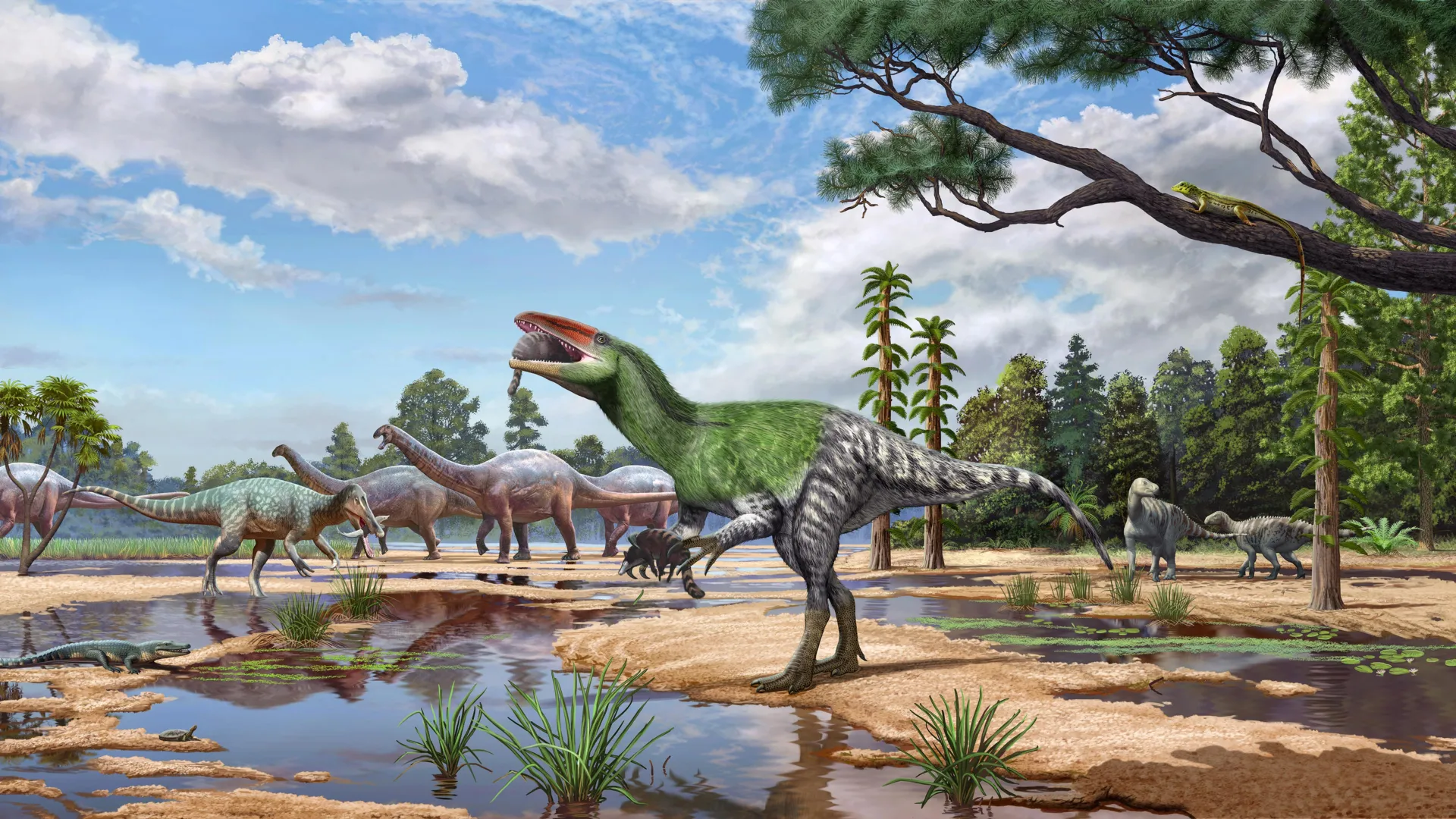
The dinosaur, named Invictibellatrix amberina, lived about 120 million years ago and was roughly the size of a large tiger. It belonged to a group of carnivorous dinosaurs called megaraptorans, which were closely related to tyrannosaurs but had narrow skulls, powerful arms, and large curved claws.
What the researchers found
Lead author Dr. Cassius Morrison said the dinosaur would have been three to four meters long and just over a meter and a half tall. It likely had feathers and claws about 10cm to 20cm long, and would have preyed on small dinosaurs, lizards, and mammals.
Morrison noted that while not the apex predator of its time, it would have been more dangerous to humans than a T. rex, as humans would have been perfectly sized prey. The fossil was originally collected by amateur paleontologist Reginald Walter Tooley and later acquired by the Natural History Museum.
It is a real mystery that this fossil was overlooked for so long, sitting in a drawer for nearly 100 years.
— Dr. Cassius Morrison
Evolutionary significance
The discovery fills a gap in megaraptoran evolution. Until now, no megaraptoran fossils had been identified in Europe. Co-author Charlie Scherer said the new species is the first proof that megaraptorans were present in Europe and reached Gondwana via this route.
The team used CT scanning to create a 3D reconstruction of the skull fragment and compared its anatomy with other carnivorous dinosaurs. Mathematical models suggest megaraptorans were widespread during the Early Cretaceous but disappeared from northern regions by the Late Cretaceous, while continuing to evolve in Gondwana.