New evidence suggests spinosaurus spent most of its life underwater
Millions of years after animals first conquered land, some took an extraordinary evolutionary U-turn and returned to the water. Using machine learning and thousands of fossil measurements, Yale scientists have uncovered surprising clues about which prehistoric creatures truly became aquatic. Their findings suggest that Spinosaurus spent most of its life underwater, while some ancient marine reptiles previously…
Key points
- A Yale University study published in Current Biology used machine learning and fossil data to reconstruct how ancient animals returned to aquatic life.
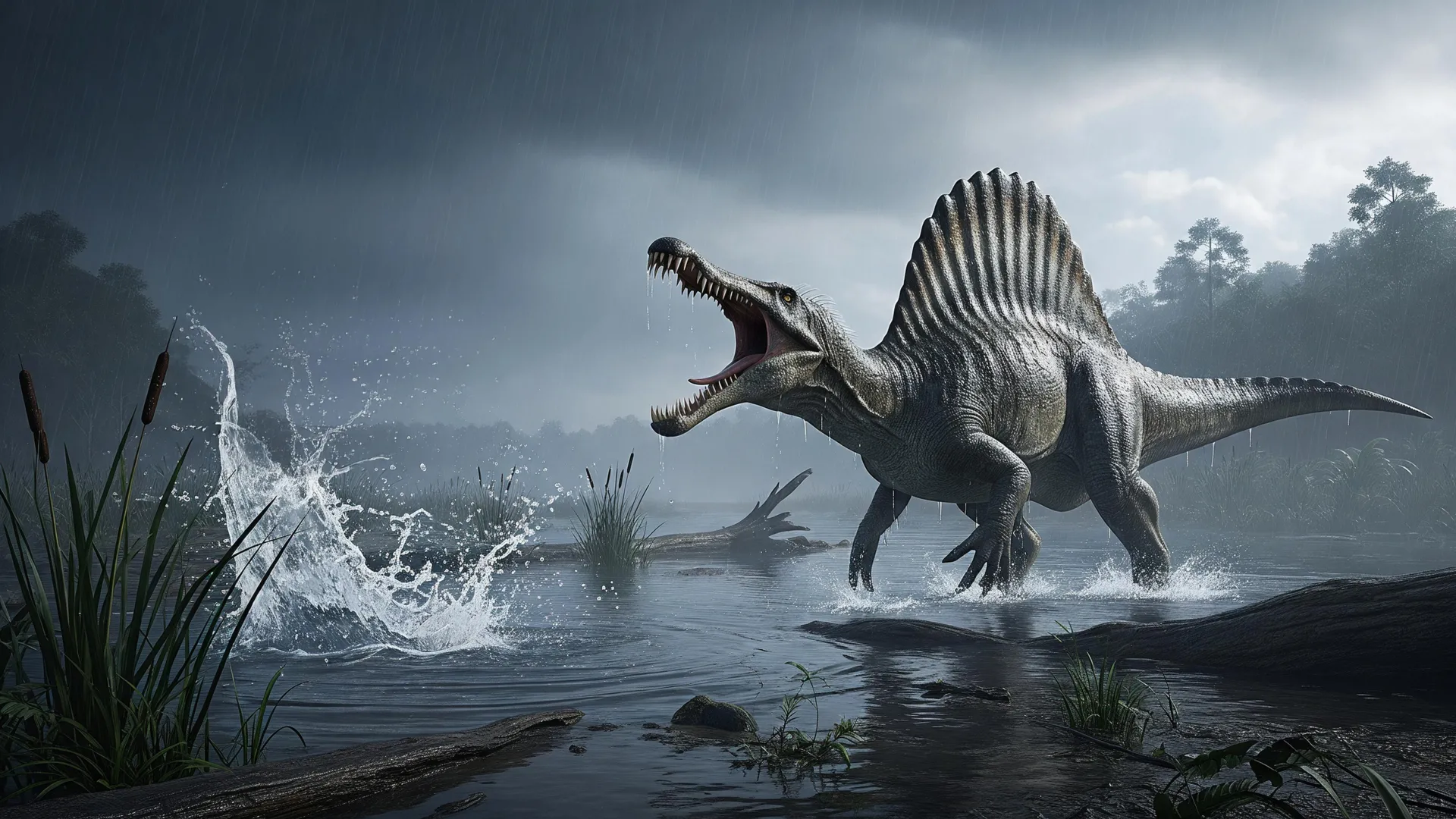
- The analysis found that Spinosaurus spent the vast majority of its time submerged in water, supporting the underwater hunting view.
- Mesosaurs, small marine reptiles from 290 million to 274 million years ago, regularly moved between water and land rather than living fully aquatically.
A new Yale University study published in Current Biology examined how dozens of major groups of mammals and reptiles returned from land to water over millions of years. The researchers combined traditional paleontological techniques with machine learning models trained on living animals to estimate how extinct species used aquatic environments.
The team examined hundreds of fossil and modern specimens from the Yale Peabody Museum and dozens of other institutions worldwide, collecting more than 11,000 measurements along with photographs and CT scans. The models could predict with more than 90% accuracy whether an animal had soft tissue flippers and highly or fully aquatic habits.
Findings on Spinosaurus and mesosaurs
The study found that Spinosaurus, which lived approximately 113 million to 94 million years ago in what is now northern Africa, spent the vast majority of its time submerged in water. The researchers said this supports the view that the giant predator hunted underwater rather than behaving like a modern heron along shorelines.
A different result emerged for mesosaurs, small marine reptiles that lived between 290 million and 274 million years ago in regions now forming parts of South Africa and eastern South America. Their skeletal proportions suggest they regularly moved between aquatic and terrestrial environments, and the researchers said all Paleozoic marine reptiles continued to return to land regularly.
We confidently recovered highly aquatic habits for Spinosaurus, indicating that it spent the vast majority of its time submerged in the water.
— Caleb Gordon
How the methods worked
The team adapted a statistical technique developed during World War II to estimate the probability that an approaching radar blip was an enemy plane, using it to assess whether an extinct animal had limbs modified for swimming. The researchers said the method removes subjectivity from interpreting skeletal remains and could later be applied to other evolutionary changes, such as when human ancestors developed bipedal walking or how bird ancestors evolved flight.