Scientists discover a hidden messaging system deep inside the brain
A tiny region deep within the brain has surprised scientists by revealing a remarkably sophisticated communication system. Previously thought to broadcast the same chemical signal throughout the brain, this region actually sends targeted messages that help control learning, attention, and behavior, according to new research in mice.
Key points
- Researchers at the Allen Institute found the locus coeruleus sends norepinephrine through distinct pathways rather than broadcasting one signal.
- Dorsal neurons connecting to the cortex were active during learning, while ventral neurons governed engagement with the environment.
- LC axons averaged about 35 centimeters, with one reconstructed at 70.32 centimeters, among the longest measured in a mouse.
A study published in Nature challenges the long-held view that a small brainstem region called the locus coeruleus sends the same norepinephrine signal across the brain. Researchers at the Allen Institute used brain imaging, neural recordings, genetic techniques and behavioral experiments in mice to show the region communicates through several distinct pathways to specific destinations.
The locus coeruleus, whose name comes from Latin words for "blue place," contains only a small fraction of the brain's neurons but produces norepinephrine, a chemical messenger involved in attention, learning, heart rate and responses to stress and excitement.
How the pathways are organized
Neurons in the upper, or dorsal, portion of the locus coeruleus mainly connect to the cerebral cortex and forebrain. Cells in the lower, or ventral, portion send signals mainly to the brainstem and spinal cord, allowing different parts of the region to influence separate brain functions.
Karel Svoboda, director of Neural Dynamics at the Allen Institute and a study co-author, said the findings suggest the system is "far more like a targeted postal network than a foghorn."
The findings suggest the brain's norepinephrine system is far more like a targeted postal network than a foghorn
— Karel Svoboda
Learning and cell structure
Dorsal cells connecting to the cortex were particularly active during learning, rising in activity when mice adjusted choices after an unfavorable result. Ventral neurons became more active shortly before mice ignored signals that a reward might be available.
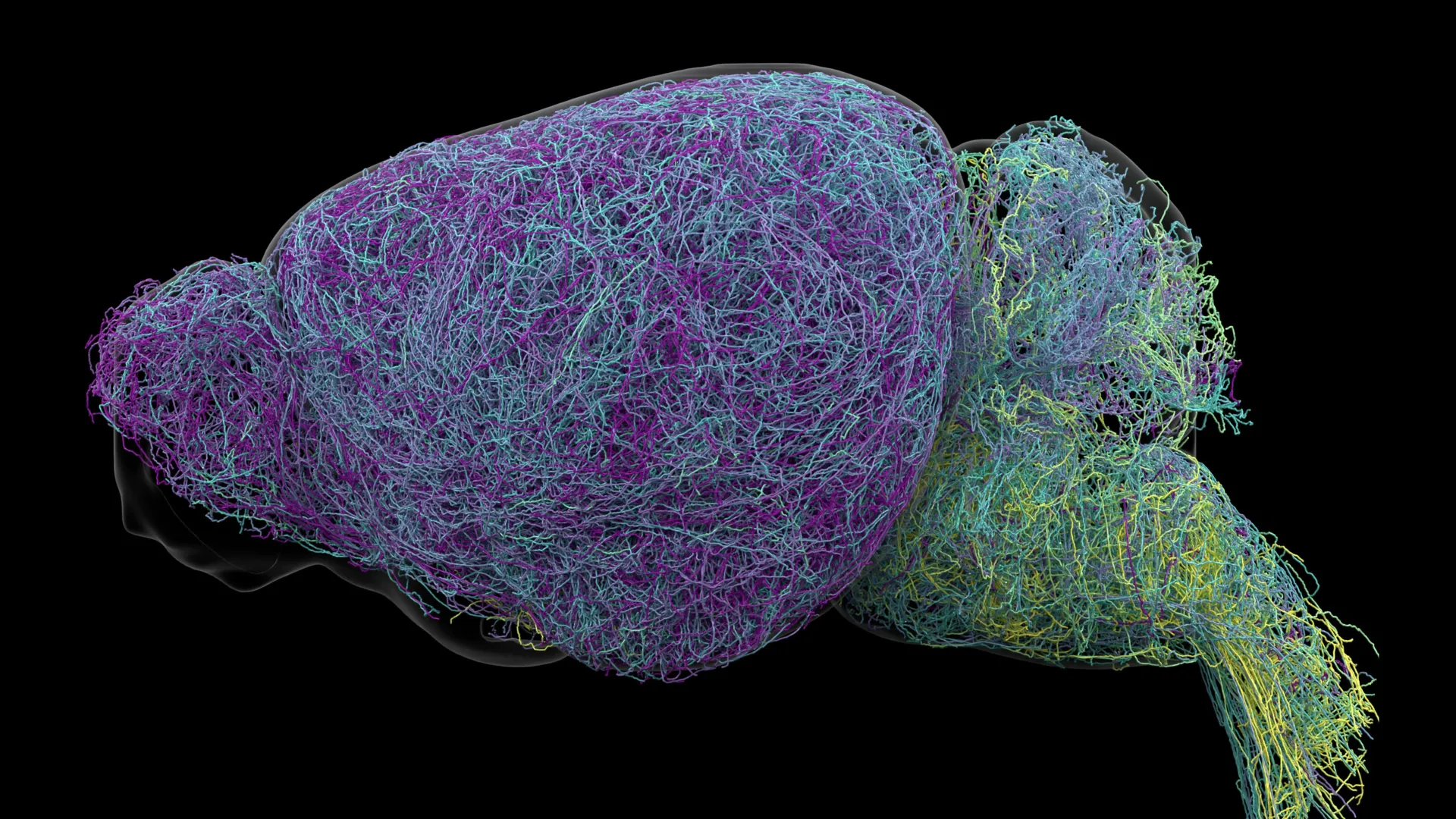
The team imaged nearly 35,000 neurons, analyzed genetic profiles of almost 400,000 cells and reconstructed several complex nerve cells. LC axons averaged about 35 centimeters, and one measured 70.32 centimeters in total reconstructed length, making it part of the longest single neuron ever measured in a mouse.
The research was supported by the National Institutes of Health's BRAIN Initiative. The authors say the mouse findings could eventually help scientists understand human brain function and design treatments targeting specific circuits.