Scientists discover mysterious seahorse lookalikes that no one has ever seen alive
Scientists have discovered that three bizarre deep-sea fish that look exactly like seahorses actually belong to a separate evolutionary group, proving that nature created the same unusual body shape more than once. Nicknamed "sea muppets," these elusive creatures are known from just seven specimens, and no one has ever seen one alive.
Key points
- Researchers identified a new fish genus, Australyichthys, after micro-CT scans showed its skeleton differs from true seahorses.
- The genus is known from just seven specimens collected over about 65 years across more than 2,500 kilometers of southern Australian coastline.
- No specimen has ever been seen alive, and the fish are now classed as lost species and a priority for targeted surveys.
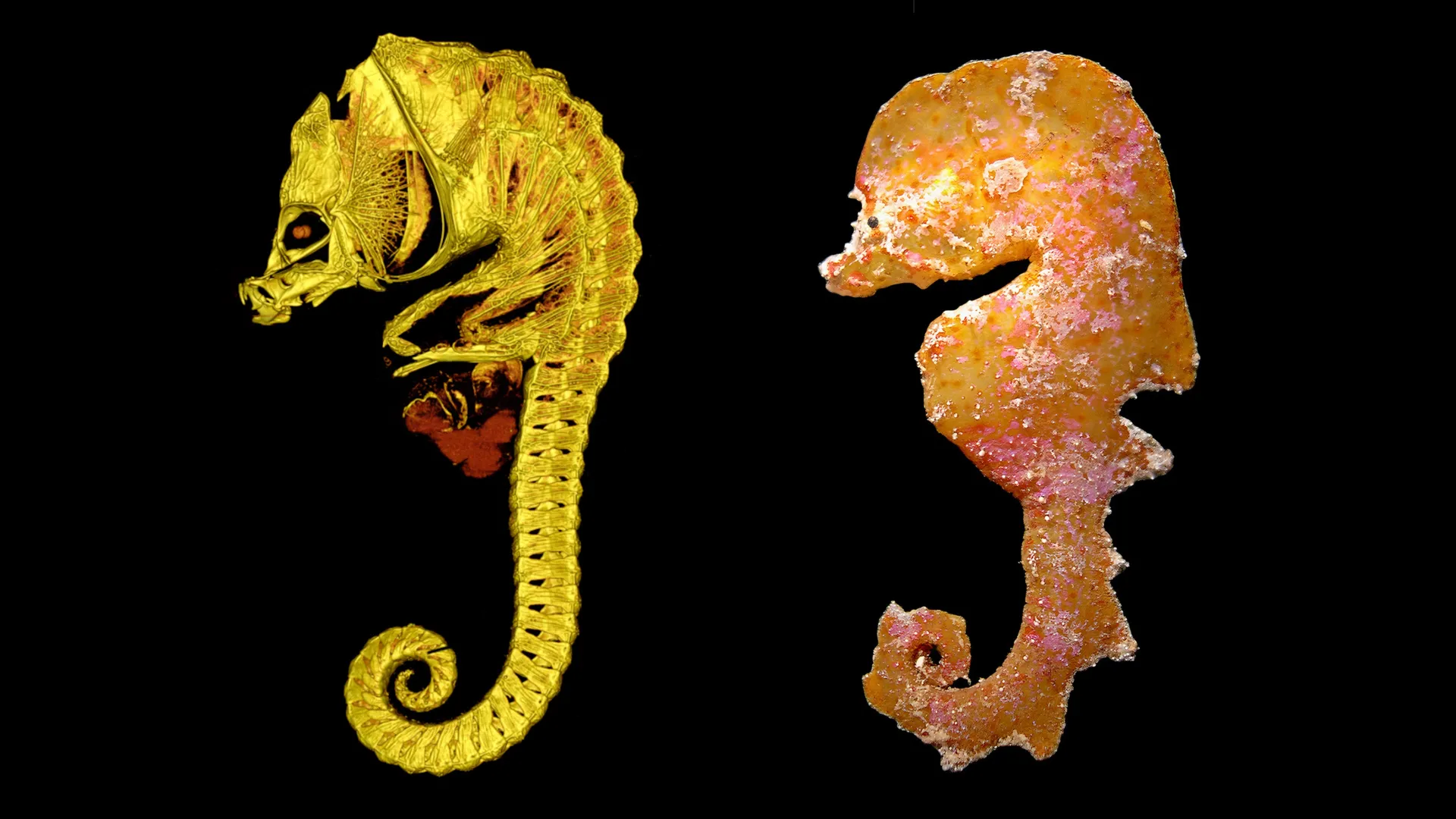
Scientists have described a new fish from deep reefs off southern Australia that looks like a seahorse but is not one. The fish, no longer than a thumb, is named Australyichthys aegis, with the common name helmethead sea muppet, after the domed crest on its head. The findings were published in the Journal of Lost Species.
The fish belongs to a small group nicknamed the sea muppets, alongside the bullneck sea muppet (A. minotaur) and the paradoxical sea muppet (A. paradoxus). The study places all three on their own branch of the family tree, separate from true seahorses.
Museum specimens and scanning
Every known specimen was caught by accident in trawl nets or dredges working the seafloor between about 50 and 125 meters down. The only A. aegis specimen was collected in 2006 near the Gambier Islands, at the mouth of South Australia's Spencer Gulf, and was misfiled in the invertebrate collection of the South Australian Museum.
Because the specimens are irreplaceable, the researchers used micro-CT scanning to build three-dimensional models of each skeleton and compare them bone by bone with true seahorses. The scans showed Australyichthys lacks the fused bony belly cage and the bony head crown found in seahorses. Genetic sequencing of the ethanol-preserved A. aegis placed it outside the seahorses, on the branch that is their closest relative.
No one has ever seen one of these fish alive; they have turned up only by chance in a passing net or dredge.
— the study authors
Never seen alive
The genus is known from just seven specimens gathered over about 65 years, scattered across more than 2,500 kilometers of coastline, and nothing has been collected in nearly two decades. No one has ever seen one of these fish alive.
The authors say calling them lost is not a prediction of extinction but marks them as a priority for targeted surveys. They are most likely still in a part of the sea that is rarely visited.