SLAC scientists find conclusive proof of a mysterious third type of magnetism
For nearly 90 years, scientists believed magnetism fell into just two categories, but researchers have now confirmed a remarkable third type called altermagnetism. Using specialized X-rays, they uncovered a unique magnetic signature that proves these materials behave differently from conventional magnets. Altermagnets combine stability with the ability to efficiently carry information, potentially overcoming major…
Key points
- SLAC-led researchers say they have confirmed altermagnetism, a third type of magnetism, in manganese telluride.
- The team found a chiral signature in the material using polarized X-rays at the ESRF in France.
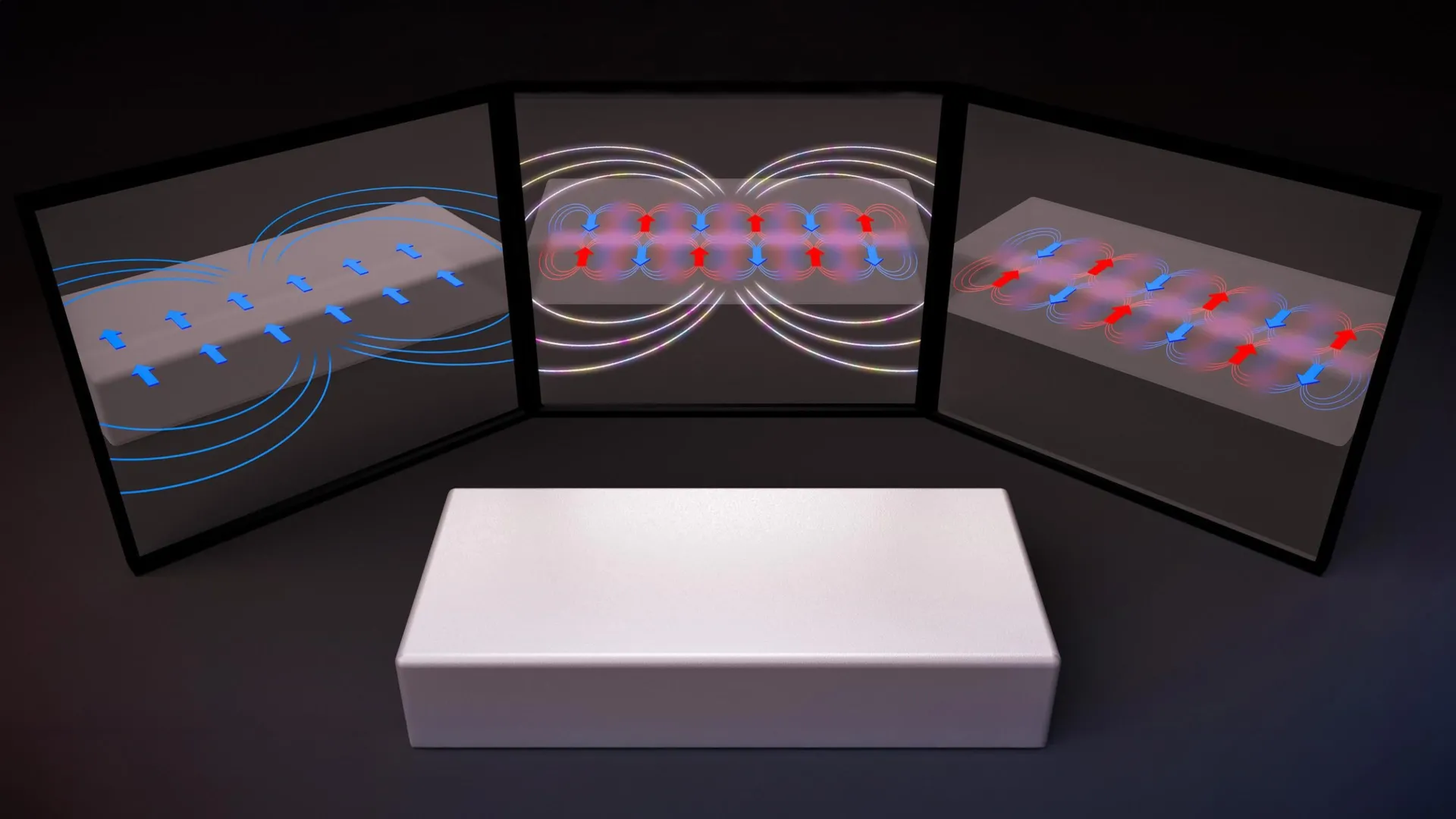
- Altermagnets could aid spintronics because they have no net magnetization but can carry spin-polarized currents.
Scientists led by the U.S. Department of Energy's SLAC National Accelerator Laboratory say they have found experimental confirmation of altermagnetism, a third form of magnetism distinct from ferromagnets and antiferromagnets. The study was published in Science.
The team studied manganese telluride (MnTe), long classified as an antiferromagnet, and found direct evidence of chirality, an asymmetry in its magnetic structure that serves as a signature of altermagnetism. The work was done at the European Synchrotron Radiation Facility (ESRF) in France.
How the evidence was found
At the ESRF's ID32 beamline, researchers used circularly polarized X-rays, whose electric fields rotate in left-handed or right-handed directions, and measured how the material scattered each form of light. Lead author Daniel Jost said chiral materials scatter the two beams differently while non-chiral materials would scatter them the same way.
The experiment showed a clear difference in how manganese telluride interacted with the two polarizations. The team first ran the experiment in 2024 and repeated it in early 2025, reproducing the results.
This chiral signature gave us the solid experimental ground to say altermagnetism stands in a class of its own
— Daniel Jost
Possible use in computing
The finding could matter for spintronics, which uses electron spin as well as charge to handle information. Jost said ferromagnets are too easily affected by magnetic fields, while antiferromagnets are hard to read, and that altermagnets combine the best of both.
Researchers say the next step is learning to control altermagnetic states with light and electricity. The work received partial funding from the DOE Office of Science.