Three giant black holes discovered in a galaxy from the dawn of time
Astronomers have discovered three actively feeding black holes inside a single galaxy more than 12.5 billion light-years away, revealing a remarkable scene from the universe’s infancy. Two of the black holes are separated by just 620 light-years and are expected to eventually merge, while a third lurks farther away. One weighs an astonishing 80 million suns, and another is growing faster than conventional theories…
Key points
- Astronomers found three actively feeding supermassive black holes in a single galaxy, J0148-4214, about 12.5 billion light-years from Earth.
- The galaxy is seen as it existed 1.2 billion years after the Big Bang, at a measured redshift of z=5.02.
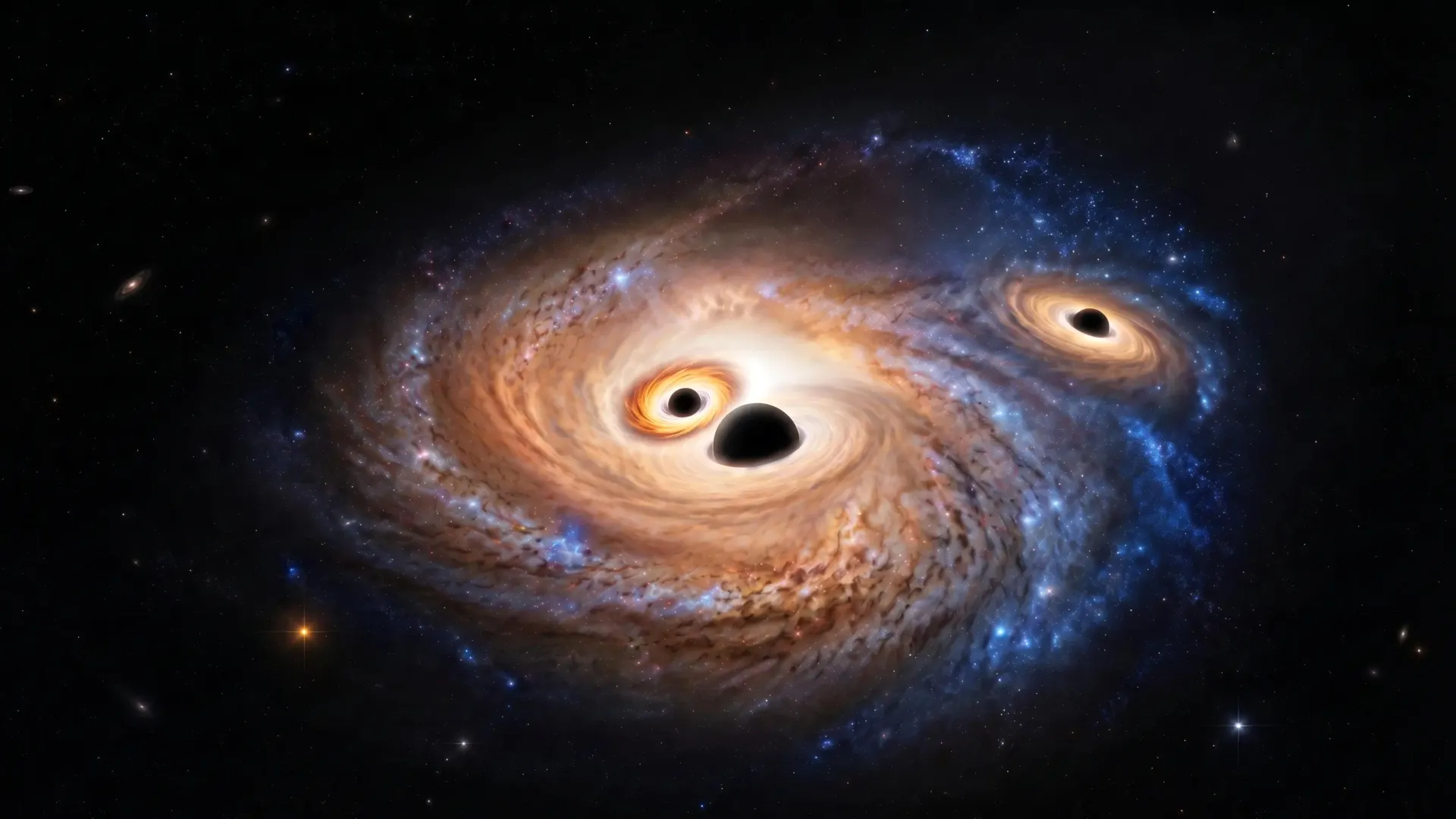
- Two black holes near the center are 620 light-years apart and are expected to merge within a few hundred million years, while a third lies about 5,500 light-years out.
An international team led by the Max Planck Institute for Extraterrestrial Physics has found three actively feeding supermassive black holes in one galaxy, J0148-4214, more than 12.5 billion light-years from Earth. Because of that distance, astronomers see the galaxy as it was just 1.2 billion years after the Big Bang, at a measured redshift of z=5.02.
The team identified the black holes through distinctive patterns in hydrogen gas light. Two sit near the galaxy's center, 620 light-years apart, and the third is about 5,500 light-years from the center. The researchers used a technique called spectro-astrometry to locate the two central black holes, which the telescope could not resolve as separate points.
Masses and feeding rates
The three black holes have estimated masses of about 80 million, 600,000 and 2 million times that of the Sun. The largest is not feeding most aggressively; its smaller neighbor, at roughly 600,000 solar masses, is accumulating matter faster than basic models predict.
The team also estimated the galaxy's total stellar mass at about 1.3 billion suns. The two central black holes are expected to merge within the next few hundred million years.
This is the first evidence of three active black holes in a single galaxy in the distant Universe
— Hannah Übler
What researchers said
Hannah Übler, research group leader at MPE and lead author, said the finding "suggests that processes in the early Universe were efficient at bringing massive black holes together."
Co-author Roberto Maiolino of the University of Cambridge said the results suggest black hole merging may be an additional, fast route for rapid growth in the early universe. The third black hole could be a remnant pushed outward by gravitational recoil or one moving toward the center.