MIT scientists break a 20-year rule and unlock never-before-seen crystal structures
MIT scientists have challenged two decades of conventional thinking by discovering that flexible molecular connections, rather than rigid ones, can unlock entirely new ways to arrange nanoparticles. The breakthrough could lead to a new generation of designer materials with unusual properties and applications in electronics, medicine, and energy.
Key points
- MIT researchers used highly flexible molecular connectors instead of rigid ones to assemble nanoparticles.
- The method produced crystal structures, called superlattices, that had never been observed before.
- Changing particle size and polymer chain length let the team control how many bonds each particle forms.
Researchers at MIT and their collaborators have found that using extremely flexible molecular connectors, rather than rigid ones, can control how nanoparticles assemble into organized structures. The team reports creating crystal structures that have never been observed before, according to findings described in a paper that will appear in Nature Materials.
The work reverses a rule that has guided the field for about 20 years: that connector molecules called ligands must be rigid, and that any deviation causes assembly to fail. The researchers say the flexible approach offers a new tool for building materials with precisely engineered properties, with potential uses in electronics, medicine, energy, agriculture and chemical manufacturing.
How the flexible connectors work
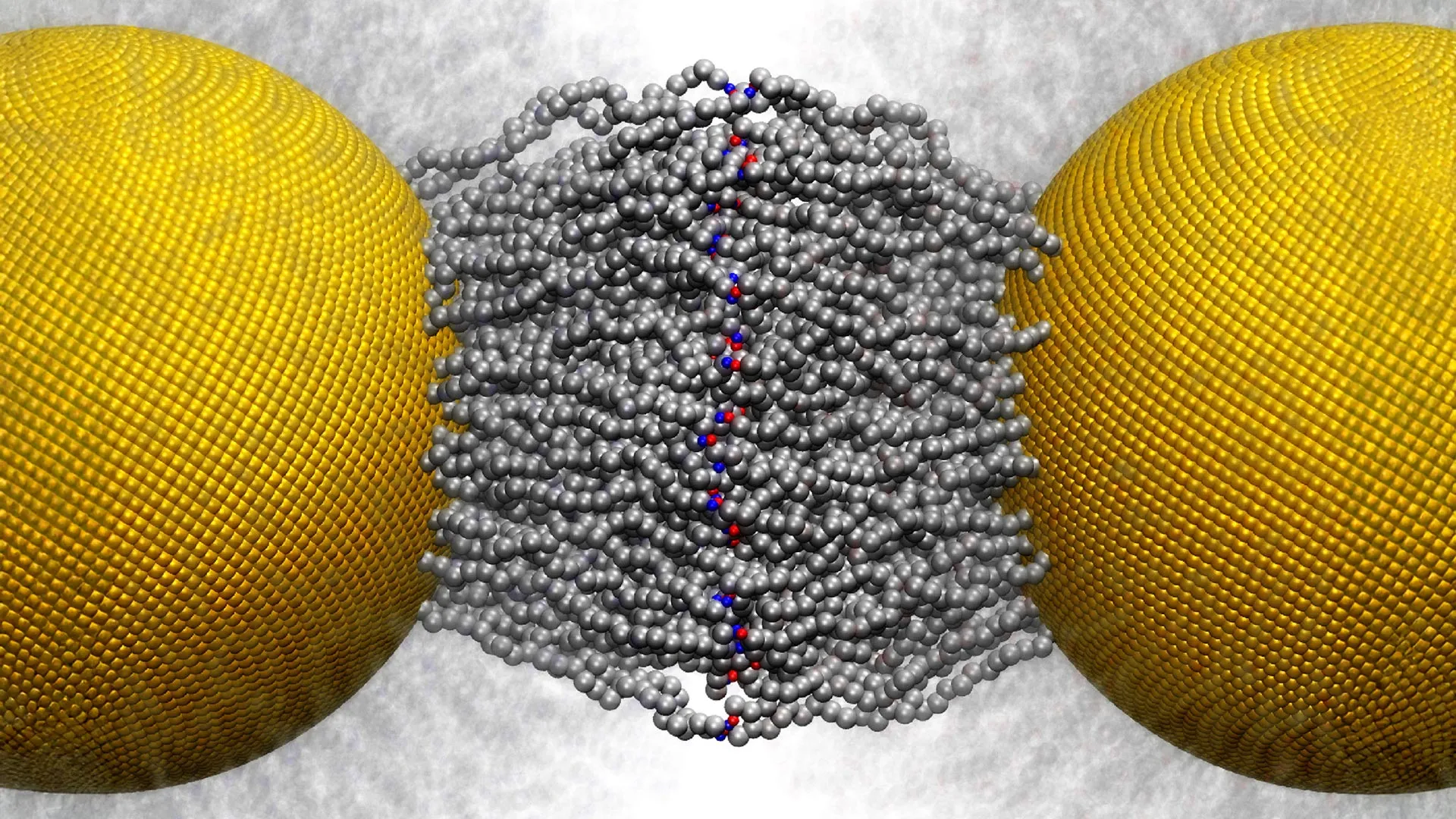
The team equipped nanoparticles with flexible polymer ligands carrying electrical charges at their ends, some positive and some negative. Because opposite charges attract, the connectors bend toward partners with the opposite charge as the particles come together, and their flexibility limits how many neighbors each particle can bind.
Experiments led by MIT PhD candidate Nicholas Sbalbi showed that changing particle sizes and the lengths of the molecular chains altered how the particles assembled. Reducing the number of connections produced more open arrangements instead of the densely packed structures that commonly form.
It's the exact opposite of what the dogma has been for 20 years
— Rob Macfarlane
What the lead researcher said
Rob Macfarlane, the Richard P. Simmons (1953) Professor in Metallurgy at MIT, said the approach is counterintuitive. "It's the exact opposite of what the dogma has been for 20 years," he said, adding that pushing flexibility to the opposite extreme works just as well.
Macfarlane said the method lets the team control the number of bonds each particle has without predesigning where particles connect or what shapes they take. The research received partial support from the National Science Foundation, the Department of Energy, the U.S. Army and the U.S. Navy.