Dead stars could break one of physics' most famous limits
A surprising new discovery suggests that some dead stars can grow far more massive than scientists once thought possible. Computer simulations show that powerful magnetic fields could allow white dwarfs to reach 2.4 times the mass of the Sun, dramatically exceeding a famous limit that has stood for decades. The findings could help explain unusually bright supernova explosions that have long puzzled astronomers.
Key points
- New simulations suggest magnetized white dwarfs can reach about 2.4 solar masses, above the 1.4-solar-mass Chandrasekhar limit.
- Researchers at the Indian Institute of Science and collaborators modeled a star's evolution from main sequence to white dwarf.
- The findings could affect how astronomers interpret Type Ia supernovae used to measure cosmic distances.
New computer simulations suggest that some dead stars may grow far more massive than a long-established physics limit allows, because strong internal magnetic fields could help them resist gravity. The work, from researchers at the Indian Institute of Science (IISc) and collaborators, was published in The Astrophysical Journal Letters.
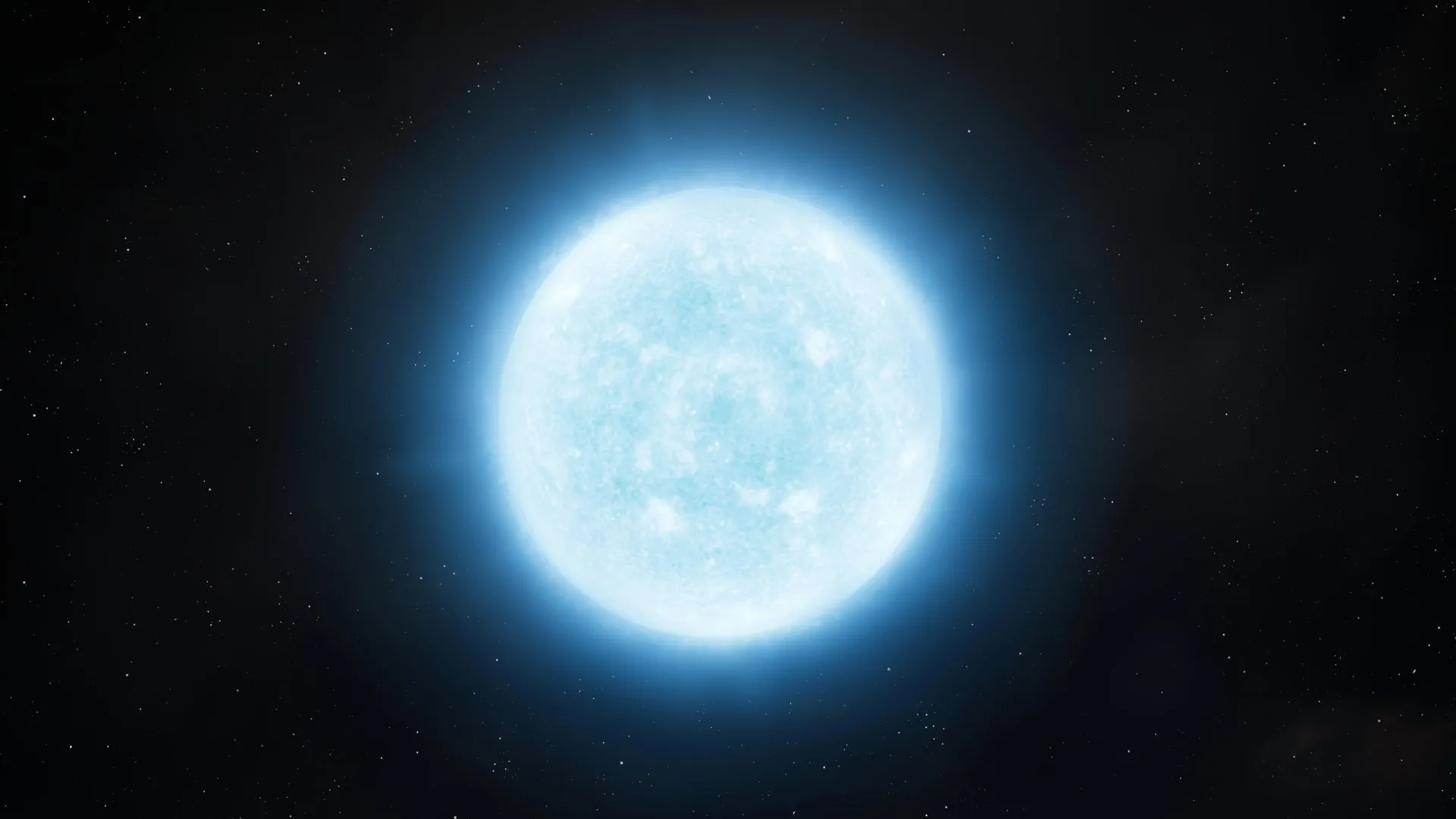
White dwarfs are dense stellar cores roughly the size of Earth that can hold as much mass as the Sun. Without strong magnetic fields or rapid rotation, they have long been thought to top out at about 1.4 times the Sun's mass, a threshold known as the Chandrasekhar limit.
Simulated star reaches 2.4 solar masses
The team modified a stellar evolution program called STARS, originally developed at the University of Cambridge, to include magnetic fields and white dwarf cooling. They followed stars from the main-sequence stage through to the white dwarf stage, then modeled a binary system where a white dwarf pulls matter from a companion star.
In one simulation, a carbon-oxygen white dwarf starting at 1.02 solar masses, formed from an eight-solar-mass star, gained material at 10⁻⁹ solar masses per year. With magnetic effects included, it reached about 2.4 solar masses; without them, a comparable model stopped near 1.4.
The important question was not simply whether a super-Chandrasekhar white dwarf is possible, but whether a star can actually evolve into one
— Zenia Zuraiq
Why the magnetic field matters
As the white dwarf accumulates matter, it becomes denser and contracts, strengthening its internal magnetic field. That field adds pressure that helps counter gravity, letting the star hold more mass and changing the usual relationship between its mass and size.
The researchers say the mechanism may also explain why some observed white dwarfs have unexpectedly large radii for their masses. They note the results come from simulations, not direct observations of white dwarfs reaching these masses.
Possible impact on cosmic measurements
Type Ia supernovae, used as standardizable candles to measure cosmic distances, are tied to the Chandrasekhar limit. The authors suggest that exploding white dwarfs with different masses and magnetic fields could produce different luminosities, possibly helping explain unusually bright Type Ia explosions.