Scientists say a forgotten particle may explain why the universe exists
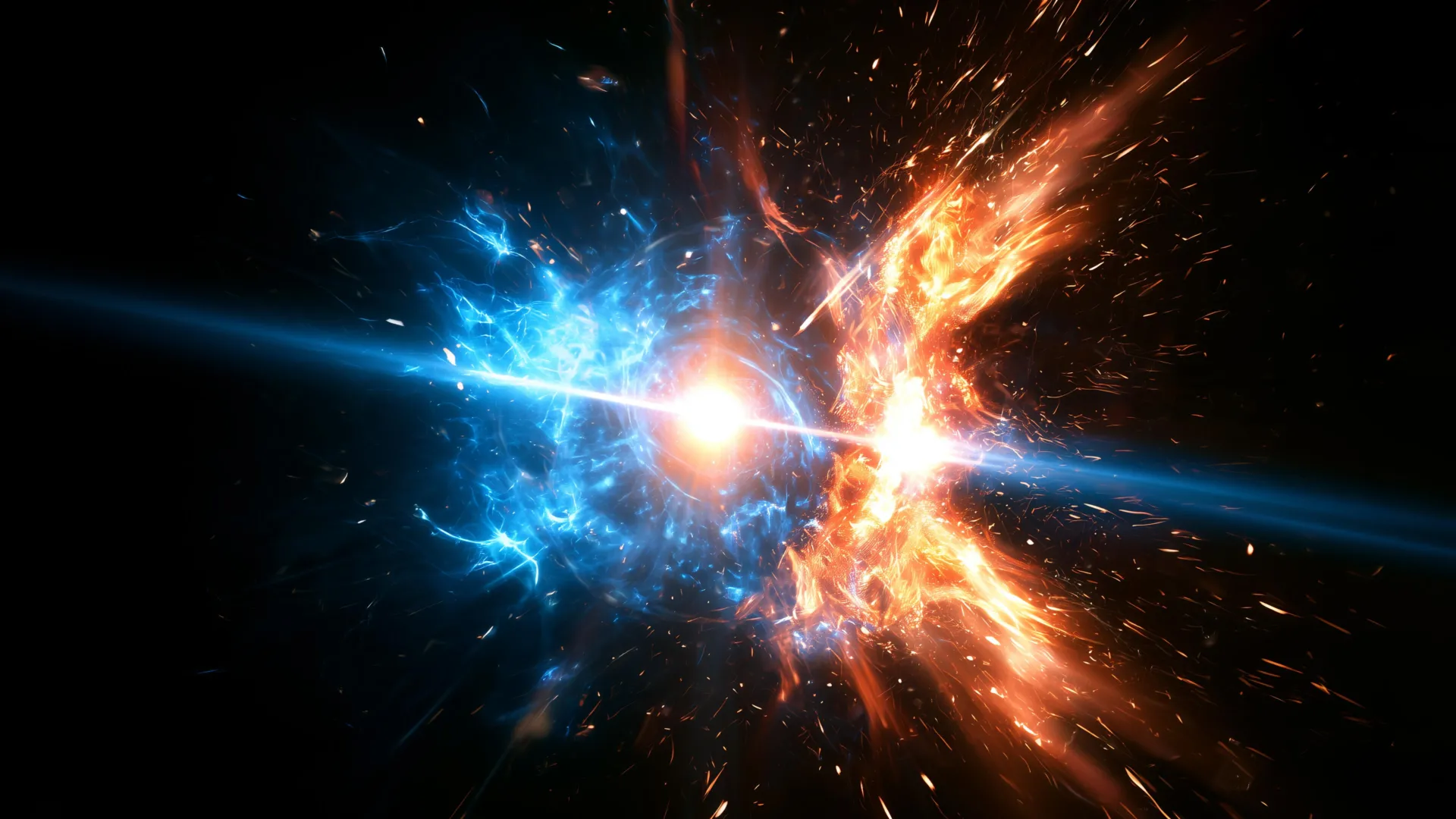
A mysterious particle overlooked for decades may hold the key to why matter survived the Big Bang, allowing stars, planets, and life to exist. Scientists believe this forgotten neutrino reshaped the early universe and may have left detectable gravitational wave signals that could help unlock the cosmos’s deepest mysteries.
Key points
- Researchers propose a decoupled heavy neutrino could explain why matter survived after the Big Bang.
- The particle's long lifetime may have let it temporarily dominate the early universe's energy density.
- Primordial gravitational waves could carry detectable signatures of this proposed particle's effects.
Scientists from the University of Southampton and the Indian Institute of Technology Kanpur have proposed a new explanation for why the universe contains matter rather than nothing. Their theory centers on a 'decoupled' heavy neutrino, a little-understood relative of the ordinary neutrino that has largely been overlooked in particle physics. The research was published in Physical Review Letters.
The work addresses why matter and antimatter, produced in nearly equal amounts after the Big Bang, did not annihilate completely. The researchers suggest the heavy neutrino's unusually long lifetime allowed it to survive long enough to temporarily dominate the universe's energy density as the cosmos cooled.
How the particle could shift the balance
Previous explanations for matter prevailing over antimatter generally excluded the decoupled heavy neutrino because it interacts so weakly with other particles. The new study finds that even such weak interactions could indirectly affect the conditions under which matter gained its advantage.
According to the team, the particle shifted the temperature at which fundamental particles like electrons interacted with their antiparticles, with help from the Standard Model Higgs boson. Dr. Rishav Roshan said this temperature 'acts like a switch that shapes how the matter-antimatter imbalance was built up.'
The fact that we are here at all proves that an asymmetry between matter and antimatter occurred
— Dr. Rishav Roshan
Signatures in gravitational waves
The theory also suggests the particle may have altered the expansion history of the young universe. Study co-author Dr. Sudipta Show said the dramatic shift could leave detectable imprints on primordial gravitational waves, offering a new way to investigate the early cosmos.
The explanation remains theoretical for now, but it provides physicists with a new possibility for solving one of cosmology's deepest mysteries.